by Matt D’Arcy
It’s The Good Life—transplanted from Surbiton to Sector E in Vale da Telha!
Amovate members Susan and Brian Jutsum are our own versions of TV’s Barbara and Tom Good who quit the rat race to become self-sufficient by living off the land.
There are some slight differences—while the Justums enjoy their own pork, fruit and vegetables at their villa on Vale da Telha, it doesn’t come from their own back garden, but from their 16-acre smallholding up in Rogil.
But let’s start at the beginning….
Susan, who is 59, is from Sheffield and Brian, 58, from Nottingham, enjoyed a successful business life in Yorkshire that owed much to Brian’s phenomenal skills not just as a carpenter but as an artistic carpenter, and Susan’s culinary and hospitality accomplishments.
Brian has been a keen spelunker (potholer) from the age of 14 and this led them to buying a seven-bedroom country house in Wensleydale—the Yorkshire Dales boast Britain’s largest collection of caves in terms of size and numbers—which they converted into a hotel so successfully that in 1988 it was voted Hotel of the Year,
(Brian’s interest in caving has never abated and he recently joined a caving club based in Lagos to continue the hobby here in Portugal).
They also subsequently had a squash club and for three years ran a friend’s hotel, all the while keeping a house in the Dales. Brian then returned to his artistic roots and became a furniture maker, creating a thriving business making bespoke oak furniture for clients like the late Richard Whiteley of Countdown fame and Janet Street-Porter.
They also segued successfully into antiques for five years or so but began to find it increasingly more difficult to turn a decent profit as the plethora of antique shows on TV began to educate the customers to become more knowledgeable….and to haggle down to the bare bones of profitability!
They came out here on a permanent basis in 2009, having bought a plot of land in Vale da Telha in 1998, completing their villa in 2000 to use purely as a holiday home, with no intention at that time of living in it on a permanent basis.
But they did have a longer-term plan. They had been coming to this part of the Algarve since the ‘80s and from very early on decided that at some point they wanted to own a property somewhere along the N120, preferably to buy the land without any buildings as a project and eventually construct their own property.
“We never stopped looking right from our first visit here,” said Susan. “We knew we had to do something to keep ourselves busy and active and we wanted to be self-sufficient if that was at all possible.”
And, after building the house on Vale da Telha they would come out for up to 12 weeks a year (sometimes sneaking in an extra week or two!) and spend much of that time looking for a good-sized tract of land to enable them to live the dream.
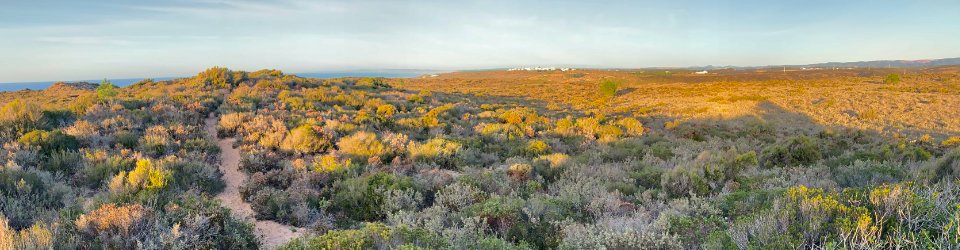
Eventually, they did find the perfect opportunity to fulfil this desire for self-sufficiency, discovering and purchasing 16 acres of land outside Rogil, three kilometres from the sea, and set about creating their own Good Life, Portuguese-style.
They had an open well which was used, via a pumping system, for irrigation. But in 2010 they had a borehole drilled to a depth of 85 metres, which flows freely at the rate of more than 300 litres an hour non-stop. This does away with the need for pumping and also means they have more fresh water than they need!
That’s good news for their pigs, because the animals have their own swimming pool, and the flow of water then runs out into a stream forming one of the boundaries of their land.
Susan and Brian started off with five pigs, but after three were butchered and eaten they were left with one pair, a male and female, aka Mr Pig and Mrs Pig. And on November 17 the female gave birth to a litter of six piglets, although one died within a couple of days.
Sadly by that time it was too late for Mr Pig to see his offspring, as he had been despatched to the freezer two days earlier.
Unlike Barbara and Tom from TV’s “The Good Life” who called their pigs by the somewhat unimaginative names of Pinky and Perky (their cockerel was Lenin and their goat Geraldine) Susan and Brian refuse to name their pigs.
They say if the relationship became that familiar it would be difficult to slaughter animals with whom you were on first name terms.
So Susan’s “christening” of the five surviving piglets as A, B, C, D and E is an ominous sign for their long-term survival!
The decision to shuffle Mr Pig off this mortal coil two days before his family was born was not as heartless as you may think. First of all, boars don’t treat their offspring too well, and secondly no-one knew Mrs Pig was pregnant, as the signs that a sow is about to give birth are not always apparent until about six to eight hours before the piglets pop out.
Besides, as far as future litters are concerned—production will be limited to two litters per year, fewer than the normal Portuguese rate of three or four—Mr Pig’s participation will no longer be needed.
Mrs Pig will be impregnated by artificial insemination, which works out considerably cheaper than keeping a boar to do the job. (And you ladies need not get any similar ideas about replacing your menfolk!).
When each litter appears Susan and Brian plan to keep two piglets for fattening, and will sell the others as they reach the age of 12 weeks.
 The Jutsum’s land, which has a 3km perimeter, is home to a broad variety of wildlife, such as wild boar, hares, foxes, buzzards, snakes and a family of lizards. There are also donkeys and horses belonging to neighbouring smallholdings which occasionally pay a visit as they wander across the Jutsum’s land.
The huge selection of fruit trees include 115 orange trees which between them bear five varieties of orange plus apple, apricot, pears, nespera, (similar to the loquat or Japanese medlar) and figs, all of which help them make their own cider and wine—including fig wine.
The land also produces a huge variety of vegetables, like potatoes, green beans, peanuts, peppers, squash, sweet corn, pumpkins and onions to mention just a few.
One of their neighbours, a German, has a fruit crushing machine and once a year they all get together, strip the apples off their trees and press out the juice, which then lasts them all year.
And after seven years of clearing one big area they can now enjoy harvest time, which this year has produced 88 bales of hay, some of it used for feed and for flooring in the stables of their neighbours, and some now forming a pen for their pigs.
Only recently, towards the end of November. Susan was on their tractor ploughing the field to prepare for the next harvest, in May.
The Jutsums are helped on their land by Vale da Telha friends and neighbours, Jeanette, Gene and Gina.
Susan and Brian, Jeanette and Gene and Gina each get a third of the produce—and pork!—they help to farm.
And it really is hard work! Susan and Brian now spend at least three days a week—and sometimes more—working the land as they process plans and planning permission to eventually build a house there.
And perhaps one day they will live ON the land they live OFF.
(Many more photos in the Gallery Below)
* * * *
BBC’s The Good Life–Self-sufficiency in Surbiton. What do you remember?
On his 40th birthday, draughtsman Tom Good decides that he’s had enough of the rat race and that he and wife Barbara will become self-sufficient.
They convert their garden into a farm, get in the chickens, pigs (Pinky and Perky), a goat (Geraldine) and a cockerel (Lenin), grow their own crops and on one memorable occasion, try to dye their own wool with nettles.
Tom and Barbara would just be lone loons were it not for their neighbours, the henpecked Jerry Leadbetter and wife Margot, a social climber who cannot bear chickens wandering the back garden.
Over its 30 episodes from 1975 to 1978 The Good Life attacked the middle class and the ‘alternative’ lifestyle at once, showing Margot’s snobbishness as blindness, and Tom’s fanatical self-sufficiency as going too far.
Examples of Tom’s pursuit of natural alternatives leading down the wrong path include his attempts to make a methane-powered car that continually breaks down, as well as the problems Barbara and Tom have trying to kill their chicken, forcing them through pride to make a ‘sumptuous feast’ of a single egg.
The Good Life was remarkable for the consistent characterisation. Though initially dominated by Tom, Barbara was soon balancing his mad schemes with pragmatism and comforting his occasional lapses into depression.
Jerry’s mocking derision of Tom’s step sideways become grudging respect, and even snobbish Margot was human and real.
The series showcased the talents of Richard Briers, Felicity Kendal, Penelope Keith and Paul Eddington and made all three of the latter into solo stars afterwards, with Kendal becoming a sex-symbol (still is, let’s face it), while Keith in To The Manor Born and Eddington in Yes Minister created roles that were to become even better known than their Good Life creations.
Briers went on to create possibly the saddest small-screen comic character of all time, Martin Brice in Ever Decreasing Circles.
The thirty episodes of The Good Life became household favourites, and are still enduring icons of their time.
In a good-natured, light-hearted way, they showed how hard it was, and is, to be different to those around you, and the kind of courage it takes to be so.
Voted Britain’s 9th most popular TV sitcom of all time.
Cast
Felicity Kendal Barbara Good
Richard Briers Tom Good
Penelope Keith Margo Leadbetter
Paul Eddington Jerry Leadbetter
John Esmonde writer
Bob Larbey writer