Category Archives: Features

Surfing In The South West

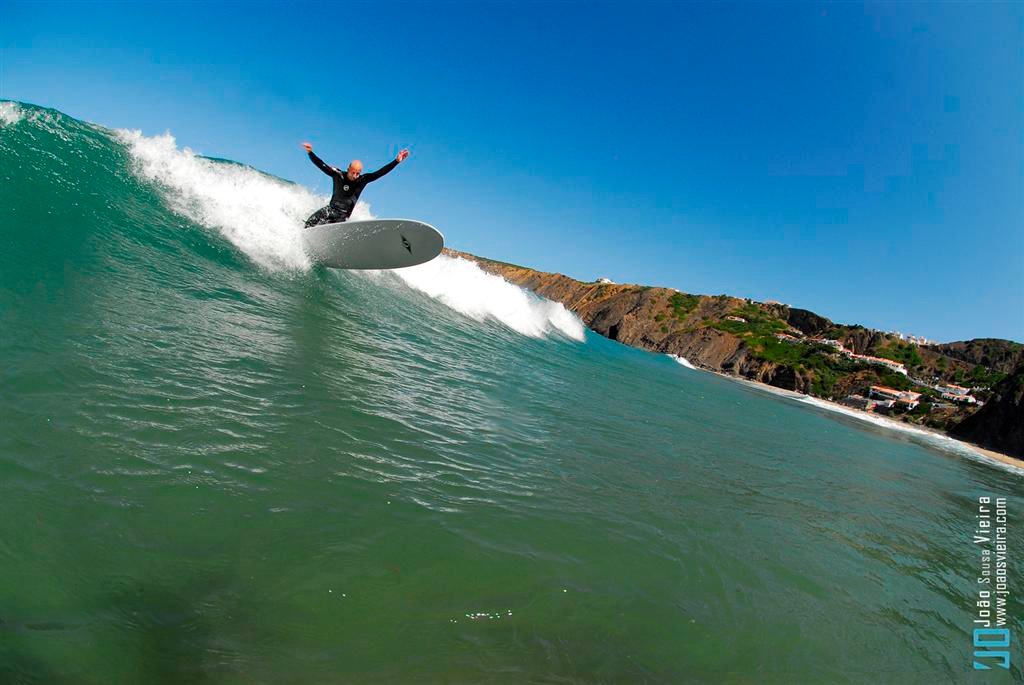
Kasper Surfing At Arrifanaby Matt D’Arcy

When a surfer talks about a “Beach Break” he’s not talking about his two-week annual holiday reclining on the sand in a sunny southern European country.

To a surfer the term “beach break” refers to the point where the waves break on the sandy seabed; the type of wave regarded as the best on which to start surfing.

But the fact remains that whether you are a sunbather looking to develop a healthy-looking tan, or a surfer seeking the perfect wave, you’ve everything you need here in south-west Portugal.

====

The wild Atlantic coastline of Portugal is world-renowned as a Surfer’s Paradise.

Those huge, curling white-capped waves racing across the ocean to hit landfall on the most westerly coastline of mainland Europe present a huge challenge to even the most accomplished of surfers.

In fact CCN Travel rated Aljezur’s Carrapateira beach at 31st in their list of the Top 50 surf spots in the world.Kasper van Nuland 1
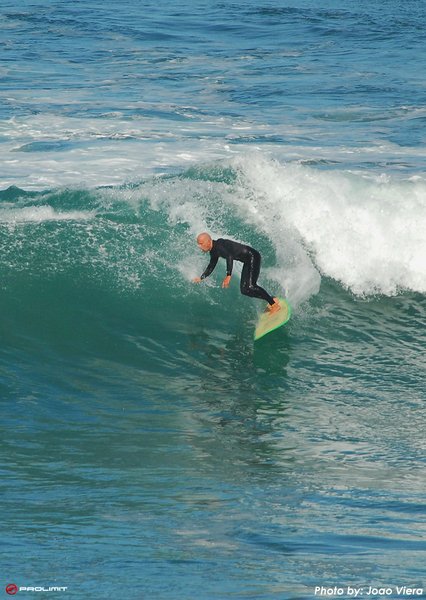
Vale da Telha’s own surf star Kasper van Nuland, who won the Algarve Overall Longboard competition in 2011, describes the surf along the Aljezur coastline as “Magic”.

It certainly cast a spell on Kasper!

This former Dutch police officer even chose Vale da Telha as the place he wished to live and set up his business despite first sampling the surf at Soorts-Hossegor, 20 miles north of Biarritz in the south west of France, which has been called “the surfing capital of Europe”.

Enthusiasts say that there the top professionals can ride tubes,(“when the crest (or lip) of a breaking wave curls over and around a surfer, the resulting situation creates an open area within the wave through which the rider can navigate. This is the epitome, pinnacle, and all-time golden moment in surfing. This, my friends, is a tube”) which can rival Hawaii for heavy walls breaking on an unnervingly shallow sandbank.

Surfing is also a major sport in Portugal’s north, and British surfer Andrew Cotton is waiting to see if he becomes the official World Record holder—and wins a place in the Guinness Book Of World Records—for surfing the biggest wave ever.

In February this year, surfing in Nazaré, 70 miles north of Lisbon, he rode a wave thought to be 24.3 metres (80 ft) high, which would beat the current record of 23.7 metres (78 ft).

In fact American champion surfer Garrett McNamara, from Hawaii, who set a previous world record at Nazaré, is to tour the country’s coastline shooting a video documentary aimed at putting Portugal on the map for surf travellers.
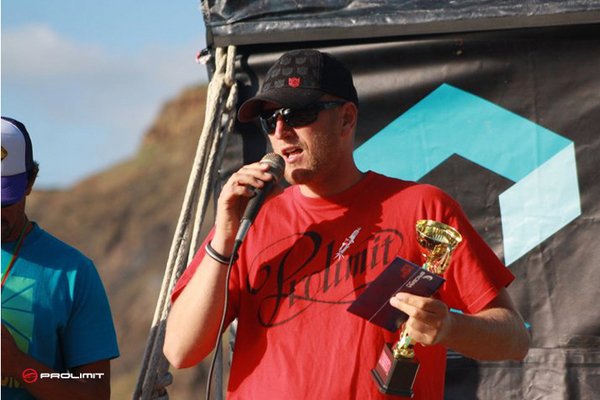
Kasper The Trophy WinnerBut Kasper, 41, and from Scheveningen—one of the eight districts of The Hague and a modern seaside resort with a long sandy beach, an esplanade, a pier, and a lighthouse—prefers the all-year round action along the Aljezur and Algarve coasts.

He explains: “Hossegor does have great waves but there are too many times when you can’t get a wave. You could book a two-week surfing holiday there and find the whole time that the sea is too flat.

“Here you can surf all the year round and when I first came here I was surprised at the amount of swell during the summer days. There is always an Atlantic swell and it also remains good for surfing in winter. The sea temperature is around 15 degrees, so it is not too cold and you can always find a wave.

“Obviously last winter we had unusually big storms here, Storm Surge Hercules, for example, which did so much damage to beaches like Monte Clerigo.

“But the beauty of being a surfer here is that when the waves are so huge and dangerous like that you can easily go down to Lagos, barely half an hour away, where the waves have lost their speed as they around the Cape, and surf there.

“It means you can surf throughout the year, and that’s why this corner of Portugal is magic for surfers.”

Obviously more and more surfers are beginning to feel the same way, as we see surf houses and surf schools proliferating all around us in Vale da Telha and Aljezur.

“The number of schools here is growing because moré and more people across Europe are discovering what I did all those years ago—that this really is a magical area for surfing.

“But the authorities need to keep a close eye on it because you can have too many surfers in the water and on the beach, so it has to be tightly controlled.”

Kasper, whose HQ is located towards the rear of Jose’s “Restaurante de Vale da Telha” on the Pines roundabout, is concerned more with the sale and supply of surfing equipment than about operating a surf school and giving lessons, although he does make sure he gets on the water just about every day, for enjoyment.Kasper Outside His Shop & Office
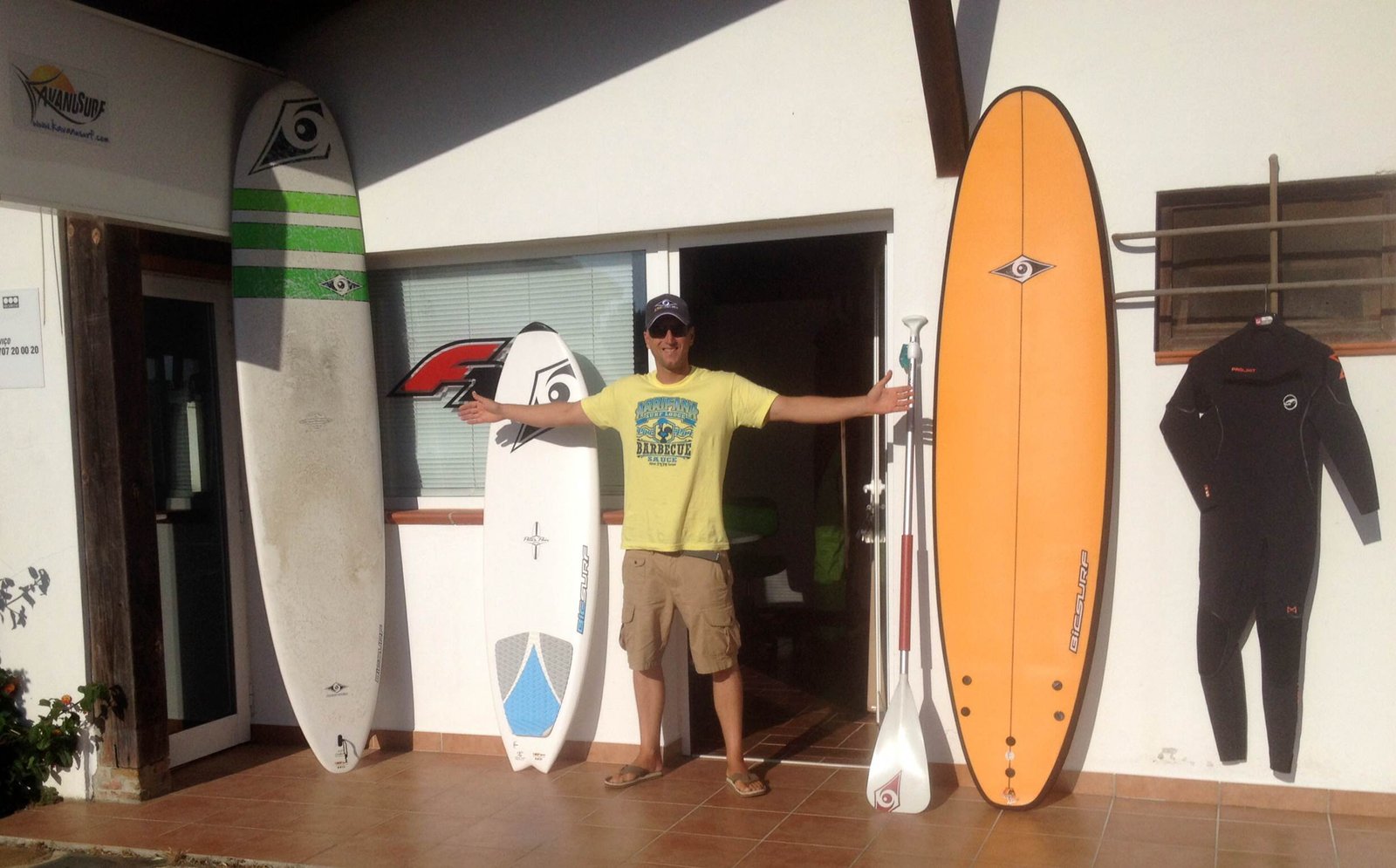
He sells state-of-the-art surfing equipment to surf schools and individuals across Portugal alongside a successful international mail-order business via his website www.kavanusurf.com

After serving with the Royal Military Police in Apeldoorn he was transferred to The Hague—a dream move, because at the time he was a fanatical windsurfer.

Eventually he joined the civilian police there and bought an apartment in Scheveningen, where he would frequently go out surfing at 7am, after finishing night patrols.

Also, he would store up his vacation time to the point where most winters he and girlfriend Marike would “hibernate” (in his words) to France or Portugal for a couple of months in his motor home.

“Surfing was a good hobby to alleviate the stress of wondering the streets at night catching crooks,” he said. “Eventually I began to look on the police work as the hobby and the surfing as my real job.

“So it made sense to turn that into reality.”

On January 1st 2007 Kasper and Marike left their jobs in Holland, bought a bigger campervan and set off for Aljezur, without any real idea of what the future would hold, other than to chill out and learn the language.

Back home Kasper had been given a small sponsorship deal with the international surf company ProLimit’s Netherlands division and when he “pitched” a sales plan for Portugal to export manager Edwin Honsbeek, he was given a licence to sell their products in this country.

It took some time to get a foothold in the market, and eventually he embarked on a sales tour across the country, mostly in the surfing hotbeds of Northern Portugal, where he gradually became accepted, both as a supplier and as a surfer through various competitions.

Now, he says, surfing has become part of daily life here in Aljezur and Vale da Telha, whether during his lunch break or in the evening after work.
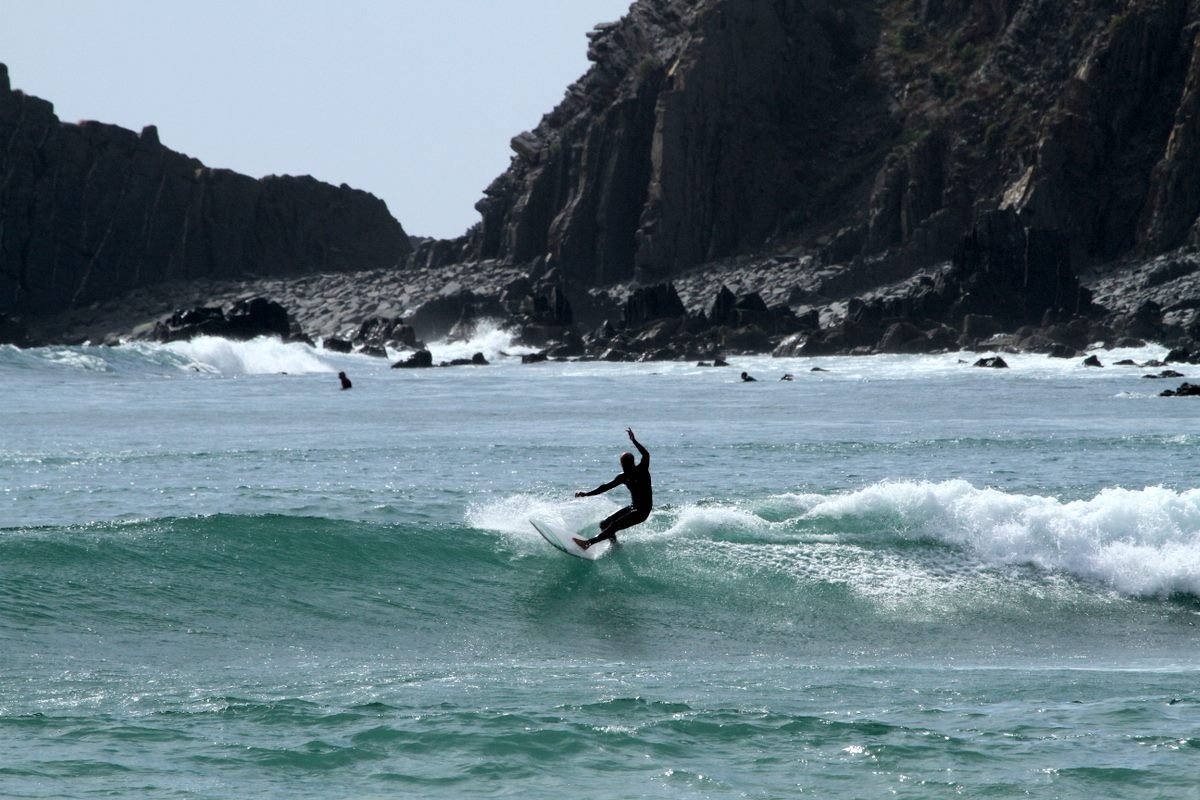
Kasper At Arrifana 2“I just surf for my own pleasure,” he says. “And it certainly is a great pleasure to surf here. There are several great surf spots all around us, each of them having a different location so you can shelter from the north wind, or the “Nortada”.

“Arrifana is the beach I use most. It is such a versatile spot. It has a very good beach break and when a heavy swell arrives you can also surf the right point in the bay.”

Since 2009 Kasper has been working with large numbers of surf schools and shops throughout Portugal and has enjoyed an expansion of the business each year since then to the point of designing clothes and working closely with the Prolimit design team in South Africa.

“Life doesn’t get much better than this—it really is a paradise here on Vale da Telha,” he smiles. “When we get back home to the Netherlands it strikes me how cold it can be and how much everyone is in a hurry.

“Here the pace is slower and the Algarve now is truly our home, a wonderful place to bring up our children.

“There are no restrictions when you go surfing. Total freedom!

“Sun, surf, beautiful surroundings and relaxed people—what more could you want?”

And finally, although surfing is his business it remains his hobby, prompting him to observe:

“Don’t take surfing too seriously. In the water, it’s all about having fun!”

ENDS

Technical details of all Aljezur’s surfing beaches.
……Information from the pamphlet “Surf Guide, Aljezur 2014”.

Surf Beaches Of Aljezur

PRAIA DA AMADO

Amado is a vast sandy beach, secluded and quiet, located just south of the town of Carrapateira and the village of Bordeira in the county of Aljezur. It is considered to be one of the best beaches in Portugal for surfing.

Praia do Amado is sought by practioners throughout Europe and is often the scene of international competitions. It is not only the most experienced who come here because there are surf schools that teach the sport.

Type: Barrelling.

Direction: Left and right.

Suitable for: Beginners.

Length of ride: 100 to 200 metres.

Best wind direction: East.

Tide: High.

Hazards: Strong tides.

Easy access, guarded beach during the bathing season, plenty of car parking, beach café.

N, 37 degrees, 10’, 1,02”, W 8 degrees, 54’, 14,21”

Beach-break.


*          *          *          *

PRAIA DA CARRAPATEIRA

Carrapateira sits on a small indented headland of limestone cliffs. The extremely fast southbound current and the jutting headland make the conditions which have made it a popular surfing destination in recent years.

The Carrapateira beach break can be world class when all the right conditions come together, offshore wind, a good swell and rightly positioned sandbanks. Clean tubes and a solid wall are the results.

Type: Barrelling.

Best wind: SE, East, NE, East.

Direction: Right hand.

Tide: Mid.

Suitable for: Intermediate.

Hazards: Rocks.

Length of ride: 50-100 metres.

Infrastructure: No. The best access is from the top, South. Guarded beach during the bathing season.

NB 37 degrees, 12’ 0, 42” W 8 degrees, 53’, 5.3, 82”.

Beach-break.


*          *          *          *

PRAIA DE VALE FIGUEIRAS.

The area where the Vale de Figueira beach is situated is one of great natural beauty, still standing near the village of Alfambras, a sparsely populated area. It is an extensive golden sandy beach.

To support sports activities there are several surf schools that claim to help those who have not previously ventured into the sport.

Easy pedestrian access. No parking. Pets not allowed. Naturism. Guarded beach during the bathing season. Activities, surf and sport fishing.

N 37 degrees, 16’,13”, W 8 degrees 51’,35”.


*          *          *          *

PRAIA DA ARRIFANA

Blue flag beach, vast and sandy and half a mile long it forms a small bay and is therefore less hit by waves. It is protected by a north rock which shields the bay from the traditional north winds.

Equipped with all of the necessary infrastructure this beach is visited throughout the year by surfers and bodyboarders.

Type: Occasionally barrelling.

Best wind: All directions.

Direction: Right hand.

Tide: All.

Suitable for intermediate.

Hazards: 2 big rocks on the inside.

Length of ride: 100-200 metres.

Infrastructure: Toilets, showers, parking, restaurant, beach with easy access for the disabled, supervised during the bathing season.

N 37 degrees, 17’, 31, 43”, W 8 degrees, 51’  54, 85”.

Point-break.


*          *          *          *

PRAIA DE MONTE CLERIGO

It’s a long sandy beach situated next to the small fishing village of Monte Clerigo. The sea, when conditions are right, makes it a popular spot for surfing and bodyboarding and in the season there is a surf school.

Please be aware that there is a strong undertow and current just off the beach. Along the the south-east fringe of the beach there is an area of sand dunes.

There is a decent beach break that can be good if the shifting banks are positioned right and the wind is offshore. Has a good swell, but is very exposed to the wind.

Type: Ordinary.

Wind direction: Right hand.

Suitable for beginners.

Length of ride: Short.

Crowds: An empty line-up.

Best wind direction: SE, E, NE.

Tides: High.

Hazards: None.

Infrastructure: Toilets, showers, parking, first-aid station, bars/restaurants, disabled toilets and guarded beach during the bathing season.

N 37 degrees, 20’22, 47, W 8 degrees, 51’, 12.99.

Beach-break.


*          *          *          * 

PRAIA DE AMOREIRA

At the mouth the River Aljezur there is this spectacular beach surrounded by dunes and cliffs, the sea and the river. It has excellent conditions for the practice of surf and bodyboarding and tends to become increasingly crowded.

This spot has little or no wind unlike other surf spots along the Aljezur coastline which are more exposed to strong winds in the area

Here, you can always count on good waves.

Infrastructure: bar/restaurant, telephone, guarded beach during the bathing season, parking,

N 37 degrees,  21’17, 26”,  W 8 degrees, 50’44.25”

Beach-break.


*          *          *          *

PRAIA DE ODECEIXE

Praia de Odeceixe is the last beach in the Algarve for those travelling along the coast from the south.

It borders the Alentejo and also has access to the other side of the river.

Located at the mouth of the river Seixe is an extensive sandy beach, great for practicing surfing and canoeing on the river. This spot has little or no wind and you can always count on good waves.

Infrastructure: Toilets and showers, parking, bar, telephone, supervised during the bathing season.

N 37 degrees, 26’ 29. W 8 degrees, 47’ 56”

Beach-break.


Arrifana’s Vanishing Parking Places

We have received the following e-mail and photographs from an Amovate member…

Arrifana’s Vanishing Parking Places

Today as a resident of Aljezur I took a ride in my car to Arrifana. This as we all know is a beautiful place with a wide variety of eating and drinking establishments.

Arrifana Car Parking (7)But there are huge man-made scars now on the face of the natural beauty of the area, just at a time when the busy tourist season is approaching—an industry that is the vital lifeblood of the whole of Aljezur.

Their sense of timing is woeful—why can this work not be done in the quietest of times, as far as tourism is concerned?

One would suspect that the National Park Authority is more concerned with driving tourists away than they are in attracting them, as they impose more and more parking restrictions in all the tourist hotspots on our coastline.

On arriving at Arrifana I was astonished to see the car park fenced off and filled with construction materials piled high in vast quantities, which appeared to be more for highway construction that anything else.

This is happening in a tourist area that can only be visited by car (or by those walking the Rota Vicentina, of course!) and which has no public transport facilities whatsoever.Odeceixe Train

The Camara provides a tourist road train to transport people from the town of Odeceixe to the beach during the summer months, but cannot do the same to bring people up to Arrifana and Monte Clerigo from Aljezur itself. Why is this? Why does Odeciexe get preferential treatment?

On my visit to Arrifana, having driven to the end of the road where the forteleza ruins are located one could easily see road pin marks as level points within the highway and several metres of fencing blocking off part of the highway.

I stopped, parked in one of perhaps only EIGHT parking spaces available for both the O Paulo Restaurant and the ruins, and went for a coffee. I asked one of the staff in the cafe what was going on and was told that work was being undertaken to alter the existing road and reduce car parking throughout Arrifana.Arrifana Car Parking (4)

Clearly this will be a problem during the holiday season as thousands of people visit this place and at present parking is insufficient with cars using the rough ground to park and use the beach as well as the businesses that are operating there.

Our local Camara are aware of this but have failed to publicly inform anyone or ask for any input into the work being undertaken; this from a Camara that only recently was proudly trumpeting to the world this area as a great surfing area!

They are telling people: “Come to the Western Algarve”….but they forgot to say most of them would not be able to park.

I also notice that workmen are now “tidying-up” the parking bays on the hill outside Monte Clerigo which looks as though this, too, will result in the reduction of the number of parking spaces available, impacting on the businesses there that are almost 100 per cent reliant on tourism for their livelihoods.

Arrifana Car Parking (13)I urge residents of the area to visit the Camara and demand to view the plans of the intended works so they can see for themselves just what devastation this will cause for the restaurant and bar areas and all the families that have people working in these businesses.

Having also seen the debacle at Amoreira and the time it has taken to lay a few kerbs and build a gutter system for drainage, I fear this work will still be on going next Christmas and beyond!

ENDS

Walking the Algarve: to Portugal’s Land’s End

Walking the Algarve: to Portugal’s Land’s End

(And spending a night on Vale Da Telha along the way)

Never mind the bright lights and sunbathing, get a taste of the authentic Algarve by walking a newly way-marked trail that finishes at Europe’s most south-westerly point.

The Guardian newspaper sent one of its writers to walk from Caldas de Monchique to Sagres, taking in Aljezur and one night at The Vale Da Telha Hotel. Here is his report…

By Kevin Gould,

The Guardian,

Saturday May 10 2014

Kevin Gould's companions walking on the coast near Bordeira. Photograph: Kevin Gould

Kevin Gould’s companions walking on the coast near Bordeira. Photograph: Kevin Gould

It’s a motley crew that set off one morning for the end of the world. Chums Toddy and Nigel, chic architects Eleo and Filipe, leader Terry, Happy the Yorkshire cross, and me. At 68, Terry is fitter and stronger than the rest of us put together: since moving to the Algarve nearly a decade ago, he has, with walking-minded friends, identified and revived an ancient pilgrim trail that wiggles from Alcoutim on the Spanish border to Cabo de São Vicente, Europe’s most south-westerly point. In Neolithic, Roman, Arab and medieval perceptions, this cape was where our earth ended, the sun sinking, hissing, each day into a boiling, snake-filled ocean.

2 GuardianTravel Algarve Map

2 GuardianTravel Algarve Map


Terry has tailored for us a four-day walk of about 100km that starts in the foothills below Caldas de Monchique, a spa village high

in the drizzly hills above the Algarve. Known as Al Gharib (“the west”) to the Arabs who ruled here for 500 years, today’s Algarve is more golf than Gulf. The plane to Faro was awash with boozy hen parties and blokey banter, but here, all is peaceful.


Day one: Caldas de Monchique and mountains 

A strolling minstrel above Monchique Photograph: Kevin Gould

A strolling minstrel above Monchique Photograph: Kevin Gould

“Hear that?” Terry asks, his accent pure Norfolk. “That’s the sound of the real Algarve.” We hear larksong, and a soft breeze rustling through oleander. Within minutes, we also hear the thump of blood in our temples, with Terry stepping briskly on while we stump wheezily behind.

As resorts such as Vilamoura and Albufeira on the narrow coastal strip somewhere below bask in sun, we’re grateful for the cool-ish mist that accompanies our first day’s trek up the Picota massif, the first of the region’s two lumpy hill ranges. We’re barely 10km from the resorty seaside yet we’ve found another Algarve – an unvarnished, untarnished place of unassuming beauty, where time (and the trail we’re on) feels endless.

Climbing steadily on footpaths, goat tracks and traffic-free roads, we come to a Tibetan monastery with prayer flags a-flutter, knobbly drystone terraces planted with spindly olive trees, and hardly a human soul. Hundreds of wild arbutus (also known as strawberry bushes) are studded with fruit; when we reach the trig point at the top of Picota at 757 metres, my face is the colour of strawberries, too.

Our happy band head downhill towards lunch through a glade of 600-year-old cork oaks that are in various stages of undress. Among their bare naked trunks the atmosphere is magical and the air is alive with yellow-and-orange Cleopatra butterflies. Pink belladonna lilies fringe a green pond.

The combination of sweat-soaked clothes, pints of cold Sagres, mountains of egg and chips and aching feet makes moving off from pretty Monchique a trial, but soon we are climbing, panting, up though shrubby garrigue to immense rockeries of slippery syenite stone. At the second peak, Fóia – the highest in the Algarve at 902 metres – there are dew-twinkled cobwebs in thickets of Scottish-like gorse and heather. There are also coachloads of excursioning Scots engaged in dedicated, intensive wine tasting at the lonely souvenir shop.

Terry plans his routes according to his groups, with luggage transfers between pre-booked hotels. These range from the bare and simple to tonight’s chintzy, softly lit palace, the spa hotel in Caldas de Monchique. Our spa treatment there involves lying face down under body-length showers of hot spa water while aching limbs are lovingly pummelled by masseuses in swimsuits. I have rarely spent a more tonic 15 minutes, or €15.

Day two: Caldas de Monchique to Aljezur

Striding out on day two we head west, rising and falling through forests of refreshing-smelling eucalyptus. The trees lead us to

Picking walnuts in Marmelete. Photograph: Kevin Gould

Picking walnuts in Marmelete. Photograph: Kevin Gould

Marmelete, a peaceful village of walnut trees and whitewashed houses with indigo architraves. This type of walking – 25km a day across sometimes challenging terrain – calls for levels of fitness and stamina somewhat lacking in our group, but buoyed by lunch at Luz snack bar, cheery waves and many a boa tarde! we press on to the Pasila and Cerca rivers, whose valleys we follow, and waters we ford. An occasional community of self-sufficient spliffed-up hippies reminds us how far we are from The Man and his golf clubs.

Soon, marooned below in arable fields under its squat fort is Aljezur (from the Arabic word for islands) a white town celebrated for its sweet potatoes. Hotel Vale de Telha is more humble than last night’s billet, but the chef at its new restaurant has a wonderful touch with chargrilled octopus and the waiter has a heavy hand with the soft red wine. I dream of white horses.

Day three: Aljezur to Carrapateira

A petisqueira (Portuguese tapas bar) in Carrapateira. Photograph: Kevin Gould

A petisqueira (Portuguese tapas bar) in Carrapateira. Photograph: Kevin Gould

The achey way from Aljezur is fringed with fine sand and deep forests of umbrella pines. The air turns briny before we spot the sea, way below. A distant fisherman casts for sea bass. We clamber down a track and peel off our steaming boots and socks to cavort in the water. Happy is in ecstasy.

Twelve kilometres of bootless beach later we’re at Bordeira, where tousled wetsuited surfers bob around like seals and we strip whitely off to be tumbled and bounced along the seabed by Atlantic rollers. The sleepy village of Carrapateira, an hour further on, depends on surfers, and adventurous tourists. Its Pensão das Dunas will fill with the aroma of our socks this evening, but before then are frozen beers and juicy salads to be enjoyed at the dub-and-dreadlocks vegetarian Microbar in Carrapateira’s main square.


Day four Carrapateira to Cabo de São Vicente

Praia de Castelejo. Photograph: Kevin Gould

Praia de Castelejo. Photograph: Kevin Gould

Having made a serious dent in Das Dunas’s stocks of Alentejan wine (at a tasty €5 a bottle) the night before, we find our final day dawns rather too brightly. Almost immediately we’re into a series of seven sweaty, panting climbs which lift us along faint, scrabbled (and sometimes scary) paths overland to our reward – a 7km stretch of empty beach, where ours are the only human footprints. A hundred metres above some of these, ropes descend from vast, sea-sculpted rocky promontories allowing precarious access for the few mad fishermen perching on crumbling ledges.

At the southern end of this stretch is tiny Praia de Castelejo, where Senhor Policarpo is proud to show off the octopus he has snared. Young families and old dears splash in the shallows. Shoals of surf schoolers teeter and splash in the rumbling, tumbling waves. There’s a cafe only too happy to supply us with mountains of garlicky clams and chips to support us on the final push to the Cape.

We march on for three or so hours across a rocky plateau towards the lighthouse, which appears to get further away the longer we walk. The final kilometre is on a metalled road until, footsore and with creaking knees, we reach the end of the earth, spent but strong, calm and softly renewed. The Algarve Way has walked us through deliciously old places with their fine old ways. As the magnesium-fringed clouds glow on the horizon, the sea’s surface turns to burnished chain mail. Happy gifts a nuzzle to each one of us. The crowd gathered to witness the sunset clap and whoop and we are immensely cheered.

How to do it
Algarve Walking Experience offers tailored guided walks for people of all abilities, including a route along the entire Algarve Way, from £100 a day for two, including B&B accommodation and luggage transfers.

Recipe Book in aid of AEZA

photo (17)

Hi folks,
I am collecting recipes from local people to make into a book to raise funds for AEZA and the canil .Please help by submitting recipes to me at the email address below, or, from Friday to the ACCT charity shop in town.

You can send recipes for Starters,Dinner,Sweet,light lunch or cakes and biscuits.you can send one or as many as you like.
Please make sure the ingredients are easily obtained,if you send a recipe from a book etc.please name the author,say whether it is easy,medium or hard to cook and say how many it feeds.  Add your name and some way of contacting you.

If we have a large number of recipes, I will ask a member of AEZA to help me choose which ones go into the book.

I will need some help finding someone who can publish,anyone got any ideas?

Closing date 30th May.

Thanks very much.
Jackie Drew
PS: pass this on please to anyone in the area who you think may be able to help.
The e-mail address to send recipes to is:
jackiephil1@hotmail.com

Amovate Asks President and Prime Minister To Intervene In Broadband Dispute

fibreOpticBoradbandAmovate has written to the President and the Prime Minister of Portugal asking them to intervene in the dispute between Aljezur Camara and the Parque Natural da Sudoeste Alentejano e Costa Vincentina over the provision of high-speed fibre optic broadband to Vale da Telha and the surrounding areas.

We understand the Park Authority refused to allow relay towers to be installed by the company rolling out the system in this part of Portugal after the Government pledged that superfast broadband access at home would be made available to a large proportion of its citizens.

Bearing in mind the fact that most expats now rely on broadband for their TV programmes from the UK and northern European countries we feel it is increasingly urgent that the programme SHOULD be rolled out across Vale da Telha and the areas around it.

That is the motivating factor behind our decision to write to the leaders of this country—with copies of the letter going to the Park Authority, to Sapo and, of course, to the President of the Aljerzur Camara—asking them to overrule the Park Authority.

This is the letter now on the way to all of these people…

===

To President Aníbal Cavaco Silva, and Prime Minister: Pedro Passos Coelho.

Last year the Portuguese government promised that superfast broadband access at home would be made available to a large proportion of its citizens.

Indeed Portugal is to be commended for the way it has so rigorously pursued that promise, which is in line with one of the European Union’s most ambitious targets—to make sure that all its citizens can get access to superfast broadband at home, if they choose, by 2020.

We understand Portugal is already nearly 75% towards achieving that aim. To its immense credit Portugal has made major investments in broadband coverage, particularly for next generation access.

We understand, too, that despite its economic problems Portugal is well ahead of the European averages for the coverage of fixed line standard and NGA services.  For example it has the fifth highest Total NGA Coverage of any of the study countries, 74.5%, and the third highest rural figure at 33%.

That being so, we are deeply concerned that a branch of your Government has denied access to superfast broadband to a community in the Western Algarve, even though such a service has already been rolled out across all the neighbouring areas.

The authorities who govern the Parque Natural da Sudoeste Alentejano e Costa Vincentina have refused permission for five relay stations to be installed across Vale da Telha and the surrounding areas even though the service WAS supplied to the town of Aljezur, whose Camara collects its taxes from the residents of Vale da Telha and those surrounding areas.

This clearly goes directly against the wishes of the Government to provide Superfast Broadband access to all its citizens.

Our Association is called AMOVATE—the Associação Dos Moradores e Amigos do Vale Da Telha—and our members represent not just the local Portuguese community but also a cross section of the various nationalities who have chosen to live here.

We find it surprising that the elected Government stands by and allows a small subsidiary arm of its administration to take it upon themselves to deny the citizens of Vale da Telha and the surrounding areas a service which has been promised to them by the Government itself.

Or do the managers of the Parque Natural da Sudoeste Alentejano e Costa Vincentina believe THEY govern this country, breaking the promises of the Government itself?

Superfast broadband is vital to the residents of this community, many of them expatriates (people who have pumped millions of Euros into the Portuguese economy) who rely on these services to keep in touch with their families, friends, and indeed the television services of their countries of origin.

We would ask you, respected President, (respected Prime Minister) to instruct the Parque Natural da Sudoeste Alentejano e Costa Vincentina to abide by the Government’s promise and reverse their decision, allowing the company responsible for fulfilling the superfast broadband installation contract, to erect those relay stations and make sure the service is available to this community.

Thanking you for your interest and awaiting your decision with interest.

(Signed) Peter Johnson,

President,


AMOVATE