Category Archives: Features

Nature Tourism in the Algarve 2014 launched in Aljezur

From The Algarve Daily News at http://www.algarvedailynews.com/

Photographs from the Facebook collection of Antonio Carvalho.

Bienal de Turismo de Natureza (1)The first biennial event for ‘Nature Tourism in the Algarve’ was held in Aljezur on 26, 27 and 28 September, organized by the Associação Vicentina, Associação In Loco and Terras do Baixo Guadiana, co-funded by ProDer and the Associação Vicentina.

Two policy makers headed south to open the event: the Minister for Regional Development, Poiares Maduro and the Secretary of State for Planning and Nature Conservation, Miguel de Castro Neto.

According to the organisers, BTN 2014 (Bienal de Turismo de Natureza ’14) was running a number of seminars and presentations by national and international speakers, a wide range of environmental education activities and celebrated World Tourism Day on September 27 with two walks, one organized by Rota Vicentina and the other by Almargem on part of the Via Algarviana.

Bienal de Turismo de Natureza (3)Over 100 exhibitors, mostly from the Algarve and relating to nature tourism and associated products, filled the Multipurpose Space in Aljezur.

Opening speeches included, “For many years the Algarve has concentrated its promotional efforts on sun and sea tourism products, causing a concentration of business along a small coastal strip which is reducing year after year. In the ’80s and ‘90s the economy was still smiling at this type of tourism.

“Today with a profound change in the tourism economic model where online and low cost dictate the rules, and competition from otherBienal de Turismo de Natureza (2) destinations multiply, one realises that seasonality and the lack of alternative tourism products may create short-term problems and accentuate socioeconomic problems in the region.

“It is also in the ‘80s and ‘90s that we saw the depopulation of nearly 70% of the territory of the Algarve, as well as the decline of traditional industries, fishing, salt, agriculture and canning.

“The strong institutional presence at the Biennial of Nature Tourism ‘14 could bring new life and a new interest in rediscovering the low density areas of the Algarve, a territory now visibly in decline, but with specific assets that can be streamlined and translated into economic activity.

“New uses for land and sea give rise to tourism companies, ranging from hiking to bird watching, biking, surfing and diving. The fishermen’s paths are now transformed into hiking trails. The villages and old farms have been made into lodgings of great charm. The salt flats are recovered and we invent new uses for even the traditional products. Cork is made into bags and umbrellas, and beeswax now is used for Bienal de Turismo de Natureza (4)surfboards.”

The organisers of the Biennial of Nature Tourism ’14 want to bring “a new vision for these areas that is positive and is focused on the opportunities available. Many of the 100 exhibitors at BTN ’14 are examples of this vision, which in Europe has a tourism market of more than 20 million potential customers.

“These are customers who choose the off-season to take holidays and are looking for regions where nature and the authenticity of the destination are key purchase factors.”


Surf Houses on Vale da Telha – Your Concerns

IMG_1154 (2)The West Coast of the Algarve is a surfers’ paradise—and over the last two or three years it’s not just the surf that has been up, but also the number of surf houses around Vale da Telha and the outlying districts.

All of us who live here are aware of the rapid growth of these establishments, with several villas sold over the past year or so being quickly turned into surf houses with an inordinately high number of occupants at busy times.

While we all understand that this is a tourist area and surf tourism is a vital component in that industry several members have approached Amovate to express their disquiet and concern over some problems that have followed the surfing community to Vale da Telha and the surrounding districts.

These members have asked us to speak with the Camara on their behalf and report the problems that they are experiencing; problems varying from noise pollution, traffic, parking congestion on the roads, and general untidiness—littering etc.

Several of the surf houses, as you know, have been established for some time and seem to be run quite well, taking care not to upset their neighbours and blending in with the community.

But there are, of course others which are creating problems and becoming a public nuisance with activities that do not befit their use among residential properties.

It is certainly not clear whether these surf properties benefit from an AL (Licença de Utilização Turística), or are suitable for such use, or even that the Camara are aware of their existence, the implicit suggestion being that some may be unlicensed and not possessing the necessary permits or achieving the standards required of such establishments by the authorities.

Amovate has now had a meeting with the Camara to discuss these concerns from our members, and the Camara have informed us that they are aware of some of the problems.

However, they stressed that to ensure they have a complete picture, anyone with such issues to raise should make direct contact to the appropriate organisations in order to lodge their individual complaints.

These organisations waiting to hear from you are the Camara itself, *ASAE (Autoride de Seguranca Alimentar e Economica), the GNR, the Bomberios and the Financas.

Some have websites through which you can lodge a complaint, otherwise your issues, identifying the specific surf house and the reasons for your concern, should be sent by letter or e-mail.

The GNR assure us they will act upon notification of noise, and in extreme situations will issue a notice to the perpetrator, who could be fined.

*ASAE – Autoridade de Segurança Alimentar e Económica 

Address: Av. Conde de Valbom, 98
Postal Code: 1069-185 Lisboa, Portugal

Atalaia Point Archaeological Discovery

ribat_1Atalaia Point Archaeological Discovery

900 Year-Old Cemetery at Atalaia investigated by archaeologists.

By Elisabete Rodrigues

Story and photographs from the website:

http://www.sulinformacao.pt/

====

Seven graves in the cemetery of the Ribat Arrifana (Fortress Arrifana), located at Ponta da Atalaia (Watchtower Point) in Vale da Telha on the coast of Aljezur, have been excavated by a team of archaeologists co-ordinated by Rosa and Mário Varela Gomes, in a short project during the last fifteen days of July.

Ponta da Atalaia has been described by the “Real Adventures” website as a “fantastic promontory where we can see many ruins and excavations of an ancient Moorish fortress (Ribat) controlled by Ibn Qasî around 1150”.

One of these graves belonged to the twelfth century Ibrāhīm bn bn Sulaymān Hayyān, perhaps one of the monks of this monastery, or an Islamic pilgrim who ended up dying there in 1148 AD.

Or perhaps, as surmised by Rosa Varela Gomes, “did he perish in battle and was buried here? “ribat_4

How do the researchers know the name of the man buried in just one of about seven dozen graves discovered in the necropolis situated alongside the ancient Ribat?

Thanks to a stele epigraph – ie a tombstone with an inscription carved in stone – which was discovered two years ago, still attached to the head of the grave they were able to identify the man whose skeleton was discovered there.

This and other stele discovered in the Islamic cemetery are considered a find of great importance and rarity. As archaeologist Rosa Varela Gomes explained: “The two epigraphed stelae we found here are the only ones known in situ in the Iberian Peninsula”.

Of the seven graves, another discovery is also said to be an oddity, since it is the skeleton of a woman. “We do not know if it was a woman who lived here,” said the archaeologist, which would be somewhat unusual, since this was a gathering place of Islamic warrior-monks.

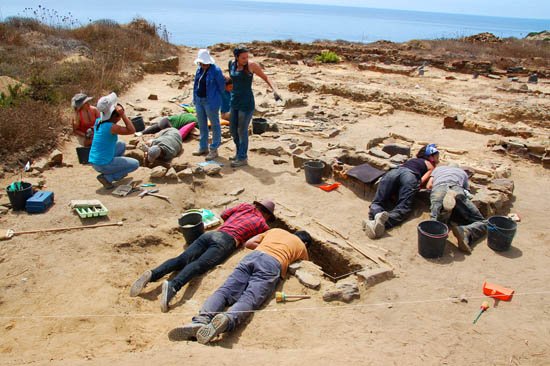
Despite the heat, wind and strong sun beating down, the team was dedicated to digging with infinite care, around the skeletons buried in that little peninsula on the sea, nine centuries ago. Sometimes it meant these young archaeologists lying prone on the ground, with their heads hanging down into the pit inches from secular bones.

“There are so many well preserved graves here in this timeline,” explained Rosa Varela Gomes.

But the survey of seven skeletons in as many graves was not the only new discovery of the short fifteen days of the excavations during this summer campaign at Ribat Arrifana.

“The big news was the identification of a section of the wall, about 10 meters south of the Ribat,” explained Rosa Varela Gomes; one more piece in the jigsaw as they try to reconstruct the history of Ribat, which was last year classified as a national monument.

ribat_2The excavation campaign team coordinated by Rosa and Mário Varela Gomes included further ten students with a Master’s Degree in Archaeology from the New University of Lisbon, as well as the anthropologists Nathalie and Filipa Antunes Ferreira dos Santos Amado.

The presence of two anthropologists is essential for monitoring the survey and making further study of the osteological remains, ie the skeletons removed from the old cemetery. After the field work, “the osteological estates are now being cleaned and studied at the Laboratory of Archaeology FCSH UNL,” said Rosa Varela Gomes.

After the early years, the campaigns of archaeological excavations have relied on the logistical and financial support of the Chamber of Aljezur and the Gulbenkian Foundation. This latest project was only possible thanks to the research project funded by the Fondation Max van Berchem, Geneva.

This time, Mário Varela Gomes lamented, ‘the Board has not given us accommodation or transport, as in previous years, which is unfortunate. We are not asking for money, we just needed logistical support, namely that let us accommodate students in the sports gymasium’.

A Sufi master grappling with Christians

For the past twelve years, ie, since 2002, the archaeologists and Mário Rosa Varela Gomes have co-ordinated excavations at the tip of Ponta da Atalaia, a small rocky promontory, on the coast of Aljezur.

At its tip, in the troubled twelfth century, there was a Ribat, a kind of fortress-monastery, inhabited by Muslim warrior-monks who took a vow of poverty, led by the celebrated Ibn-Qasi, a Sufi master who then inhabited the community until the Moors were driven out of Portugal by the Christian Knights of D. Afonso Henriques.

During over a dozen archaeological campaigns, researchers have already uncovered several structures of the ancient monastery-fortress, namely the circular base of the minaret, with its mosques mihrabs (oratories facing Mecca), Koranic school ( madrasa ) and necropolis. Because these, by neccessity of cost and opportunity, are short archaeological campaigns, much work remains to ribat_6be done—in fact only about a third of all the Ribat is already dug.

The Ribat of Ponta da Atalaia is considered the most important structure of its kind in the Iberian Peninsula and its discovery has sparked the interest of researchers across Europe. It is, according stressed Rosa Varela Gomes, the “most western Islamic archaeological site of Europe.”

Classified as a national monument last year – the only one of the entire municipality of Aljezur – the Ribat is located on private land, but has not yet been purchased by the state, something that came to be expected in the first version of the Southwest Coast Polis Environmental Assessment Study of the Strategic Intervention for Rehabilitation and Improvement of the Southwest Alentejo and Costa Vicentina / Polis Coastal South,

Over the years of archaeological work, the Ribat Arrifana has been visited by many citizens of Islamic countries, some quite distinguished, especially princes, ambassadors and other dignitaries.

These contacts left the arachaeologists constantly hoping that they would generate some financial and logistical support, taking into account the historical importance of the site for Muslims. But so far none has been fortchcoming.

A Slice of the City: Lisbon

If anyone likes the idea of popping onto the bus from Aljezur next to the market and making your leisurely way up to Lisbon, this may give you a few ideas:

This Article About Lisbon First Appeared In The Independent Newspaper


Lisbon 1A Slice of the City: Lisbon


A gourmet tour of Portugal’s capital shows more than the city’s sweet tooth
Lisbon is a fortuitous marriage of gastronomy and geography. The Portuguese may specialise in calorific cakes – a legacy of colonising sugar-giant Brazil – but since their capital is draped across seven hills, a brisk hike up from the Tagus River’s banks will counter some of the damage.

A gourmet walk is a good option in a city less about headline sights, more about navigating alleys of classily crumbling buildings and happening upon yet another pastelaria that looks too good to pass.

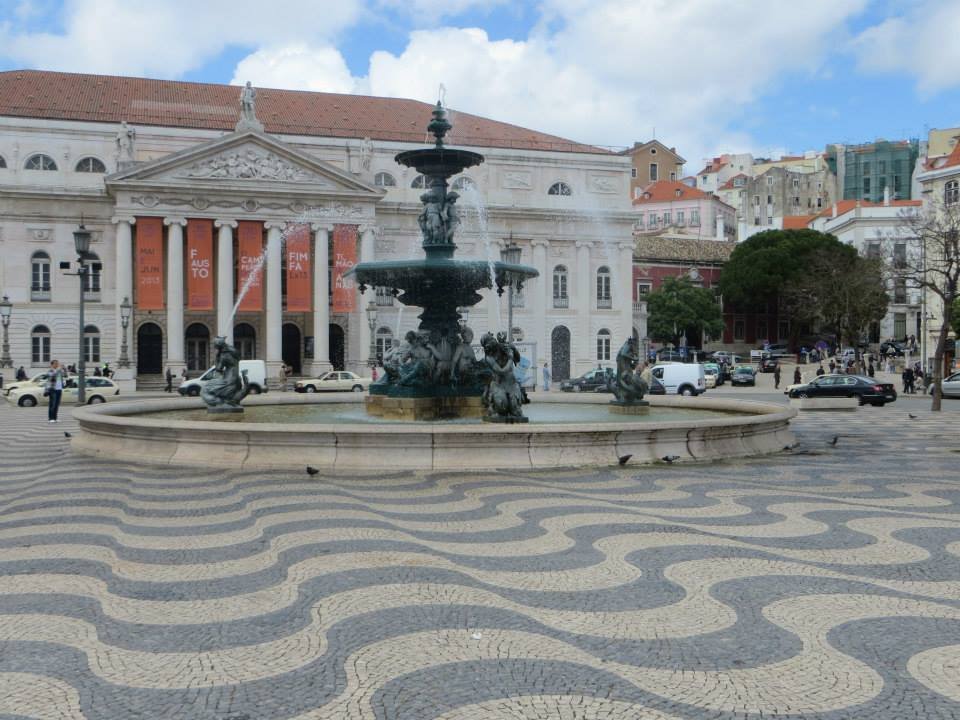
Both my feet and stomach were in good hands – food-loving Lisboeta guide Alex was showing me around. We met in wide  Praca do Comercio – a riverside square from which the city fans upwards and outwards – by the  King Dom Jose statue and triumphal Rua Augusta Arch, the crowning glories of the rebuild that followed the 1755 earthquake, tsunami and fires that devastated the city.

We headed north, under the Arco, heading into the heart of the Baixa (downtown) district, turning right down Rua da Conceicao, then left up Rua dos Correeiros to peer into the BCR bank. Inside weren’t cash machines but Roman ruins. “These vats were used to make garum – fish sauce,” said Alex. “It was exported across the empire and gained Lisbon a smelly reputation.”

Lisbon 2At Rua de Sao Nicolau, we turned left, then right back on to  Rua Augusta, Baixa’s main thoroughfare. At Rua de Santa Justa we turned left; ahead stood the 32m-high latticed-metal Elevador. Built in 1902, it whisks the weary to the higher levels of Baixa. We, however, were walking up.

Turning right down Rua dos Sapateiros, passing a glorious Art Nouveau theatre façade (now a peep show), we emerged into Praca Dom Pedro IV, turning immediately right for Praca da Figueira, once site of Lisbon’s main market. Although it no longer hosts the market, there’s still a strong foodie theme here. We paused at Manuel Tavares (00 351 213 424209; manueltavares.com), purveyor of cured meats and vintage port since 1860, and we drooled at the venerable pastry shop  Confeitaria Nacional (00 351 213 424470; confeitarianacional.com).  Less appealing was the pungent  Antiga Casa do Bacalhau (00 351 213 426256), piled with salt cod.

We exited the square via Rua Dom Antao de Almada, which widened into Largo de Sao Domingos, a popular gathering place for Lisbon’s immigrant communities. “This is where to buy obscure African ingredients,” Alex remarked. The square promotes tolerance – an olive tree stands in front of the tragedy-scarred Igreja de Sao Domingos. In 1506 , this church witnessed a massacre of converted Jews; when a fire destroyed its interior in the 1950s, it was pointedly left unrestored. Outside, we lifted the sombre mood at A Ginjinha, the city’s original hole-in-the-wall ginjinha bar, which has sold shots of this sweet cherry brandy since the 1840s.

Next, we aimed for Rua das Portas de Santo Antao, known for its seafood restaurants – and inflated prices. However, it was worth nosing into Casa do Alentejo (00 351 213 405140) – formerly a 17th-century palace whose Moorish-style interior has fine azulejos tiles and a grandly gilded bar-restaurant.

We cut down the narrow Travessa de Santo Antao, heading south around Praca dos Restauradores. “I know a trick,” declared Alex, leading us through the  entrance of Rossio Station – not to catch a train, but to use the escalators and save our energy. We exited on Calcada do Carmo, climbing south to leafy Largo do Carmo – home to the Museu Arqueologico (00 351 213 460 473; museuarqueologicodocarmo.pt), housed in the 14th-century  Convento, one of the few buildings to survive the destruction in 1755.Lisbon 6

From here, we followed Rua Serpa Pinto to turn right on to bustling Rua Garrett; much of the hubbub surrounded Art Deco A Brasileira (00 351 213 469 541). “In Lisbon we don’t say espresso, we say bica – which comes from this place,” Alex explained. “In 1905, it was first to sell small cups of strong coffee – which weren’t initially popular. So, they put a sign up saying ‘drink this with sugar’ – in Portuguese, the initials of these words spell ‘bica’.”

After a quick shot at the bar, we continued west to Praca Luis de Camoes, then cut right into the alleys of the Bairro Alto – Lisbon’s party district. We took Rua do Norte to Grapes & Bites (00 351 213 472431; grapesandbites.com). In its vaulted interior we were introduced to five Portuguese cheeses of increasing potency, from mild Alentejo goats’ cheese to a spiky well-aged Azorean queijo. We also sampled olive oils and cured meats: smoked pork sausage with garlic and pepper; a salami mixed with uncooked rice; presunto, sliced from a huge ham, right at our table. Then there were ports, from a complex white to a vintage ruby, which our sommelier opened using red-hot tongs. It was so good that it wasn’t hard to indulge – and besides, we’d walk it off tomorrow.

Fresh cuts

Lisbon’s Ribeira das Naus reopened in April. The renovated riverfront, which launched many a 16th-century explorer, features a wide promenade and a staircase down to the water – a re-creation of one that existed here before the 1755 earthquake.

Due to open later this month, Memmo Alfama (00 351 213 514368; memmoalfama.com) will be the first boutique hotel in the city’s Moorish Alfama district, complete with wine bar and pool overlooking the river.

New for foodies, local Michelin-starred chef Jose Avillez has just opened Pizzaria Lisboa (00 351 211 554945; joseavillez.pt) in trendy Chiado. His high-quality, innovative pizzas start at €9.50.

Travel essentials

Getting there

Sarah Baxter travelled with easyJet (0843 104 5000; easyJet.com), which flies to Lisbon from Gatwick, Luton, Bristol, Liverpool and Edinburgh. One-way fares start at £30. Lisbon is also served by TAP Portugal (0845 601 0932; flytap.com/UK) from Heathrow, Gatwick and Manchester and by BA (0844 493 0787; ba.com) from Heathrow.

Staying there

Lisbon offers everything from affordable five-stars to award-winning hostels. To live more like a local, try an apartment rental from HouseTrip (020-3641 9944; housetrip.com). For example, host Dianka’s central, river-view, characterful flat, excellently located in Baixa, sleeps six and costs from £72 a night. Ref: 159705.

Go guided

Tripbod (020-8144 0565; tripbod.com) offers guided tours with Lisboetas; a four-hour Lisbon and Port Wine Tasting trip with Alex costs £63.50pp, including cheese, meats, and five port wines.

The Algarve: Europe’s Best Place To Retire

Portugal_flagEurope’s best known Retirement Secret!

American journalist Kathleen Peddicord*, writing this month in the US News & World Report, lists 11 reasons to retire to Portugal’s Algarve………….

She says the golf courses, beaches and European lifestyle are among the many attractions of southern Portugal and claims that Portugal’s Algarve, home to more than 100,000 resident expat retirees, could be the best place in the world to retire that nobody’s talking about. Particularly appealing are the two municipalities of Silves and Lagoa that are situated slightly west of the center of Portugal’s southernmost province. In these two spots, you can enjoy the best the region has to offer, from medieval towns and fishing villages to open-air markets, local wine and some of Europe’s best sandy beaches. This is a land of cobblestoned streets, whitewashed houses with lace-patterned chimneys and everywhere there are fig, olive, almond and carob trees.

Here are 11 reasons the Algarve qualifies as one of Europe’s top retirement havens:

1. Great weather. This region enjoys one of the most stable climates in the world and 3,300 hours of sunshine per year, meaning more sunny days than almost anywhere else in Europe. As a result, the Algarve has a longstanding reputation as a top summer destination among European sun-seekers and a top winter retreat for those looking to escape Northern Europe’s coldest months. It’s a popular holiday destination among the Portuguese year-round, and the Spanish love the region’s wilder western coast.

2. Safety. Portugal ranks as the 17th safest country in the world. Violent crime is rare, and petty crime is limited to street crime during the busy tourist season.

3. Good infrastructure. Portugal and the Algarve have enjoyed important infrastructure investments, specifically in the country’s highway network and airports. This could be a great base for exploring all of Europe and northern Africa.

4. International-standard health care. Medical tourism is a growing industry in the region, particularly if you are interested the aesthetic, hip replacement and dental specialties.

5. Golf. The region boasts 42 courses in less than 100 miles and is generally recognized as a top golfing destination in continental Europe, and some would say the world.

6. Great beaches. The Algarve’s 100 miles of Atlantic coastline is punctuated by jagged rock formations, lagoons and extensive sandy beaches, many awarded coveted blue flags from the European Blue Flag Association. The water off these shores is azure and the cliff-top vistas are spectacular. Most beaches have lifeguards during the summer season. Many have restaurants or snack bars, sometimes open only seasonally.

7. Affordable cost of living. The cost of living in Portugal is among the lowest in Western Europe, on average 30 percent lower than in any other country of the region. A retired couple could live here comfortably but modestly on a budget of as little as $1,500 per month. With a budget of $2,000 per month or more, you could enjoy a fully appointed lifestyle in the heart of the Old World.

8. English is widely spoken. Thanks to Portugal’s strong historic and cultural links with England, English is widely spoken in the country in general and even more so in the Algarve, the country’s main tourist draw. Retired here, you could get by without learning to speak Portuguese if you wanted to.

9. Healthy living and eating. The Portuguese are the biggest fish eaters per capita in Europe, and fresh fish of great variety is available in all the ever-present daily markets. In addition, the abundance of sunshine in this part of the world means an abundance of fresh produce is also available in the local markets.

10. Retirement income is not taxed. Recent legislation allows resident foreign retirees to receive pension income in the country tax-free. The law also provides for reduced taxation on wages, intellectual property, interest, dividends and capital gains.

11. Severely undervalued property market. Real estate in Portugal is undervalued and among the most affordable in Europe. Further, Portuguese real estate has one of the most favorable price-to-rent ratios (a measure of the profitability of owning a house) and price-to-income ratios (a measure of affordability) in the region. What that means is that housing is cheaper to buy and investors can make more money from rentals than in many other European countries. Print Email

So, what else does the Algarve have to offer?

Kathleen Peddiford writes:

Portugal’s Algarve, located at Europe’s westernmost tip and boasting more than 100 miles of Atlantic coastline, could be Europe’s most famous secret. This region boasts Europe’s best beaches, Europe’s best golf courses, some of Europe’s friendliest folk, and Western Europe’s lowest cost of living. It’s also Europe’s newest tax haven.

European retirees have recognized all that the Algarve has to offer for a long time and this sunny coastal region is the chosen destination for more than 100,000 of them. Beyond Europe, the Algarve is largely ignored as a retirement haven.

However, if a Continental lifestyle appeals to you and don’t have the budget for France, Italy, or Spain, this could be an appealing alternative, that offers history, Old World charm, and spectacular beaches.

Portugal has been named Europe’s “Best Golf Destination” for 2014, and 40 of its top courses are in the Algarve.

What else could you do with yourself, retired to this part of the world?

Fatacil, the large fairgrounds in the province, hosts the International Algarve Fair every June. This unites the local and expatriate communities, as does the annual summer fair in August, with daily live concerts. Admission is a few euros a ticket per day, and you won’t find better value for money on a sultry summer night.

The Medieval Fair in Silves is a celebration of the city’s roots and features dancers, jugglers, flame-throwers fire-eaters, and snake charmers, along with a feast of regional cuisine. Many attend in period costume.

In Lagoa, the annual sweets festival showcases delicacies produced from local ingredients, including fig, orange, almond, and carob. And once a year in June the municipality celebrates the start of sardine season with more festivals and grilled sardines on every restaurant menu. Order by the half-dozen.

Throughout the year there are open-air jazz and classical concerts, most free. Experience jazz at Lagoa’s Sitio das Fontes and local youth concerts at the Lagoa Auditorium. The Arade Congress Centre is the place to come for special events, from a motor car launch to a performance by the Russian ballet or the finals of the World Dance championships.

If you’re looking for sporting and outdoors activities, try kayaking, paddling, or cave fishing on the Arade River. The sailing schools at the river mouth are a bargain by international standards.

Bottom line, Portugal in general and the Algarve in particular offer an opportunity to savour the best of an old-school, Old World lifestyle at a very affordable cost.

===

*Kathleen Peddicord is the founder of the Live and Invest Overseas publishing group. With more than 28 years experience covering this beat, Kathleen reports daily on current opportunities for living, retiring and investing overseas in her free e-letter. Her newest book, “How To Buy Real estate Overseas”, published by Wiley & Sons, is the culmination of decades of personal experience living and investing around the world.