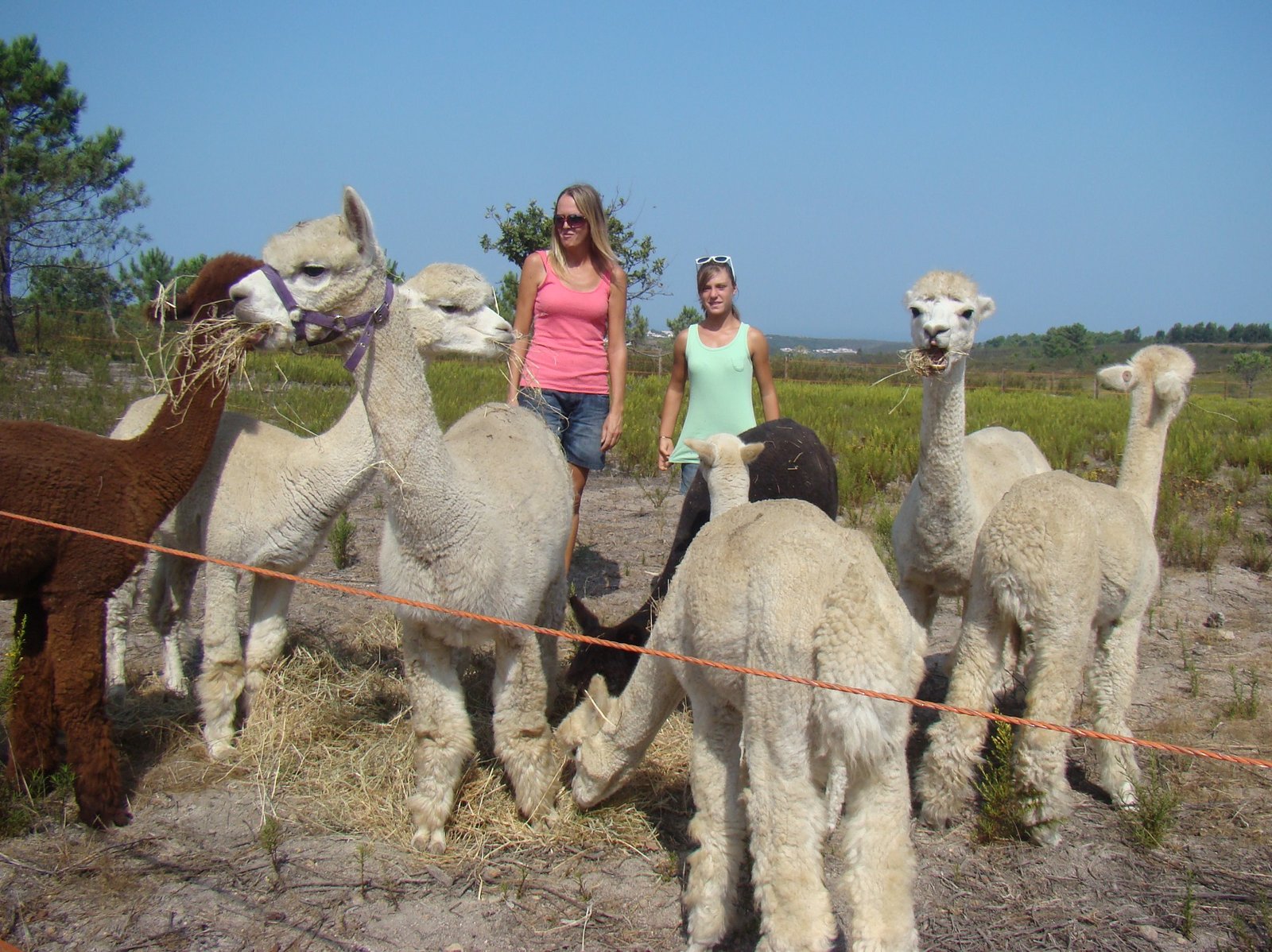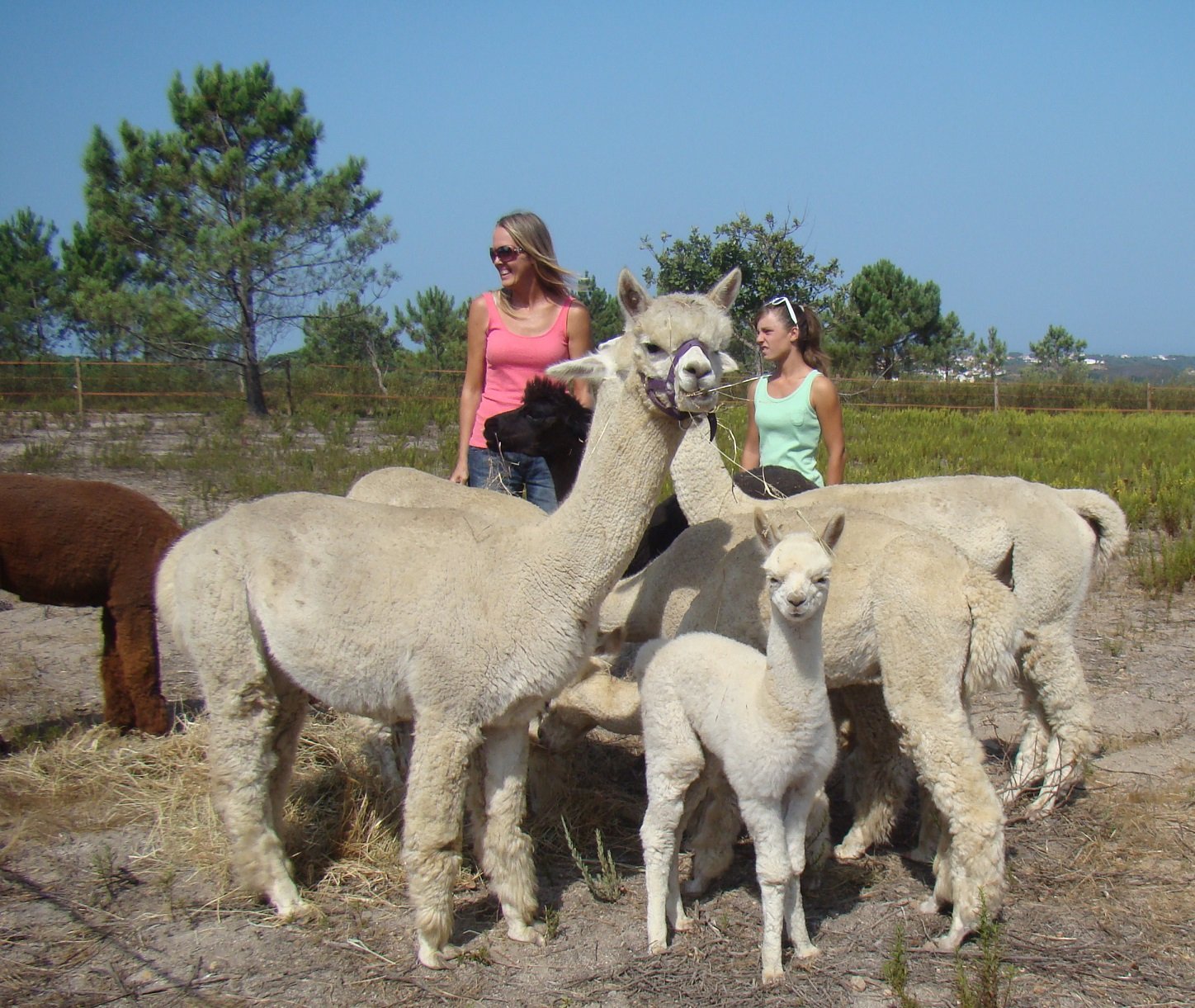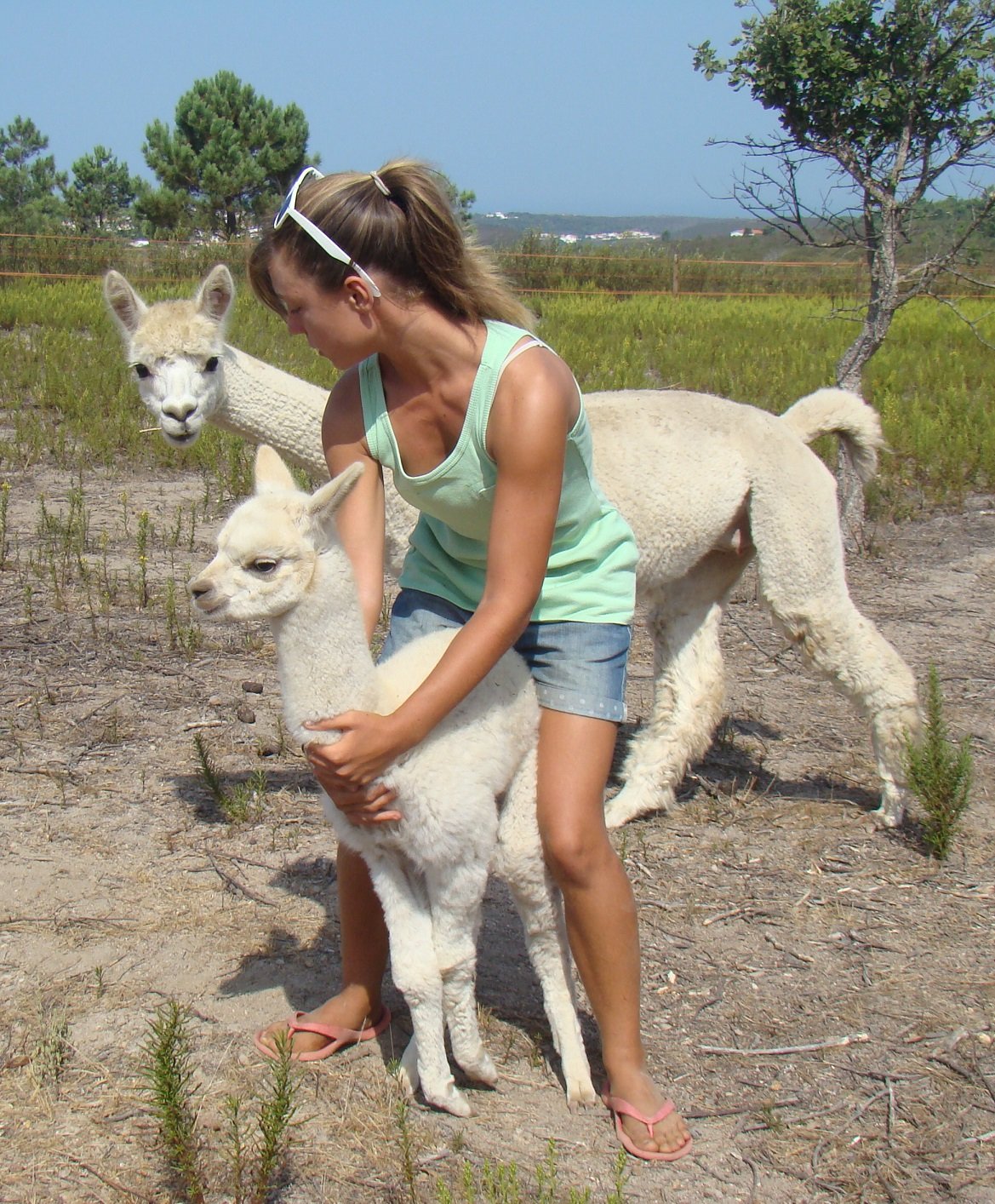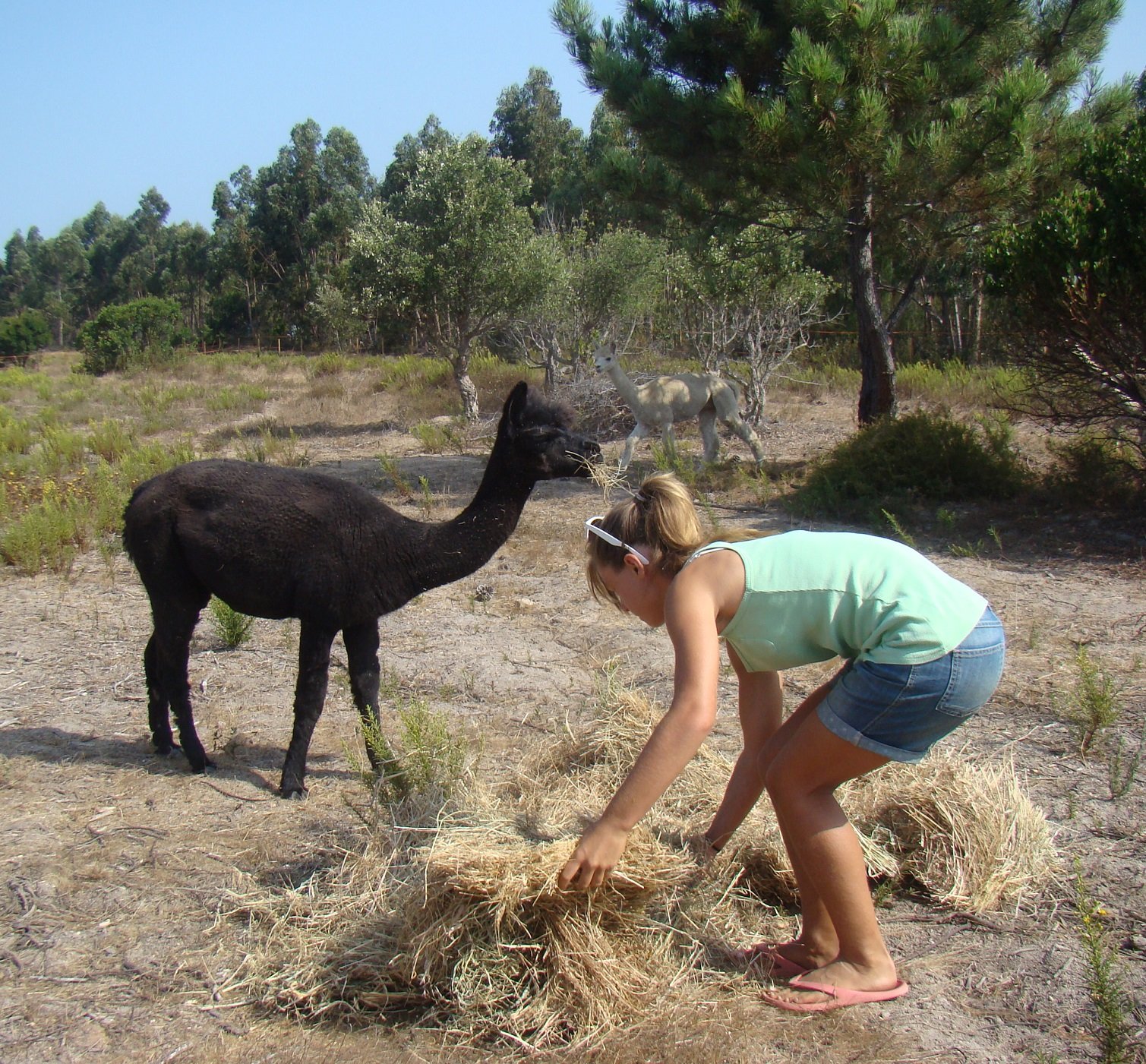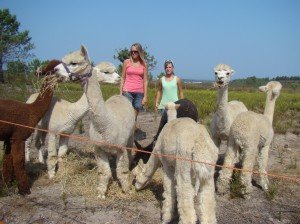
Sally And Selina With The Alpacas
By Matt D’Arcy
The Algarve’s west coast is not the Andes, nor does it soar 5,000 metres above sea level.
But it is now home to a herd of animals which originated in those high plains of west-central South America; the alpaca.
Matt and Sally Henman have created “Aljezur Alpacas” here on the Vale da Telha plateau.
And although their paddocks are capable of sustaining up to 100 alpacas, they intend to increase their current herd from eight to a maximum of 50 through a careful breeding programme in association with other pedigree farms including the nearest such breeder, based in Andalusia in Spain.
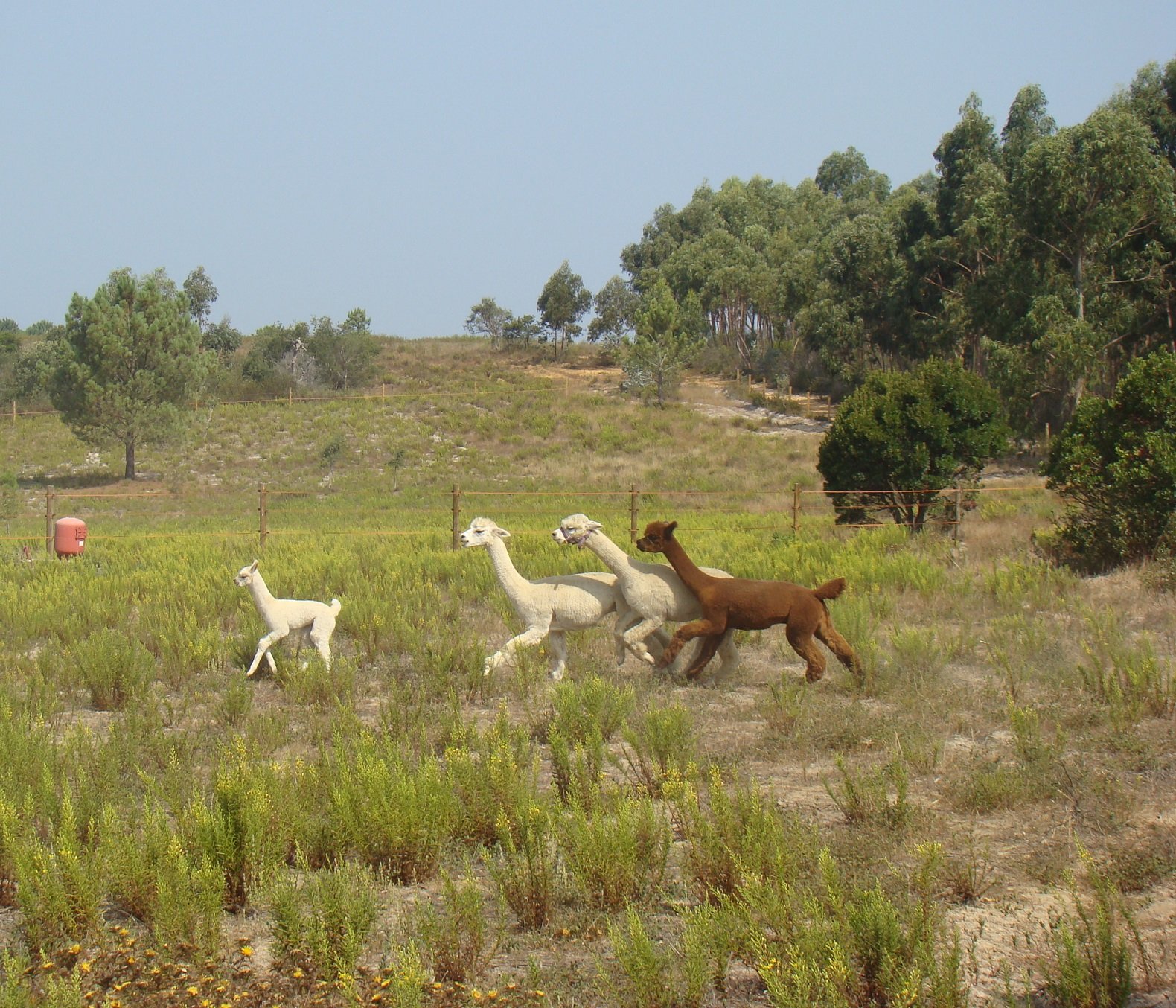
In fact, they have already had their first Aljezur-born cria(the name for baby alpacas, much like foals to horses) who now goes by the name of Dumbledore, so the
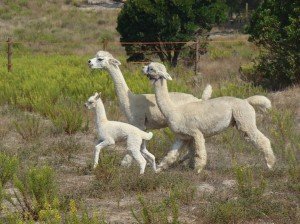
Dumbledore Leads The Charge
project is already healthily under way.
Although alpaca meat is seen in some quarters to be healthy and flavourful, high in protein, Matt and Sally plan only to breed a stock with a 100 per cent pedigree bloodline to sell to other breeders, and to use the animals’ sumptuously soft fleece, or fibre, for commercial purposes.
Alpaca fibre is widely recognised as one of the most luxurious fibres in the world, and comes in 22 officially recognised colours and every shade in between. It is used for making designer clothes as well as knitted and woven items similar to, but much superior to, wool; items that include blankets, sweaters, hats, gloves, scarves, socks, coats and even bedding.
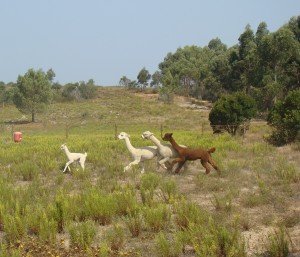
Dumbledore Leads Them On A Merry Chase
Aljezur’s alpacas are already very much at home in the Henman family’s paddocks to the east of Sector E in Vale da Telha, out towards the top of the hill leading up from Aljezur, despite their forebears being ideally suited to life 16,000ft above sea level!
Matt and Sally moved here from Edinburgh where Sally was in the Travel and Tourism Industry and Matt was working in Insurance and Pensions. They felt that their three children, Selina (now 13), Aiden (11) and 6 year-old Jamie would have a better lifestyle and quality of life growing up in rural Portugal than growing up in the UK.
The couple have long been intrigued by the possibilities and prospects of alpaca farming and breeding and, as they already owned a property in Vale da Telha, they felt this would be the perfect area to follow the dream.
The Henmans had been visiting Portugal for almost 20 years, mainly around the
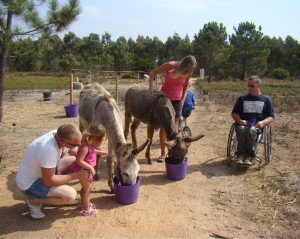
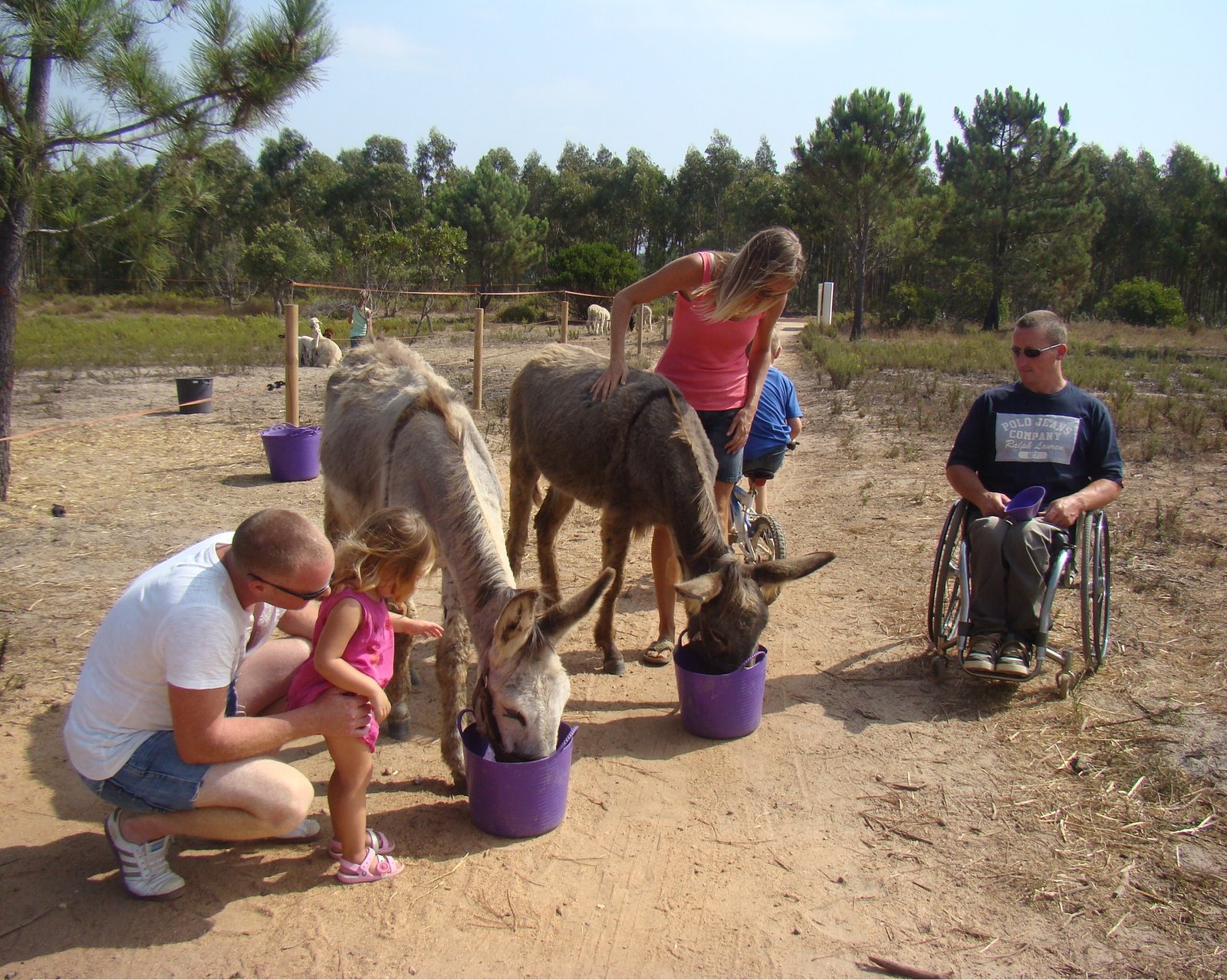
Sally & Matt (Right) Feed The Donkeys, With A Little Help
Almancil area, but found the southern Algarve increasingly noisy and uncomfortably busy to consider making their home there.
Once they visited the West Coast and the Costa Vicentina, they fell in love with the peace and tranquillity of this vast but undeveloped area, and its possibilities, which prompted them to buy a villa on Vale da Telha.
From that anchor-point they began working towards bringing their dream to fruition, firstly by buying 18 acres of land not far from Quinta da Lago Silencioso, with trees, pastures and a stream running along the edge of the property.
They then applied for—and got!—planning permission to build a new house and a storage building on the land. They lived in their older property for two years before finally their habitation licence came though and they officially moved into their new “estate” in July 2013.
By that time they had already been acquiring pedigree alpacas in Suffolk, where they were kept in livery with their breeder.
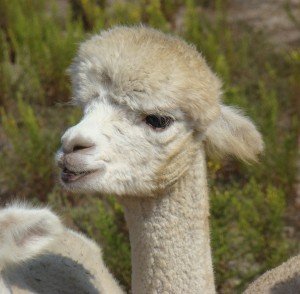
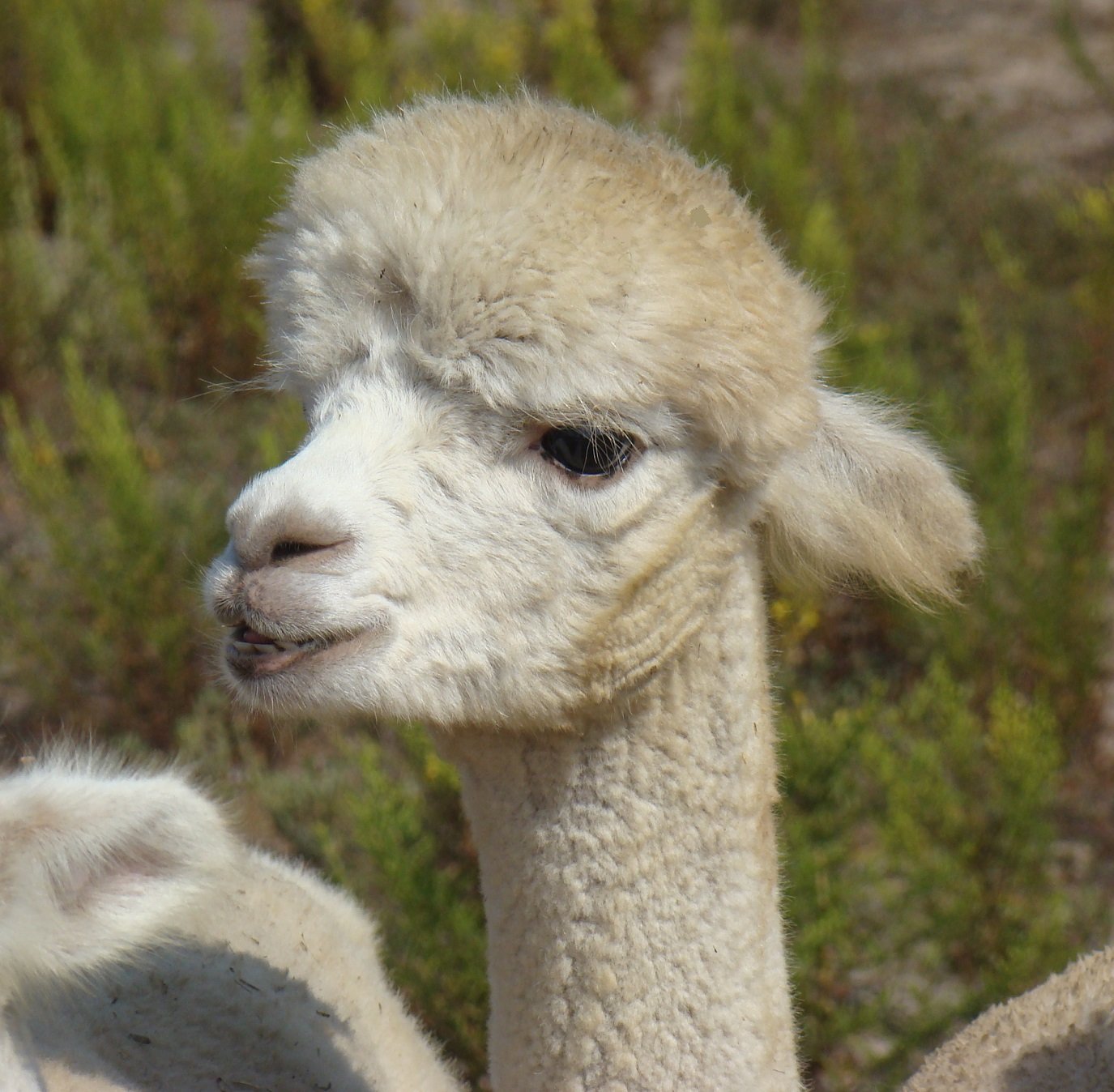
One Of The Alpacas 'Poses' For A Portrait
And when it came to shipping them over to their new home outside Aljezur in the summer of 2013, the “Aljezur Alpacas” totalled seven animals, one of them (named Elektra), already pregnant.
Right at the outset, in 2010, the Henman children had the privilege of naming each alpaca as it came into the family.
They decided to name them after cartoon characters or some of their literary favourites, beginning with the letter “A”, the initial then changing from ‘B’, to ‘C’, etc., each year. This meant the new cria’s name would begin with the letter “D”…and so little Dumbledore was the first of the Aljezur Alpacas to actually be born in Aljezur.
There are other Alpaca farms in Portugal but Matt and Sally decided from the outset that the Aljezur Alpaca bloodline would be 100 per cent pedigree. This means that their breeding programme would have to be scrupulously monitored and, once new blood needs to be introduced to the herd, they will be working with the nearest pedigree stock in Andalusia, in Spain
They decided to work towards creating a herd with a maximum of around 50 alpacas
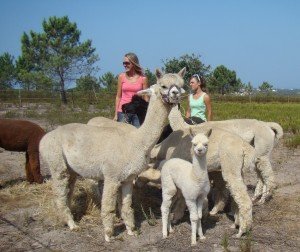
Dumbledore Takes Centre Stage
to make handling the stock easier and more efficient. All of the veterinary needs, inoculations, vaccinations etc are handled by Matt and Sally themselves as there are no vets sufficiently qualified in this region.
The long-term aim is to breed and sell the stock to other breeders across Europe. Alpaca fleece is highly marketable and Matt and Sally will be looking for ways to best utilise the shearings, with the Middle East a major market for alpaca wool.
For example they displayed the sumptuously soft fleece from their alpacas recently at Fatacil, and a lady who makes soft toys using sheep wool is now interested in replacing that with the much softer and more tactile wool from the alpacas.
Eventually the Henman’s hope that Aljezur Alpacas will benefit the area by playing a key role in attracting more visitors to the area which is already attracting a great deal of media interest across Europe with the opening of the Rota Vicentina and a growing awareness of the natural beauty of the coastline.
Sally intends to build on her experiences of marketing in the tourism trade to promote the business and the attractions of the region, explaining:
“We want to build up people’s awareness of the desirability of alpaca fleeces and wool and to develop the product.
“At the moment people have to import the high-quality fleece of pedigree alpacas. We have it in the garage.”
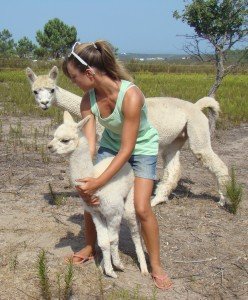
Dumbledore's Mum Keeps An Eye On Selina With Her Offspring
Sally has also been in discussions with schools in the area to develop a relationship that would benefit the pupils.
The International School already plans to take some of the fleeces from the Aljezur Alpacas and develop a weaving project as part of their curriculum. And as the farm is located on the Costa Vicentina national park and along the route of the Rota Vicentina, with its accent on eco-tourism and sustainable green industries the Henmans hope the Park authorities, looking at “weird and wonderful” projects, will incorporate Aljezur Alpacas into its tourism programme.
Looking further ahead Matt and Sally are exploring the potential of Alpaca Trekking as the animals will happily submit themselves to a lead.
And even their by-products are sellable!
Alpaca manure is dry, formed in small pellets and is virtually odourless but is a highly efficient fertiliser. It can be placed directly onto plants or you can run water through a bag of the manure and use the water to feed the plants.
Sally claims this is every bit as good as more commercially available products like Baby Bio, and they now have a customer base of local people calling in to buy the bags, which are filled by the Henman children.
Matt laughed: “The kids get their pocket money this way.”
The Henman project is still in its early stages. But already the family has 18 ducks, to provide them with fresh eggs (“once they start laying,” Sally said a little ruefully) and a pair of pigs for breeding which will eventually produce all the pork and ham they need, as well as piglets to sell on to other breeders.
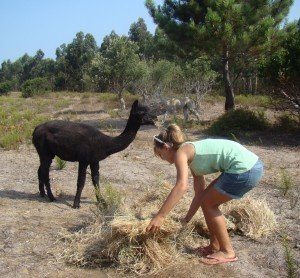
Selina Sets Out Lunch
They also own two donkeys and are currently establishing a boarding kennels for dogs which they say will have plenty of room for the pets to be comfortable, and good quality dog walks to give the boarders plenty of daily exercise, vital for their wellbeing.
Aljezur Alpacas and all its associated parts, is pretty much self-sufficient with the Henmans producing their own electricity from an expanse of solar panels, backed up in the winter by a generator, and all their water comes from their own borehole.
“It’s hard work, but so rewarding,” Sally said.
“It’s wonderful for the children to grow up in an environment like this and for Matt and myself to have a real sense of accomplishment and achievement as we see it all beginning to take shape.
“It is giving us all that we wanted and no-one can ask for more than that.”
Matt and Sally can be contacted by e-mail at:
ALL YOU NEED TO KNOW ABOUT ALPACAS
What are alpacas?
Alpacas originate from the Altiplano (Spanish for high plain) in west-central South America. Spanning the borders of Peru, Chile and Bolivia, this area of the Andes averages nearly 4000 metres. Alpacas are one of the camelid species, closely related to the llama. There are four species of South American camelid – Llamas (Lama glama) and alpacas (Vicugna pacos) are domesticated and vicuna (Vicugna vicugna) and guanaco (Lama guanicoe) remain wild and are protected species. All four are found mainly in Peru in the Andes, with smaller numbers in Chile and Bolivia.
It is believed that the alpaca and the llama were domesticated from the wild species vicuna and guanaco over 6000 years ago. The alpaca was developed primarily as a fleece producing animal with meat as a secondary product.
The llama was developed primarily as a pack animal and has the ability to carry about 25kg of weight on its back and travel 10-12 miles per day up and down the mountains of the Andes.
Alpaca fibre
Its most remarkable quality is its softness – alpaca fibre is inherently soft. This is due to the fact it has less scales on each individual fibre, compared to sheep’s wool which has many, and more prominent scales on each individual fibre. (Suri alpaca have less scales than huacaya alpaca so their fibre is even softer.) Even at its coarsest, alpaca is inherently softer than sheep’s wool and often a certain percentage of alpaca fibre is added to sheep’s wool during the woollen process to enhance the handle or feel.
The lack of scales and smoothness of the fibre also gives alpaca a natural brightness as the smoother surface reflects the light better. Suri alpaca (because it has less scales) reflects the light like a mirror and is renowned for its deep lustre, as well as its luxuriously smooth handle.
History
Alpaca has been a must have item ever since Sir Titus Salt introduced it into the UK marketplace in around 1836. Alpaca coats, gowns and materials were very fashionable during Queen Victoria’s reign – in fact they were so prized and so hardwearing that they were bequeathed in the wills of the deceased to the next generations. Sir Titus became the largest employer in Bradford, West Yorkshire, building the model industrial village of Saltaire in 1851 on the back of this success.
Today, many UK breeders process their own alpaca fibre and sell the yarns and products direct to the public. BAS members are making and selling all kinds of alpaca products, ranging from insoles for boots and wellingtons with coarser fibre, to babywear and exclusive luxury fashion items at the other extreme.
Knitters adore alpaca and rapidly become addicted to it once they have felt the softness and quality of the yarns. South Americans use a lot of heavy bright dyes on their yarns which suit the garments and products they want to make for their home market.
However, here in Europe the attraction is the vast range of natural colours. The natural, subtle but expansive colour palette offered by the alpaca is one of its main attractions. In its natural state, undyed, it also comes with an environmental cache, making it very attractive to the ‘green’ market.
Properties of alpaca
Alpaca is a dry fibre with a minimum lanolin content which means it does not need to be scoured prior to spinning. It can be spun into yarn straight from the fleece and is often washed at the hank (a coiled bundle or yarn) stage of processing.
At its finest alpaca fibre gets as low as 15-16 microns (the mean of the fibre diameters or average diameter) which is very fine indeed, in fact it is often described as a hard wearing cashmere. At its finest it is used like cashmere to produce high quality, luxury garments in both the woollen process for knitwear and weaving and in the worsted process for fine suiting and materials.
Suri fleece
The fibre from the huacaya alpaca (those that look like teddy bears) is more suited to the woollen process and the fibre from the suri alpaca is a lot like silk and more akin to the worsted process. At its finest, women’s lingerie can be made from suri fibre.
However, even on a global scale, alpaca fibre is still very much a niche market. There are roughly three million kg of alpaca fibre produced in South America every year and this still only represents .04% of all the fibres processed in any given year. The average alpaca produces around 2.4kg of alpaca fibre per annum, with some having the potential to produce around 4-6kg per annum.
Why keep alpacas?
Alpacas are a niche market livestock enabling owners with small acreages the ability to trade and earn income from their land. There is growing demand for quality alpacas developing throughout the UK and Europe. Quality alpaca fleece is a rare commodity and alpacas that can produce this throughout their lifespan will always command a premium.
The breeding of the alpaca as a luxury fibre producing animal has seen dramatic improvements. As breeders worldwide return the alpaca to its pre-Conquest quality, the potential becomes more apparent with each breeding season.
However, some geneticists consider that even the best alpaca in the world today is still only 50% of what it once was.
Excitingly in the UK, alongside a very sophisticated breeding industry, a vibrant marketplace for alpaca fibre is emerging. This will only improve as alpaca yarns and products gain popularity and command more of a market share from the other niche fibres.
As a unique niche fibre that has a fixed growth potential in South America due to limitations in grazing and husbandry, as well as climactic restrictions, the production of quality assured alpaca fibre outside of South America has huge potential in the European marketplace.
Attracted by the softness of the fine yarns and the abundance of shades in natural undyed colours, the modern world is embracing alpaca with a passion. And although the industry will always be subject to the whims of fashion, it is worth considering that the total alpaca production in the world today represents only .04% of the world production of processed fibres – the potential for alpaca is huge.
Information sourced from The British Alpaca Society at: http://www.bas-uk.com/






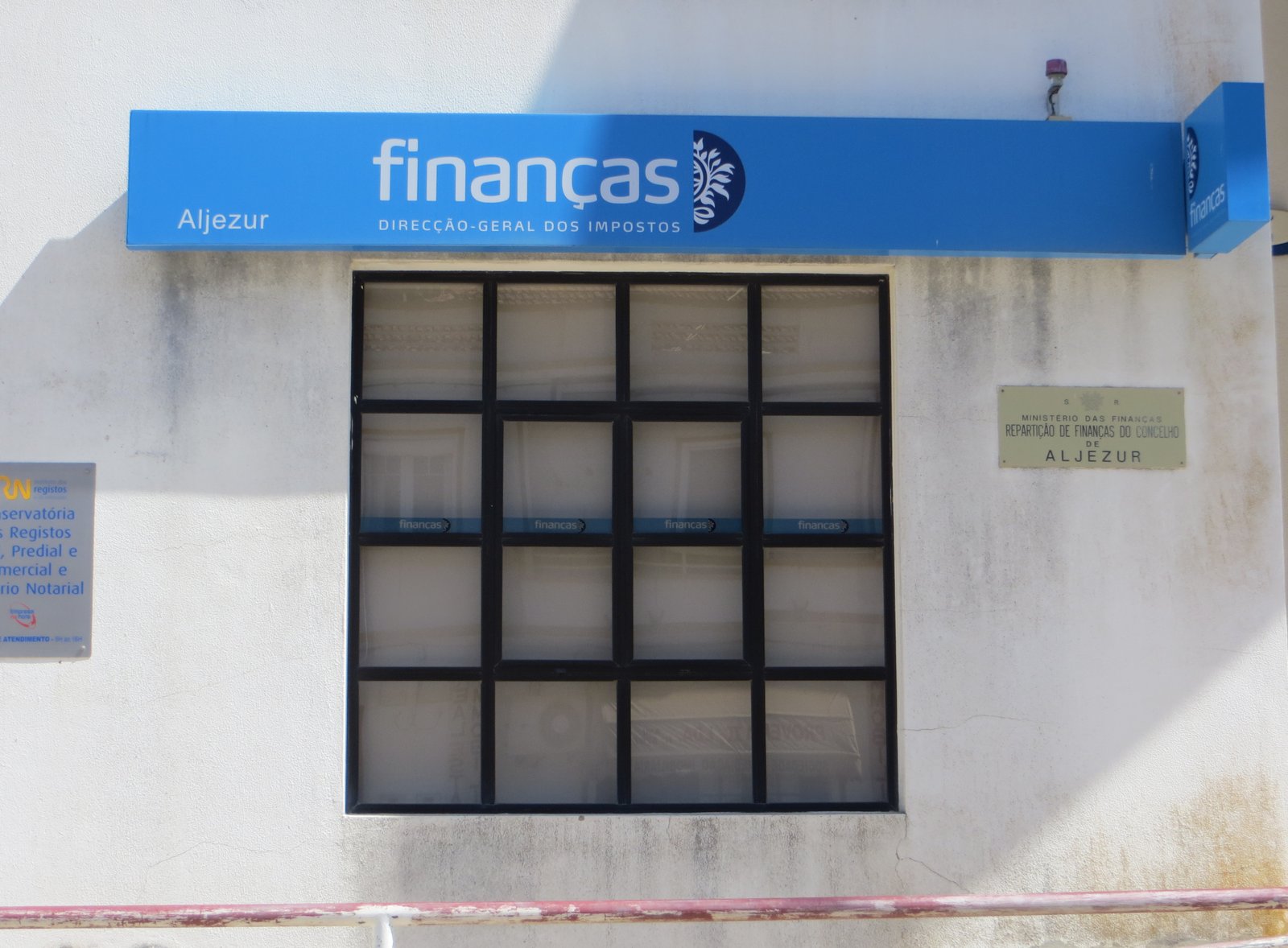 The Municipality of Aljezur has condemned the planned closure of the local Finanças office.