



 By Matt D’Arcy
Part 2
Susan’s next e-mail was dated January 12 2012, and she reported:
“Since my last post the last six days, as expected, have been the best of the trip.
“We left Midelt and travelled to Rich and then Gorges da Ziz, not as spectacular as we have seen in other countries.
“We continued on southward to Ar-Rachidia, Erford and took a small road to Dar Kauoua. But then the road became inaccessible, except for serious 4×4 driving.
“We went down a track to a village and saw a walled property. I asked a Berber man if we could stay for a night he said yes and invited us up onto the terrace where he served us tea olives and bread.
“The next morning we walked for about 30 minutes until we came to where people were digging minerals, fossils etc. This is an important area for fossils; places selling fossils are everywhere.
“We said goodbye to our host and his family and had to go back to Erford to go round to Rissini to pick the road up to the Erg Chebbi, a large sand dune.
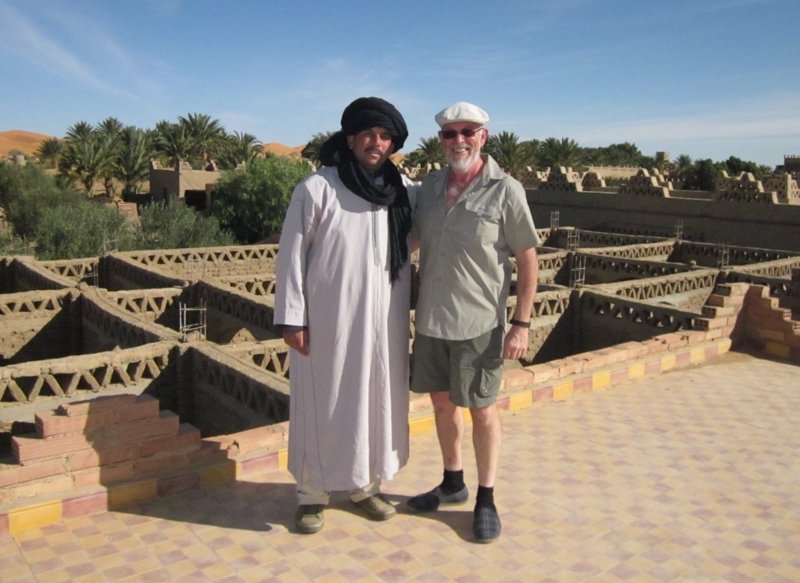
Brian & The Justsums Berber Friend at Merzouga
“We went into the village of Merzouga and parked up deciding what to do. A handsome looking Berber turned up and asked us if we were looking for somewhere to camp.
“We followed him to the village of Adrouine and he took us to an Aubuge (a desert hotel). It was lovely and the staff were fabulous; they had no one staying in the hotel, just 4 campervans—ours, and three from Germany.
“The Aubuge was called Haven in the Desert and it sure was—I could have stayed for ever!
“I never understood why people raved about the desert, thinking that surely it is just sand. But, no, it is much more, peace like you have never known, stars so bright and no wind. We have struck so lucky with the weather and the area and the village were enchanting.”
Susan recalled: “We learned a lot about the desert. When you see palm trees, you assume there is water somewhere. Wells are dug and the water is only 6 metres deep.
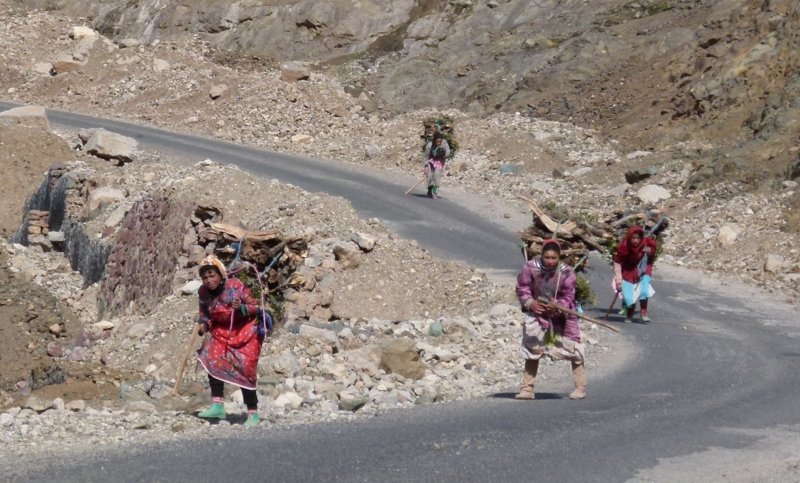
Girls Collecting Wood on High Atlas, Day Before Snows Came
“The Berber women across Northern Africa grow crops under the palm trees, mainly in summer but here they grow them all year round. The women were digging up carrots, white turnips, broad beans and coriander, and of course mint; unbelievable in such a hostile environment of 28 degrees in the day and -2 at night, climbing in summer up to 50 in the day and -14 at night.
“Here apart from bread they eat what they grow. The villagers make lavages and have allotments, each about 6×10 meters and all well watered.
“Walking around the village was great. We were invited into a Berber school for women, all aged about 18 to 40 learning how to write, sew and some in a Spanish class.
“Everyone was so welcoming. We saw a lady sitting on a carpet sorting out grain and she showed us how she had to sort the grain, grind it and make bread every day for a family of 8.
“She also had to go and collect the dead palm leaves to use for fire to cook the bread. How easy do we have it?
“She invited us in for tea and gave us some of her lovely bread. In the houses they have nothing except bench seating covered in carpets and 1 table/ tray for the mint tea.
“One of her little girls aged 8 walked with us back to the village centre where there was one shop. We bought her and her two friends sticky lollies. They were great kids and tried to teach us some Berber language.
“We stayed here three days and could have stayed much longer. I would love to come back here. We had all the facilities of the Auberge, even a swimming pool, for just 4 euros a night, and the best showers and toilets so far.
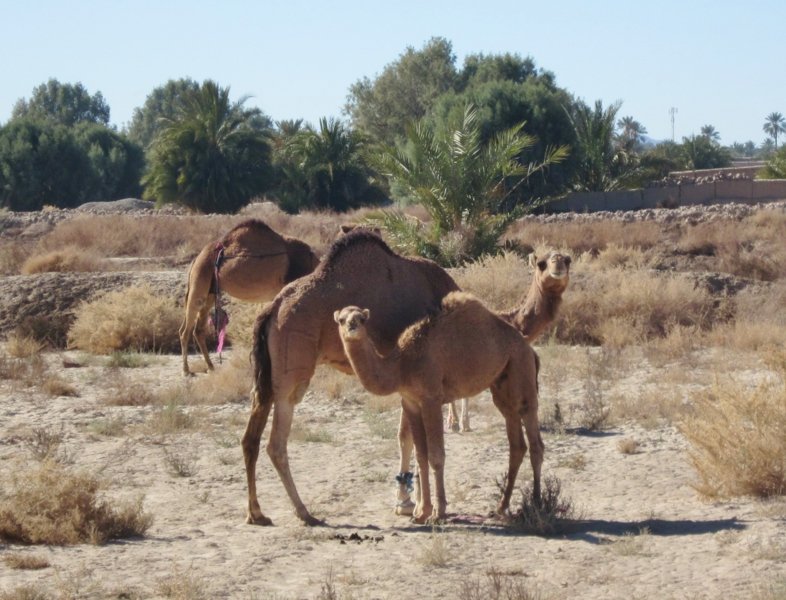
Desert Dromedaries near Merzouga
“Before we set off for this trip I wanted to see camels, and I have now seen so many. But of course they are not camels they are dromedaries, only having one hump.
“It’s best when you see them grazing with their babies feeding, not harnessed or in attire for trips with rich tourists. That’s not us—no rides thank you!”
The following morning Susan and Brian retraced their steps to Ar-Rachidia, stopping at the weekly souk (market) in Rissini.
“This was by far the best to date,” said Susan. “It was a very old locality with narrow alleys and so many stalls, not a tourist in sight, all aimed at the local people.
“They sold everything from camels’ hooves and intestines to spices and silks. In a dark alley we saw about 25 bundles and as we walked by we realised they were women covered in black crouched down; quite spooky.
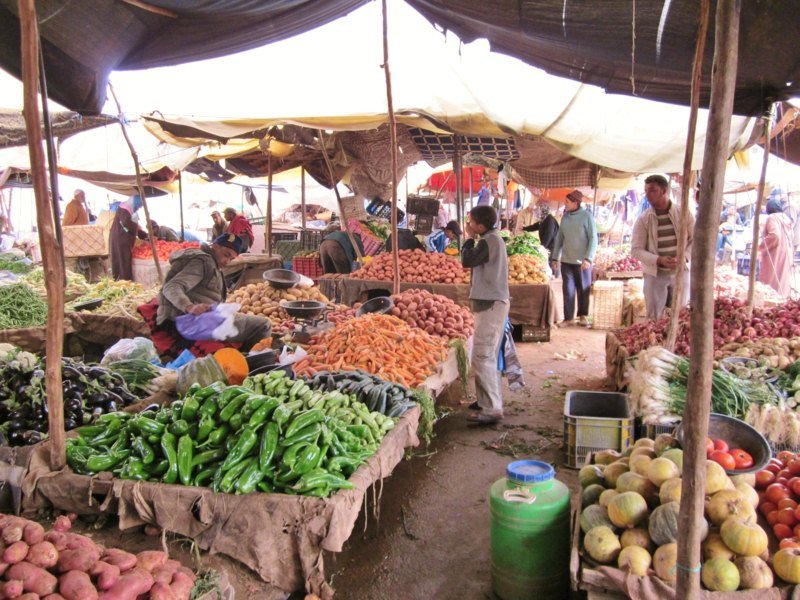
Local Market Vegetable Stalls
“Then, we headed back to Ar-Rachidia and on to Goulmima and Tinerhir. This was on our way to the Todra Gorge staying in a small village on a campsite at Z-S-Abdelali.
“Next morning we set off for the Gorge. The sheer rock face at the start of the gorge is 1000ft straight up and the mountains behind 10,000ft—quite a sight and hard to photograph.
“We walked for about a mile to get the feel of it before our long drive up the Gorge reaching 9,000ft. After about 3 hours we dropped down to the village of Agoudal, about 8,000 ft. high, where yet again we struck lucky.
“It is a place of 2,500 people and we did not see a single vehicle. On the way we are mobbed by children and then we see a small Auberge. As we slow down the proprietor, Ibrahim, comes out to meet us.
“We had not intended to stay here, but we did for 2 nights and it was again fantastic, better than we could have imagined. We should have stayed longer.”
When Susan and Brian went into the Auberge, Ibrahim had lit a fire for them and they saw a picture of a cave they told him they would like to explore.
Susan recalled: “The next morning Ibrahim took us through the village in the van—we would have never found the route
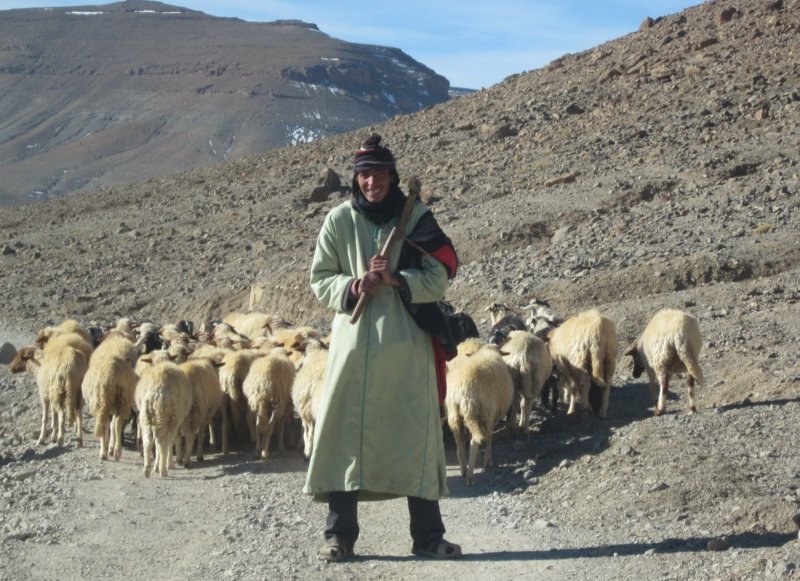
Shepherd En Route To Agoudal Cave
without him. The roads were terrible and he told us to drive “off piste” for about 5km. We passed a few shepherds, who stopped and asked for food; one of them is in the pictures.
“When we arrived at the point Abram had told us to leave the van, near a stream, we started our 5km walk to the cave, leaving the van in the middle of nowhere.
“This area was so bleak little or nothing growing and all the sheep herders carried axes!
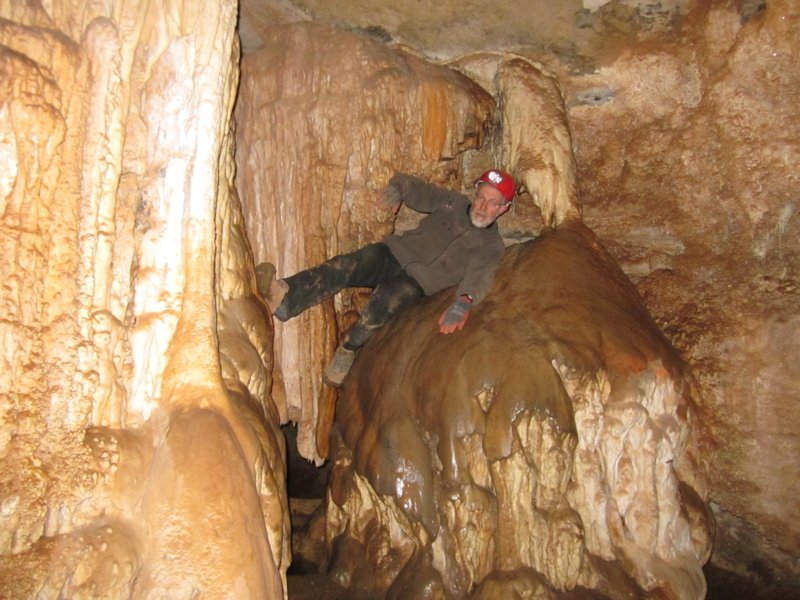
Brian In Cave Near Agoudal
“The cave when we eventually found it was fantastic. We had walked uphill through ice fields and frozen waterfalls, until we were at 9,000ft. We found a water point where cleaned sardine tins had been left to drink from.
“After about 3 hours exploring we stared our descent and as the van came into view we could see smoke and a fire, plus goats, a dog—and a shepherd.
“As we approached him he had water boiling in an old tin tea pot and had made us tea, even though he had just one glass to share between the three of us.
“He had open-toed sandals and it was freezing cold!
“He was a lovely young chap who only spoke Berber, but you can do a lot with a smile and a little sign language. He demonstrated that the axes were to cut what little vegetation there was for the goats to get to the roots.
“He walked back with us to the van where we had made a curry for supper. So gave him a take away and offered him socks but he refused these.
“However, he WAS delighted with his supper and he went over to a bush and set fire to it, beckoning us over to warm our
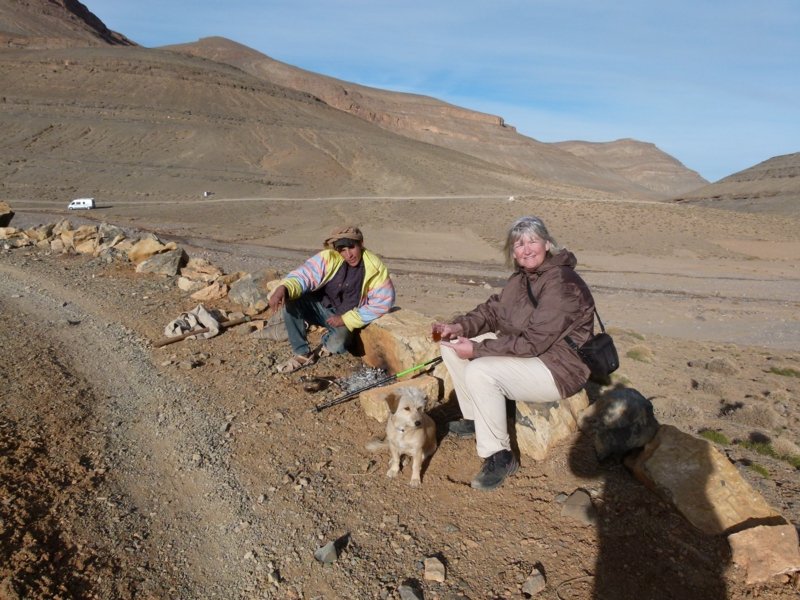
Susan With the Shepherd
hands.
“At this point I thought perhaps this is where the burning bush in the Bible came from? Certainly, there were lots of shepherds in the bible!”
Susan wrote that they were still struggling to cope with the way temperatures plummeted at night.
“We have started wearing about 4 layers and 2 pairs of trousers,” she explained. “Our first night here was -4 in the van at 8am and outside at 10am, when the sun had been up two hours, it was still -8.
“We don’t make for early mornings.”
Susan and Brian’s memories of their trip conjure up images as much of the people—particularly the children—as it does about the culture, the scenery, the landscape, the cities, towns and villages.
“The children hunt in packs of about 15 at a time and I just love them,” she wrote.
“Many have faces I will never forget—I could adopt them all.
“Today I met a lady with 14 children and another on the way. She looked so haggard and she showed me the baby had no clothes on under her wrappings.
“Now I know why they are always washing in freezing cold streams—they have to. This is the poorest area we have been to, no donkeys here.
“We both will return with children’s clothes. They don’t want money, as they have nothing to spend it on. This village has only had tarmac for 2 years and it took us 3 hours to drive from Todra.
“We are having an enlightening experience as much as a holiday.
“Morocco is changing fast and much of it will not continue in its present form. What must the people here think of us in our van and warm clothes?”
READ PART 3 for the next installment……………………..
~~~~~~~~~~~~~~~~~~~~~~~~~~~~~~~~~~~~~~~~~~~~~~