Category Archives: News

Portuguese Food

 Courtesy of Portugal Today.

Portugal recently chose it’s seven gastronomic wonders.

Mirandela sausage, Serra da Estrela cheese, caldo verde, seafood rice, grilled sardines, Bairrada suckling pig and Belém custard tarts are the culinary delights elected by the public as the best the country has to offer.

“The 7 wonders” is a competition where Portugal‘s greatest assets and passions are assessed. The initiative aims to disseminate and promote the national gastronomic heritage which is known all over the world for its diversity, unique flavours and quality.

Traditional food has been chosen as a starting point, but a contemporary approach by famous chefs will not be left out.

The final choices were made by public voting.

A total of seven delicacies were chosen from the 21 finalists in seven different categories. Traditional dishes were the major winners of the competition.

If you are visitingPortugalbe sure to try at least some of them, as they are a definite part of the Portuguese identity.

Entrées

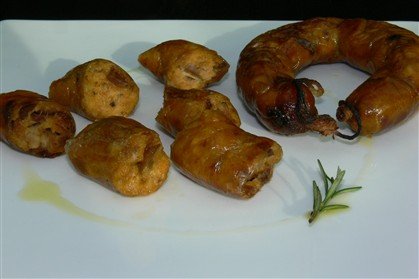
Alheira de Mirandela

1. Alheira de Mirandela (Mirandela sausage), a smoky poultry and bread sausage which can be served either grilled or fried. It has a vinegary taste too, which cuts into its smokiness and fattiness. The Alheira comes from the northern regions of Trás-os-Montes and AltoDouro.


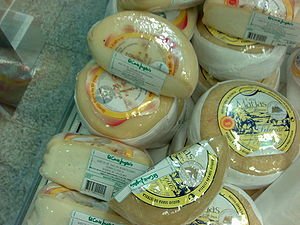
Queijo da Serra

2. Queijo da Serra (Serra da Estrela cheese), a matured buttery cheese made from sheep’s milk. It is considered the best cheese in Portugal and can be eaten on its own. It is commonly used in other dishes due to its distinctive flavour. It comes from the mountainous region of the Serra da Estrela.


Soups

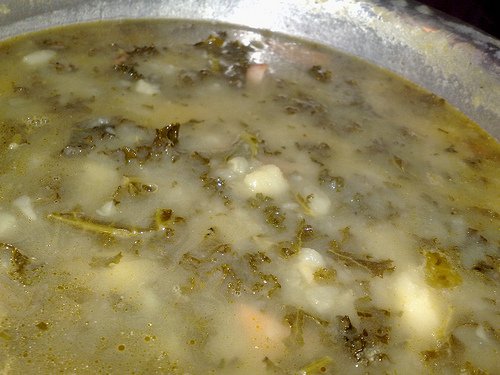
Caldo Verde

3. Caldo Verde (green broth) is a kale and potato soup usually accompanied with chouriço sausage. It is a thick soup with green as its predominant colour. The soup is traditionally served in clay bowls, with a sprinkle of olive oil, slices of chouriço sausage and a slice of broa de milho (corn bread). Originally from the northern region of Minho, it has become a national staple.


Seafood

Arroz de Marisco

4. Arroz de Marisco, a very well know seafood rice dish made with seafood stock, prawns and crab claws. This dish is very soupy and is served in vast quantities. It can be very expensive and comes from the central regions of Estremadura and Ribatejo.


Fish

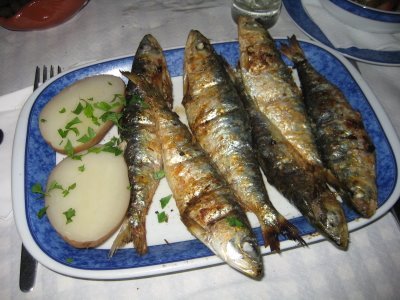
Sardinha assada

5. Sardinha Assada (grilled sardines), a staple food eaten by the majority of the Portuguese in the summer, it is usually accompanied with bread, salad and boiled potatoes. Often seen in the Algarve, and an icon of Lisbon’s festivities during the summer, it can be found on every coastal restaurant’s menu. Grilled sardines are in fact a gastronomic institution.


Meat

Leitão da Bairrada

6. Leitão da Bairrada (Bairrada suckling pig), calls to mind the image of a pig with an orange in its mouth. Roasted suckling pig is much more succulent than normal pork, and can be served either hot or cold with thin-sliced fried potatoes, a sauce boat of pepper sauce and salad. Leitão can be found all over the country but it is originally from Bairrada, a part of the central region of Beira Litoral. Mealhada is the main town producing this dish.


Sweets

Pastel de Belem

7. The Pastel de Belém, is a must if you visit Lisbon. The custard tart is usually bought in Belém, a historic district were the café and factory that make them is located. Known as the original version of the ubiquitous ‘pastel de nata’, the pastel de Belém is crispy and buttery. You can eat it with cinnamon and sugar sprinkled on top. It is originally from Lisbon.


Bob’s Gym Sessions are Back !

AMOVATE GYM SESSIONS RE-STARTING

Feeling a bit sluggish? Got some weight to shed after the Christmas and New Year Celebrations?

Made a resolution to rediscover that sparkle, that zest, the get-up-and-go that you thought had got up and gone…..?

Well, there’s no longer any reason not to get fit and stay fit.

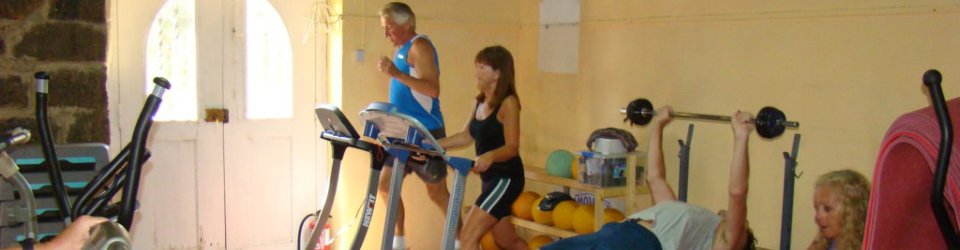
Bob Packham is re-starting the weekly gym sessions at the Amovate HQ from next Thursday, January 5th, between 5 and 6pm.

Bob already runs a thriving Keep Fit club at the Old Schoolhouse, which meets twice weekly for a 10-15 minute aerobic workout followed by circuit training in sessions lasting no more than a total of one hour.

Those classes will be re-starting on Wednesday after the winter break and there is room, incidentally, for more people who’d like to join in—the classes are held on Mondays at 11.30am—12.30pm and Wednesdays from 11am-12 noon and cost €2.50 per session.

Bob’s gym sessions will re-start on Thursday and differ from the Keep-Fit classes which are supervised for the full hour, Bob and Ian leading the class throughout.

But the gym sessions are there for people to simply use the wide range of equipment at their own pace, following their own programme although Bob will be there to keep an eye on things and assist or advise only when requested.

Following Amovate’s acquisition of a Portacabin which now provides storage for the tables and chairs normally kept inside the building there is much more space, allowing Bob to set up a much more amenable and convenient gym area.

He has been able to provide quality equipment via his Keep Fit classes, which includes a multi-gym, two excellent cross-training machines, two exercise bikes, tread machines, weights and weights bench, rowing machine, steps, etc; plenty to keep you going.

And as Bob ploughs all funds back into new equipment the quality of the apparatus will continue to get better and better.

So, why not come along and join in, beginning next Thursday at 5pm.

And if the numbers of people using the gym grows as high as those attending the Keep Fit classes then Bob will look at the prospects of expanding the gym sessions to another day, making them twice-weekly.

Just turn up in your work-out kit (sadly, we don’t yet stretch to changing facilities and showers), sign in, pay your €2.50, and use the equipment at your own pace, unless you want Bob to monitor your progress and give advice.

Beverages such as tea (bags), coffee (instant), water, beer, soft drinks etc will be available.

And even if you are not sure whether it’s for you or not, come along anyway, have a look and a chat over a drink and make up your own mind…

Incidentally, if anyone has any gym or exercise equipment of a decent quality that they no longer use, or which is lying forgotten at the back of your garage or garden shed, why not donate it to Amovate where it will find a good home and be put to good use.

Just give Bob a ring on 91 796 1555 and he’ll arrange to have it collected.

The Good Life In Portugal

by Matt D’Arcy

It’s The Good Life—transplanted from Surbiton to Sector E in Vale da Telha!

Amovate members Susan and Brian Jutsum are our own versions of TV’s Barbara and Tom Good who quit the rat race to become self-sufficient by living off the land.

There are some slight differences—while the Justums enjoy their own pork, fruit and vegetables at their villa on Vale da Telha, it doesn’t come from their own back garden, but from their 16-acre smallholding up in Rogil.

But let’s start at the beginning….

Susan, who is 59, is from Sheffield and Brian, 58, from Nottingham, enjoyed a successful business life in Yorkshire that owed much to Brian’s phenomenal skills not just as a carpenter but as an artistic carpenter, and Susan’s culinary and hospitality accomplishments.

Brian has been a keen spelunker (potholer) from the age of 14 and this led them to buying a seven-bedroom country house in Wensleydale—the Yorkshire Dales boast Britain’s largest collection of caves in terms of size and numbers—which they converted into a hotel so successfully that in 1988 it was voted Hotel of the Year,

(Brian’s interest in caving has never abated and he recently joined a caving club based in Lagos to continue the hobby here in Portugal).

They also subsequently had a squash club and for three years ran a friend’s hotel, all the while keeping a house in the Dales. Brian then returned to his artistic roots and became a furniture maker, creating a thriving business making bespoke oak furniture for clients like the late Richard Whiteley of Countdown fame and Janet Street-Porter.

They also segued successfully into antiques for five years or so but began to find it increasingly more difficult to turn a decent profit as the plethora of antique shows on TV began to educate the customers to become more knowledgeable….and to haggle down to the bare bones of profitability!

They came out here on a permanent basis in 2009, having bought a plot of land in Vale da Telha in 1998, completing their villa in 2000 to use purely as a holiday home, with no intention at that time of living in it on a permanent basis.

But they did have a longer-term plan. They had been coming to this part of the Algarve since the ‘80s and from very early on decided that at some point they wanted to own a property somewhere along the N120, preferably to buy the land without any buildings as a project and eventually construct their own property.

“We never stopped looking right from our first visit here,” said Susan. “We knew we had to do something to keep ourselves busy and active and we wanted to be self-sufficient if that was at all possible.”

And, after building the house on Vale da Telha they would come out for up to 12 weeks a year (sometimes sneaking in an extra week or two!) and spend much of that time looking for a good-sized tract of land to enable them to live the dream.

Eventually, they did find the perfect opportunity to fulfil this desire for self-sufficiency, discovering and purchasing 16 acres of land outside Rogil, three kilometres from the sea, and set about creating their own Good Life, Portuguese-style.

They had an open well which was used, via a pumping system, for irrigation. But in 2010 they had a borehole drilled to a depth of 85 metres, which flows freely at the rate of more than 300 litres an hour non-stop. This does away with the need for pumping and also means they have more fresh water than they need!

That’s good news for their pigs, because the animals have their own swimming pool, and the flow of water then runs out into a stream forming one of the boundaries of their land.

Susan and Brian started off with five pigs, but after three were butchered and eaten they were left with one pair, a male and female, aka Mr Pig and Mrs Pig. And on November 17 the female gave birth to a litter of six piglets, although one died within a couple of days.

Sadly by that time it was too late for Mr Pig to see his offspring, as he had been despatched to the freezer two days earlier.

Unlike Barbara and Tom from TV’s “The Good Life” who called their pigs by the somewhat unimaginative names of Pinky and Perky (their cockerel was Lenin and their goat Geraldine) Susan and Brian refuse to name their pigs.

They say if the relationship became that familiar it would be difficult to slaughter animals with whom you were on first name terms.

So Susan’s “christening” of the five surviving piglets as A, B, C, D and E is an ominous sign for their long-term survival!

The decision to shuffle Mr Pig off this mortal coil two days before his family was born was not as heartless as you may think. First of all, boars don’t treat their offspring too well, and secondly no-one knew Mrs Pig was pregnant, as the signs that a sow is about to give birth are not always apparent until about six to eight hours before the piglets pop out.

Besides, as far as future litters are concerned—production will be limited to two litters per year, fewer than the normal Portuguese rate of three or four—Mr Pig’s participation will no longer be needed.

Mrs Pig will be impregnated by artificial insemination, which works out considerably cheaper than keeping a boar to do the job. (And you ladies need not get any similar ideas about replacing your menfolk!).

When each litter appears Susan and Brian plan to keep two piglets for fattening, and will sell the others as they reach the age of 12 weeks.

The Jutsum’s land, which has a 3km perimeter, is home to a broad variety of wildlife, such as wild boar, hares, foxes, buzzards, snakes and a family of lizards. There are also donkeys and horses belonging to neighbouring smallholdings which occasionally pay a visit as they wander across the Jutsum’s land.

The huge selection of fruit trees include 115 orange trees which between them bear five varieties of orange plus apple, apricot, pears, nespera, (similar to the loquat or Japanese medlar) and figs, all of which help them make their own cider and wine—including fig wine.

The land also produces a huge variety of vegetables, like potatoes, green beans, peanuts, peppers, squash, sweet corn, pumpkins and onions to mention just a few.

One of their neighbours, a German, has a fruit crushing machine and once a year they all get together, strip the apples off their trees and press out the juice, which then lasts them all year.

And after seven years of clearing one big area they can now enjoy harvest time, which this year has produced 88 bales of hay, some of it used for feed and for flooring in the stables of their neighbours, and some now forming a pen for their pigs.

Only recently, towards the end of November. Susan was on their tractor ploughing the field to prepare for the next harvest, in May.

The Jutsums are helped on their land by Vale da Telha friends and neighbours, Jeanette, Gene and Gina.

Susan and Brian, Jeanette and Gene and Gina each get a third of the produce—and pork!—they help to farm.

And it really is hard work! Susan and Brian now spend at least three days a week—and sometimes more—working the land as they process plans and planning permission to eventually build a house there.

And perhaps one day they will live ON the land they live OFF.

(Many more photos in the Gallery Below)

*           *           *           *

BBC’s The Good Life–Self-sufficiency in Surbiton. What do you remember?

On his 40th birthday, draughtsman Tom Good decides that he’s had enough of the rat race and that he and wife Barbara will become self-sufficient.

They convert their garden into a farm, get in the chickens, pigs (Pinky and Perky), a goat (Geraldine) and a cockerel (Lenin), grow their own crops and on one memorable occasion, try to dye their own wool with nettles.

Tom and Barbara would just be lone loons were it not for their neighbours, the henpecked Jerry Leadbetter and wife Margot, a social climber who cannot bear chickens wandering the back garden.

Over its 30 episodes from 1975 to 1978 The Good Life attacked the middle class and the ‘alternative’ lifestyle at once, showing Margot’s snobbishness as blindness, and Tom’s fanatical self-sufficiency as going too far.

Examples of Tom’s pursuit of natural alternatives leading down the wrong path include his attempts to make a methane-powered car that continually breaks down, as well as the problems Barbara and Tom have trying to kill their chicken, forcing them through pride to make a ‘sumptuous feast’ of a single egg.

The Good Life was remarkable for the consistent characterisation. Though initially dominated by Tom, Barbara was soon balancing his mad schemes with pragmatism and comforting his occasional lapses into depression.

Jerry’s mocking derision of Tom’s step sideways become grudging respect, and even snobbish Margot was human and real.

The series showcased the talents of Richard Briers, Felicity Kendal, Penelope Keith and Paul Eddington and made all three of the latter into solo stars afterwards, with Kendal becoming a sex-symbol (still is, let’s face it), while Keith in To The Manor Born and Eddington in Yes Minister created roles that were to become even better known than their Good Life creations.

Briers went on to create possibly the saddest small-screen comic character of all time, Martin Brice in Ever Decreasing Circles.

The thirty episodes of The Good Life became household favourites, and are still enduring icons of their time.

In a good-natured, light-hearted way, they showed how hard it was, and is, to be different to those around you, and the kind of courage it takes to be so.

Voted Britain’s 9th most popular TV sitcom of all time.

Cast

Felicity Kendal          Barbara Good

Richard Briers           Tom Good

Penelope Keith          Margo Leadbetter

Paul Eddington         Jerry Leadbetter

John Esmonde writer

Bob Larbey writer
VdT Original Sales Brochure

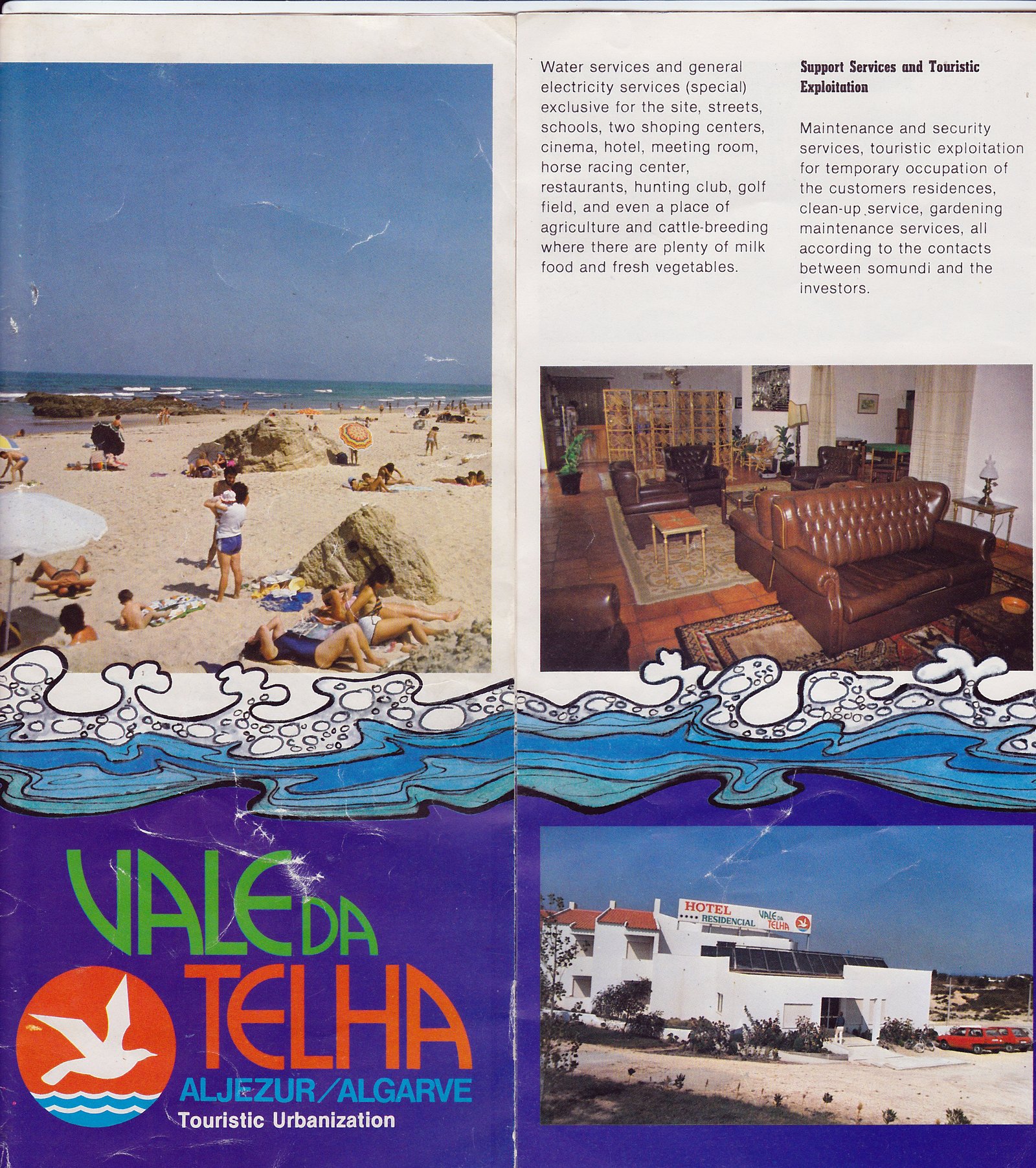
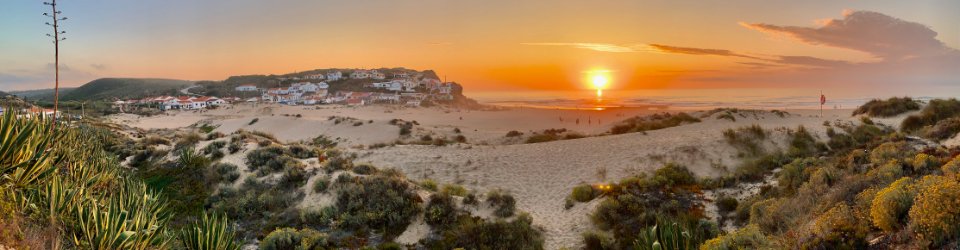
John Morgan, who supplied us with so much information and photographic records for our article “The History of Vale da Telha” has allowed us to reproduce another of his prized possessions, an original sales brochure from the launch of the Vale da Telha project, published probably around 1980.

It is an eight-sided “concertina’ pamphlet and gives us an intriguing look at the original concept and sales pitch by the initial developers, Somundi, whose grand scheme ended in the company’s bankruptcy.

Many of their grandiose ideas simply failed to materialise—like the golf course and the cinema.

We have left the original text unedited so you can see that the brochure did lack a degree of professionalism in this English version aimed at the UK and Irish markets.

Page 1 & 2

Page One:

Photograph of what we assume is Monte Clerigo beach. Under which are the words:

Vale da Telha, Aljezur/Algarve.
Touristic Urbanization.

Page Two:

A photograph of the hotel and the hotel bar (?)

Text:

Support Services and Touristic Exploitation

Water services and general electricity services (special!) exclusive for the site, streets, schools, two shopping centres, cinema, hotel, meeting room, horse racing centre, restaurants, hunting club, golf field and even a place of agriculture and cattle-breeding where there are plenty of milk, food and fresh vegetables.

Maintenance and security services, touristic exploitation for temporary occupation of the customer’s residences, clean-up service, gardening maintenance services, all according to the contacts between Somundi and the investors.

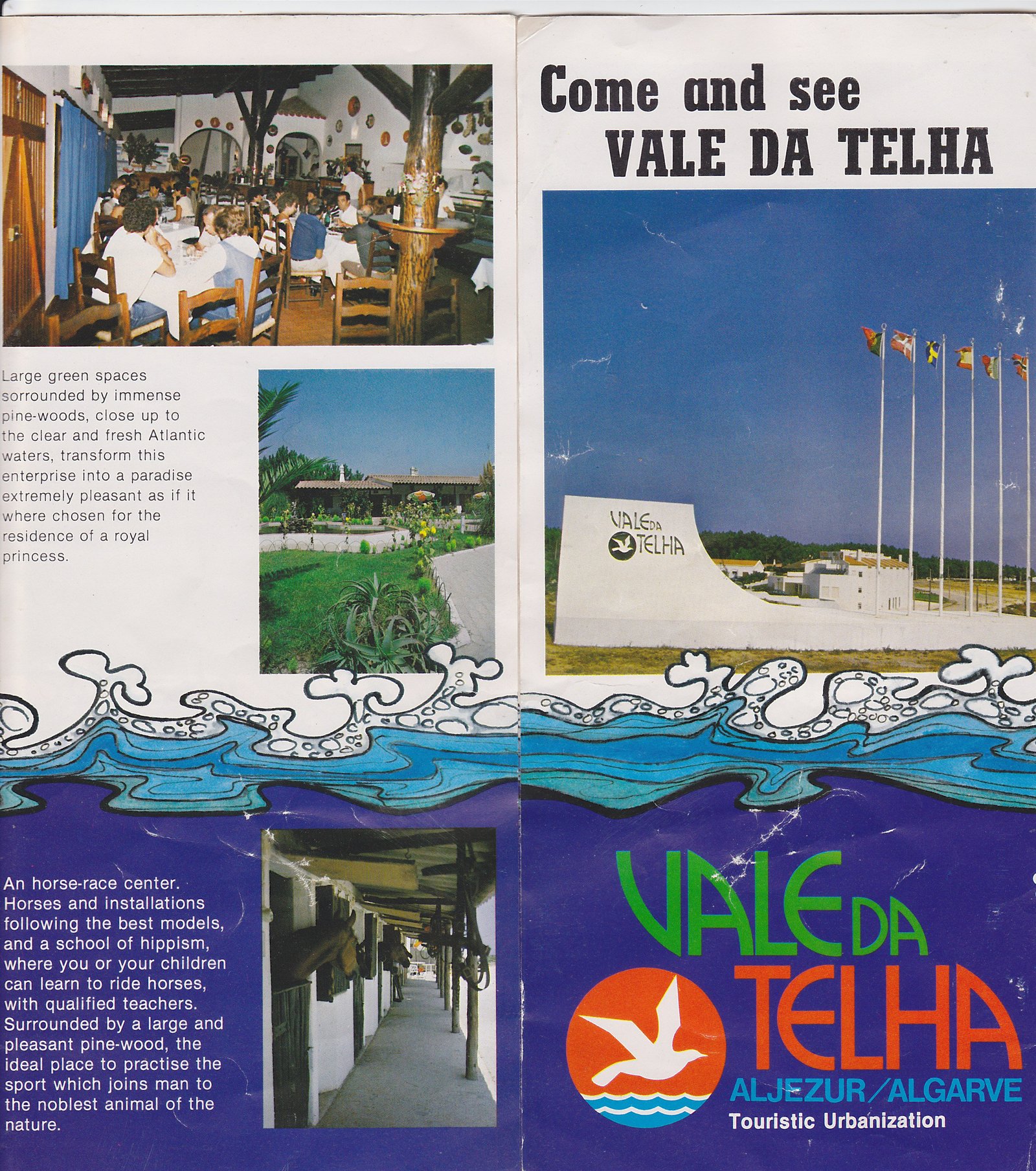
Page 3 & 4

Page Three:

Interior photograph of a restaurant ( now Restaurant Vale da Telha), another of the outside of the Restaurant Vale da Telha, and a third of the stables, with horses poking their heads out of every door.

Text:

Large green spaces surrounded by immense pinewoods, close to the clear and fresh Atlantic waters, transform this enterprise into a paradise extremely pleasant as if it where (sic) chosen for the residence of a royal princess.

An (sic) horse-race centre. Horses and installations following the best models and a school of hippism where you or your children can learn to ride horses with qualified teachers. Surrounded by a large and pleasant pinewood the ideal place to practise the sport which joins man to the noblest animal of the nature.

Page Four:

Photograph of the wall—with seagull inset and flagpoles—which greets arrivals at the entrance to VdT

Text:

Come and see Vale da Telha.
Vale da Telha
Aljezur/Algarve
Touristic Urbanisation


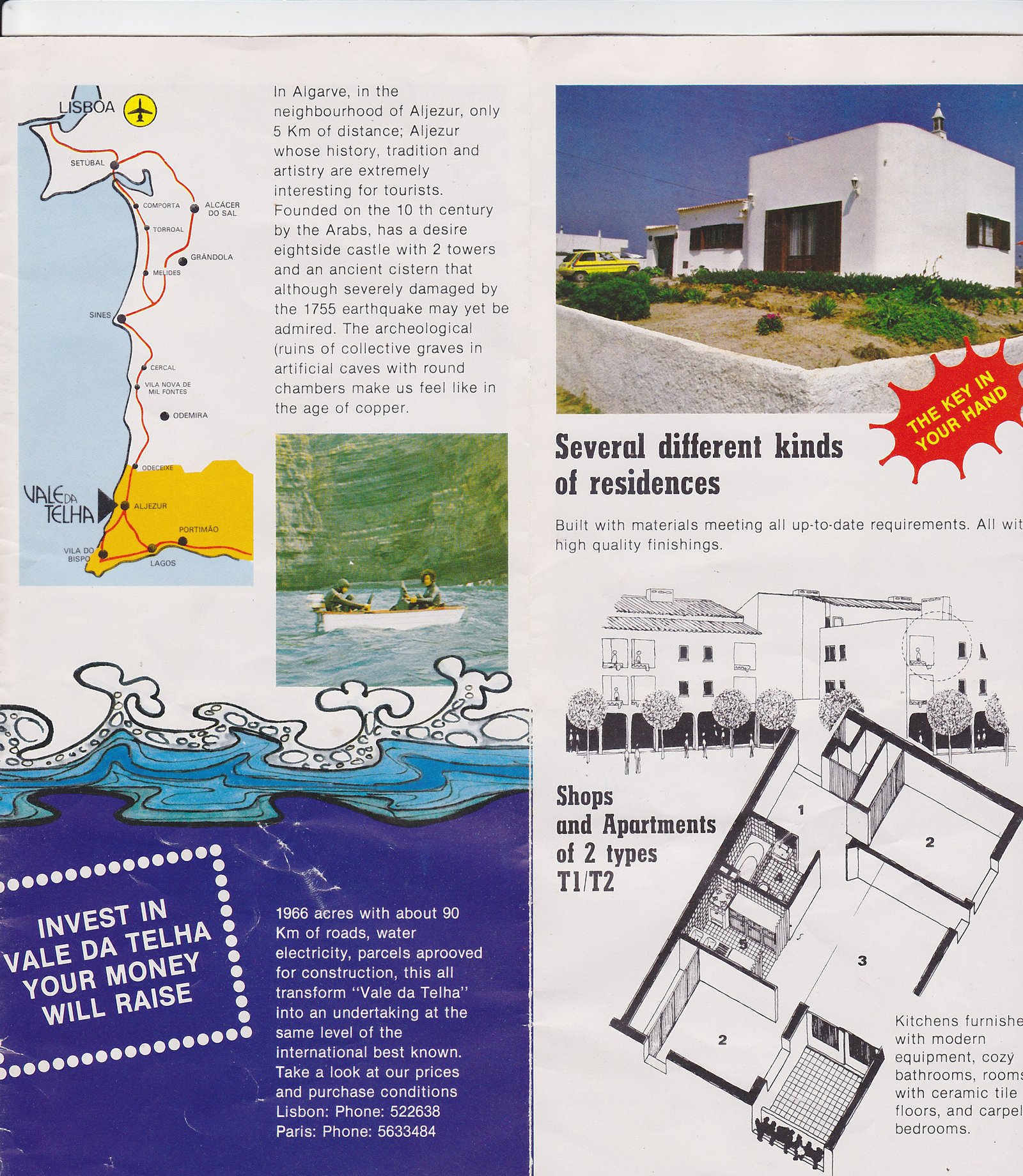
Page 5 & 6

Page Five:

Map of Portuguese coast south off Lisbon, showing the locality of Vale da Telha, plus a photograph of fishermen in a small dinghy

Text:

Invest in Vale da Telha.
Your money will raise.
In Algarve, in the neighbourhood of Aljezur, only 5km of distance.

Aljezur whose history, tradition and artistry are extremely interesting for tourists.

Founded in the 10th century by the Arabs, has a desire eight side castle with two towers and an ancient cistern that although severely damaged by the 1755 earthquake may yet be admired.

The archaeological ruins of collective graves in artificial caves with round chambers make us feel like in the age of copper.

1966 acres with about 90km of roads, water, electricity, parcels approved for construction this all transform Vale da Telha into an undertaking at the same level of the international best known.

Take a look at our prices and purchase conditions.
Lisbon: Phone 522639
Paris: Phone 5633484

Page Six :

Picture of a villa, drawing of the commercial centre and the plan of a house.

Text:

Several different kinds of residences.
The key in your hand.
Built with materials meeting all up to date requirements. All with high-quality finishings.
Kitchens furnished with modern equipment, cozy bathrooms, rooms with ceramic tile floors and carpeted bedrooms.

Page 7 & 8

Page Seven:

Photographs of a hunter shooting, the tennis courts and the beach.

Text: These are some of the characteristics in which Vale da Telha in an exciting vigorous rithm (sic). In Algarve a world full of interest for national and international tourism.

Meet Us At Vale da Telha

Please come to Vale da Telha to appreciate the beauty and splendour of this place. Let us show you how life is better in Vale da Telha also the quality and complete support offered to residents and tourists.

Page Eight:

Picture of the round building at the hotel, on the Pines Roundabout, which was the Somundi sales office, along with details of Somundi, giving its addresses with the HQ in Lisbon, and branches in Vale da Telha, Coimbra, Leiria, Lagos, Palhaça, Aljezur and França.

Amovate and the Community Oct 2011

AMOVATE is forging ahead with its plans to work more closely with the Câmara and the Junta in order to improve the facilities and the visual appearance of Vale da Telha.

The cleaning work around the VDT Lake has already started, the machines are working there cleaning the road….

We already have an undertaking following our submissions, that the local authorities will clear the path around the lake and bridge the gap at the end of the “dam” that at the current time makes it impossible to complete a full circuit of this lovely feature of Vale da Telha.

And it is looking increasingly more promising that for the first time we will have a permanent road sweeper / cleaner based up here to keep the main thoroughfares tidy.

Since the AGM on October 6th the Committee has drafted a series of proposals to improve various aspects of life up here and has already held some meetings with Câmara and Junta leaders. We also believe the residents can do more to improve the situation.

Our three new Committee members Vice President Gabriel Reis—the Aljezur GNR commander—and prominent local businessmen Armindo Santos Almeida and Alvaro Figueiredo, have been particularly active in driving these ideas forward.

They will also represent Amovate and the area in regular meetings and briefings with the President of the Câmara and his officials—on a monthly basis, we hope.

It is quite clear that in the past year or so Amovate’s activities are striking a deeper chord with the local community.

In the two or three weeks following the AGM, 31 new members have joined the organisation—one French, two English and, most significantly, the rest being Portuguese.

When the new Committee took over a couple of years ago our first declared intention was to rid Amovate of its unfair reputation of being just “the English Club.” Nobody can fairly level that charge at the Association now although we accept that unfortunately there still remains a small hard core of people with an anti-Amovate bias.

And nor can anybody accuse Amovate of not working for the local community, which is why we urge more of you to join the Association. The more members we have the more the authorities will listen to us and act on the wishes of those we represent.

There isn’t just safety in numbers—there is a degree of power and if you’d like to be part of it, check out the membership application details on the website.

A bigger membership will help us get action on the points we have listed below and which we are now discussing with the local authorities in an attempt to see some action.

We believe that in the past Vale da Telha has been the “child” the Aljezur family did not want, yet we know that many millions of Euros have flowed down the hill linking the communities up here to Aljezur, and into the coffers of the Câmara.

We certainly don’t think enough has been flowing the other way, and even though the Câmara, like everyone else, is now struggling in these difficult economic times, we still feel a lot more can be done to correct that imbalance which has been so unfair to VdT in the past.

To that effect your new committee has drawn up a list of priorities we feel must be tackled over the coming months. Those priorities—about which we are already in discussions with the Câmara–are listed below, with updates. If you have any further ideas we can bring to their attention (remembering their financial restraints) please e-mail those ideas to us at: info@amovate.com

• Identification and location of builders’ rubbish

As everybody knows only too well builders rubbish and materials, including items of rusting machinery, are spread indiscriminately around the urbanisation and give some parts an air of abandonment and neglect. The aim is to address the builders responsible in order to raise awareness of cleanliness and order. We will point out that these people make a living out of selling houses in the area, yet they are perhaps more guilty than anyone of contributing to its ’uglification’ (for want of a better word) of certain parts, which can deter people from buying here in what is otherwise such a naturally beautiful part of Portugal.

• Identification of road surface damage

There are several stretches of road that need urgent intervention due to the advanced state of degradation and consequent road hazards, such as repair of potholes on the roads, protruding drain covers, landslips and consequent damage to the pavement, etc…

Following this point:

• Cleaning and maintenance of kerbsides, etc

There needs to be a greater degree of cleaning and maintenance of kerbsides, rainwater run-off gullies, ditches and water courses which needs to be carried out before the rainy season. It is important to make homeowners aware of the need to keep the pavements outside their properties clean and clear, with no obstacles (e.g. large rocks to deter parking, cacti, eucalyptus…) so we can safely walk along the roads. The front wall of your property may be your boundary but you do surely accept that you have a moral obligation to keep the strip of land across the front of your property clear and in decent condition for the benefit not only of yourself but of the entire community.

• Roundabouts and Triangles in the Urbanization:

– We are trying in conjunction with the local council and local businesses to organise and beautify green spaces, presenting proposals for redevelopment of these areas that are completely abandoned and that give a picture of neglect.

– We have set out to involve the School of Aljezur, by undertaking a joint project with the students of its gardening and sculpture classes, asking them to submit projects for rehabilitation / renovation / refurbishment of the Pines roundabout to the entrance of Vale da Telha.

As you will have seen, workers have already been clearing the roundabout of accumulated rubbish and pine needles.

Amovate Vice-President Gabriel Reis has already met the head of the school to explain the idea, which was received enthusiastically. The head has promised full co-operation and will be instructing his pupils accordingly.

Projects designed by various teams of the schoolchildren would be considered and voted on by the Câmara and AMOVATE with the winners—and all the other teams from the school which entered—carrying out the renovations as part of their training.

It is necessary to point out that some of the pine trees may have to go as they are considered to be increasingly unsafe and liable to topple over.

Green Waste Collection

– We are seeking an urgent meeting with ALGAR, the body responsible for all rubbish collection across the Algarve, so that we can discuss and discover workable solutions for green waste collection in Vale da Telha.  It is a large problem causing unsightly areas that needs urgent resolution. Given the scale of urbanisation and its nature (within the Natural Park, where the lots are approximately 1000m2 on average, of which 500m2 must be green areas) and the fact that we want to keep a healthy balance in harmony with the environment, a solution must be found with the relevant authorities.

• Schedule a meeting with the Chairman of the Junta de Freguesia to discuss various issues coming under their remit.

– Gabriel, our vice-President and committee members Armindo and Alvaro have in fact already had that meeting. Here is what they discussed, and updates:

– Improving the areas of ​​the rubbish bins (i.e screening them). The President of the Junta said he will explore the feasibility of hiding all the rubbish bins behind wooden screens.

– Possible signs (in wood) identifying areas of urbanisation (Residential Areas).

– Road signs identifying the residential area at certain strategic points

– Replacement of the Vale da Telha maps in some areas. The President said we should submit proposals to him about the first two measures regarding signs, showing how we would like them to appear, and he will contact the company that supplied the large painted maps at various vantage points to see if they can be repaired or replaced.

– Discussions about the possibility of placing some speed bumps in strategic areas in order to slow the speed. The Junta President said for various reasons this would be impractical but we will go back to him with the ideas for strategic road signs, such as “Slow Down–Children Playing”, “Slow—Residential Area.”

– Placement of a litter bin next to the ATM at Vales. He said he will have a look at that, but sees no reason why that cannot be done.

– Maintenance of mailboxes at Pines roundabout. These mailboxes are not under the authority of Amovate but are the responsibility of the Junta, and the President took notes about the damage, and says he will address the problem.

• Urgent meeting with Câmara President regarding street cleaning

– The Portuguese committee members wondered whether it would be possible to take one or two out-of-work individual registered with the Unemployment Centre in Aljezur to work full time across Vale da Telha on street cleaning duties, clearing the road edges, pruning problem trees, etc. We are told that current employment law allows for there to be a protocol between the Câmara and Amovate, relating to the payment of wages. The wages would be subsidised by the Government on six-monthly renewable contracts with a 20 per cent contribution to be paid by the Câmara. The worker or workers would be briefed each morning on reporting for work regarding their duties that day.

• Maintain contact with EDP

– Amovate has already had some success with EDP in improving the electricity supply to the area but we want to maintain our communications with them in order to keep identifying problems with electricity supply, replacement of damaged poles with new ones, and solving any problems with damaged cables which are dangerous and must be removed. One resident, for example, has for some time had a live fallen cable lying across the land he cultivates!

• Talks with the Câmara regarding street lighting

– Amovate has learned that as a cost-cutting measure street lights at some point will be lit for shorter hours, coming on later and switching off earlier. We understand this necessity but we will continue to point out to the Camara places that require lighting.

• Schedule a meeting with all the Vale da Telha business owners

– Amovate has been seeking to get all the business in the area to join forces and lobby the authorities in the campaign to have all these measures, and more, implemented. We can now confirm that this meeting will take place next Wednesday October 26th at the Old Schoolhouse starting at 17:00 hours.  All business are welcome to join this meeting to discuss ways to combine efforts and jointly streamline effective intervention measures for Vale da Telha.

• Works around the Lake

Area to be bridged


Before

After

– Amovate have now held discussions with the local authorities in our campaign to have the entire pathway around the lake restored (already in progress) and completed so residents and visitors can enjoy walking the full circuit without interruption, perhaps paving the way for such events as Fun Runs etc.

The two gaps in the road that were created to drain excess water now need to be bridged in some way to link the two banks. The local developers/builders on the Committee have proposed to use perhaps a dozen square concrete drainage pipes of 1 meter by 1.5 meters for that purpose, which will then be covered with earth to bridge the gap and complete the circuit.  They have met with the Junta and construction machinery will be provided, along with equipment to clear and smooth the entire path around the lake. Once completed these works will create a recreational space in harmony with nature, for walking and perhaps even a cycling route.

• Keeping in regular contact with the Câmara regarding the Government’s plans for Vale da Telha

– Amovate will continue to exert some pressure on the local authorities to keep us informed and up to date about the restructuring plans for Vale da Telha of the Ministry of the Environment and the National Parks Authority, the latest proposals for which have been rejected in Lisbon.

• Creating a “Welcome” sign at the entrance of Vale da Telha

– We are asking the authorities to place an attractive “Welcome To Vale da Telha” sign at the beginning of the urbanisation and also to improve the approach road and sidewalks just before the Pines Roundabout, which have been disturbed by the palm trees flanking the road.

We are also requesting that the sides of the road from the junction alongside the Old School House and the Vale da Telha hotel be cleared, preferably on both sides allowing greater visibility of the road and allowing the safe movement of pedestrians who currently have to walk ON the road itself, stepping off it to avoid oncoming traffic.