Category Archives: News

Amovate is Looking for new Committee Members

Do you care for your community here on Vale da Telha?

Do you feel you can help to make a difference?

Do you think you can help create a more vibrant social life here on what has been called The Plateau of Perfect Peace?

Then why not become a more active and, indeed, a more pro-active member of Amovate!

In fact, if you’d really like to roll up your sleeves and get stuck in why not think about joining (or re-joining) the Amovate Committee.

It’s not a huge commitment and will not take up too much of your time, but you can play your part in improving the way of life right across the area.

We are looking for inspired and imaginative people of all nationalities to replace the valued Committee members who plan to step down at the upcoming AGM and take a well-deserved break after serving the Association and its members for up to five years.

If you think you fit the job description and are keen to help out then just have a chat with any of the committee members whose names you find in the “Committee” link on the top bar, or e-mail us with your details at:

info@amovate.com

We are also asking for members to step forward and help the committee to form a number of volunteer groups to help organise and look after our programme of events, to organise the library and help with office cover—all working with committee members.

It will only mean being involved a few hours a month (or, if you’re really keen, as much time as you want to give!) and can be pretty rewarding.

So, if you’re up for it, if you have enthusiasm and imagination to come up with ideas for events, projects, distribution of charity money etc, then put up your hand and let us know…

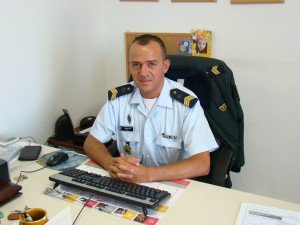
May 2012 Interview with Sargento Gabriel

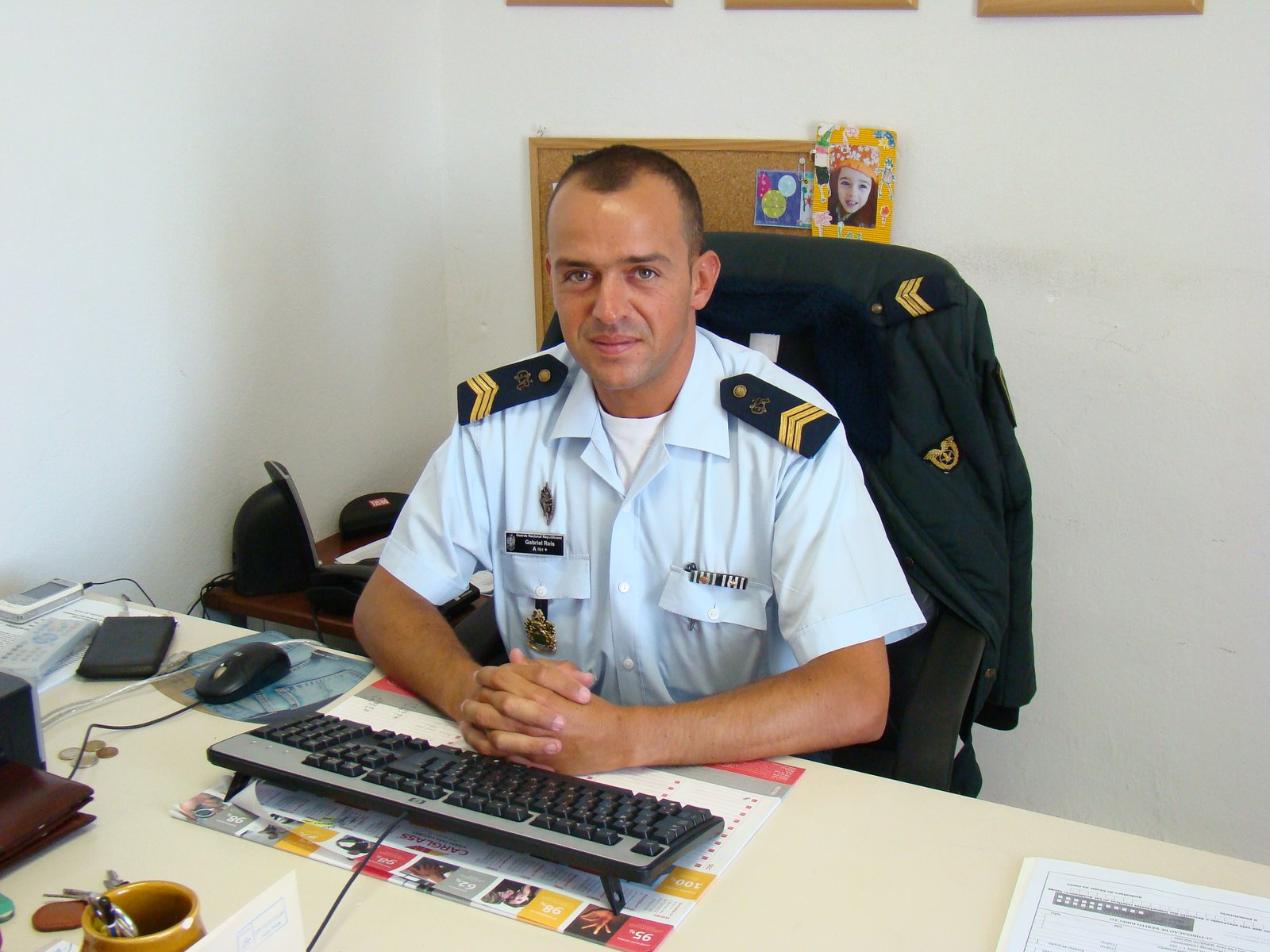
Sargento Gabriel Reis

**SEE BELOW FOR ADDITIONAL INFORMATION FROM SARGENTO GABRIEL

It could be called “an open and shut case.”

We’re talking about the latest bizarre crime to hit the area.

First of all let us assure anyone not au fait with life in the Vale da Telha area that official crime figures here have been falling year-on-year.

And that was coming down from a very low level to begin with, as this is probably one of the safest areas to live, not just in the Algarve but in the whole of Portugal.

But no area is entirely without some problems and our local GNR do have the occasional incident to deal with.

In the last couple of days they had one incident reported on Vale da Telha which fell outside the normal parameter of thefts, although a similar incident occured a week or two earlier in Odeceixe at the extreme northern edge of their territory.

One of our residents woke on on Wednesday morning to find four of his SHUTTERS had been stolen from his windows during the night!

It seems that if you leave them open they can quite easily be lifted from their hinges, and carted away by opportunist thieves who sell them to make a little money.

Needless to say it’s not just worrying to realise that someone has been prowling around your property at night, but two sets of shutters are also expensive to replace.

Aljezur police commander Sargento Gabriel Reis, a Vale da Telha resident and a member of Amovate’s committee, has been talking to us about crime prevention, etc., in his quarterly briefing with the website.

The advice is to make sure all your shutters are closed at night—once closed they cannot be lifted off their hinges. But remember, again, that whilst thefts like this are disturbing for the people affected, they are extremely isolated incidents.

As we said at the outset this is a hugely safe and secure area in which to live. And as we want to keep it that way Gabriel has again been offering some advice to residents about how to achieve that.

He was full of praise, for instance for Amovate General Assembly President John Bergstrom-Potter, who flagged—via his and Sarah Sibbert’s Vale da Telha website—an attempted break-in in Sector E. Bergy was online within a few minutes of the incident occuring, requesting residents to be on the look-out for would-be thieves in the area.

As Bergy also pointed out: Phone the GNR if you suspect anyone of just hanging around or if they trespass on an empty property. Make sure you lock your doors even if you are just popping up to the rubbish bins.

And earlier this year Trevor Herrington in Sector G worked closely with the GNR identifying a property in his road which he felt was the target of criminals, notifying and then working with the GNR to expose an audacious theft of the fixtures and fittings of an empty house where the owners were living in the UK.

The burglar had even drilled out and changed the front door lock!

Eventually, thanks to Trevor’s vigilance, the GNR had a suspect and may even be able to trace some of the stolen property as he was able to identify one of the cars seen at the house.

As Trevor told us: “Essentially residents need to be vigilant of empty properties and report suspicious activity to the GNR.

“It also raises other issues about leaving contact details with someone, especially the GNR.”

That is the kind of thing the GNR encourage—residents working together to keep watch on their own and their neighbours’ properties and alerting the community to any suspicious activity.

If it does happen that would-be thieves come into the area it could be a powerful deterrent that they come to realise they are being watched and their movements monitored and reported.

It would certainly be a help if every one of us had the GNR telephone number readily available by the phone, or—better still—programmed into the phone wherever possible.

They can be found at:

GUARDA NATIONAL REPUBLICANA DE ALJEZUR

Rua da Escola

Igreja Nova

8670-063 Aljezur

Tel. 282 998130

The GNR say people should inform them when they are leaving their villas unoccupied, either going back to the UK, or any other country of origin for a holiday or a visit, or if they are residents in another country and have a holiday house here in the Aljezur area, particularly Vale da Telha and the surrounding areas.

They can call into the GNR office to tell the officers the dates the villa is unoccupied, or e-mail the information to them. Gabriel’s e-mail address at the GNR station is:

reis.jgas@gnr.pt

“We do take this seriously,” he said. “Even if your villa has an alarm or security system the added back-up of a highly visible police patrol checking the property on a regular basis doubles the deterrent.

“It’s not something we take lightly–not only do my officers make these visits, and have to record them on a check-list document, I make my own checks on the property and then ask questions of my officers regarding details they could only know if they had been there themselves.

“This way, I know the property HAS been visited, not just driven past.”

Gabriel also recommends the “Safe Communities” project supported by this website. It was set up by former Interpol, UN and Hong Kong police officer  David Thomas, who now lives near Boliqueime, and has become involved in community work in the Algarve regarding crime prevention.

He has been helping the GNR and the civil authorities here in respect of crime prevention and at the end of last year he launched Safe Communities Algarve a website dedicated to crime prevention, and the only one of its type in Portugal.

David says the working relationship between the Aljezur GNR and Amovate is a model to follow, and has asked us to also work with his project.

His website address is:

www.safecommunitiesalgarve.com

*           *           *           *

Obviously, with summer on the horizon and the warmer weather with us, we should all be careful to make sure windows and doors that are out of sight when we are using our pools or just sunbathing, are closed and secured against opportunistic thieves.

And all garden tools, etc, should be locked away when they are not being used.

Sargento Gabriel says that one of the GNR’s biggest headaches is the issue of people leaving valuables in their cars in full view of anyone passing, especially on and around Aljezur’s beautiful beaches.

He says you might as well put a sign in your car window saying: “Break in and steal me.”

He repeated the advice he has issued before:

“Really, it goes without saying that you should not leave any valuables at all in the car, not just to put them out of sight.

“Opportunist thieves tend not to break into cars where they cannot see anything of value. But there are exceptions to the rule and once a thief has broken or forced a window and got into the car they can then open the boot and take any valuables left there.

“So take only what you need on the beach, and don’t leave any of that in your vehicle.

“And of course, while you are relaxing on the beach make sure that when you go away from your ‘base camp’, to swim or maybe to go and buy a drink or ice cream, at least one person always stays behind to guard your belongings.”

Gabriel also advises you not to leave personal effects like your driver’s licence and passport in your glove compartments.

“When you go out in your car within the Aljezur region you can carry a copy of your licence and your passport, which will service as identification should my officers stop you,” he said. “That will be sufficient in this area, although other areas may want to see the original documents.

“It would also help, but is not absolutely neccessary, that this copy has been signed by a solicitor or notary to help verify the details.”

So, whether you have taken a drive out to one of those beaches, either for a swim or to use of the beach bars, or your visitors and guests are planning a day on the beach, remember Gabriel’s advice:

  • If possible leave all your valuables at home.
  • Whatever you felt you needed to take to the beach, either lock it in the boot of your car out of sight, or take it with you when you exit your vehicle.

*           *           *           *

One growing problem causing the GNR some concern is the number of cars speeding on the main roads through Vales and Vale da Telha, especially the wide thoroughfare from the Pines roundabout down past the tennis courts heading for Monte Clerigo.

Gabriel says this developing into a serious problem and his officers are now on the lookout for offenders. He warns he could even be forced to borrow a speed radar camera from Lagos if the problem doesn’t cease.

Amovate has talked to the Camara about installing speed bumps much like the permanent fixtures located in Marmelete on the road towards Monchique. But, again, budget issues have raised their ugly head.

Amovate does feel that the considerable sums of money flowing down the hill into the Camara’s coffers from the Vale da Telha area never manage to flow back UP the hill to be spent on improvements in this area.

And that is something we plan to tackle head on with the Camara in the coming months as we feel VdT is wilfully neglected by the Camara President and his officials, despite their high-sounding promises when we meet with them.

Incidentally, while we are on the subject of the road from the Pines roundabout towards Monte Clerigo, residents should realise that you cannot legally park on the far side of the road opposite Roque’s supermarket.

One problem is that the Camara has positioned the sign warning of this too far away and people don’t always realise it is an offence.

And the GNR are concerned about some rather careless parking outside Roque’s even where it is OK to park. To use an expression from back home they want you to “park prettily” and don’t leave your car a few feet from the kerbside, or at an angle, or even double-parked as sometimes happens.

Gabriel also says that they have recorded incidents in the late evenings of cars having to swerve at the last moment to avoid people out walking, or cycling in dark clothing.

Obviously cyclists should ensure they have front and rear lights on their bikes. But both cyclists and walkers can minimise the danger to themselves by wearing brightly coloured clothing or even the fluorescent jackets of the type required by drivers at the site of a vehicle breakdown, and which are cheap enough to buy.

*           *           *           *

One last issue again raised by residents is an old subject but one that keeps coming back – DOGS.

But as Gabriel observed drily when we broached the subject with him: “Dogs are not the problem—owners are!”

He says it is something they are constantly attempting to address, and revealed that Sector E has the biggest problem, with dogs getting loose, chasing cars, foulling the streets, attacking other dogs walking with their owners.

Unfortunately, we understand that the Camara has dispensed with the veterinarian as part of their cost-cutting measures which has effectively tied the hands of the GNR when it comes to dealing with this nuisance.

As an organisation Amovate really feels the Camara should be more pro-active in controlling the problem.

The police go to the villas, talk to the owners and they are even fined –twice in the case of one owner we are aware of.

Gabriel says they will continue to do this. But Amovate’s own advice is for groups of neighbours suffering in this regard to approach the errant owners reasonably and responsibly, ask for a friendly discussion and point out just how upsetting the situation is, asking for the owner’s co-operation in resolving the issue.

If that doesn’t work, they should, as a group, make the owner aware that their next step will be to involve the police. Hopefully, this will be enough of a deterrent to make him control his dogs.

If it doesn’t…then INVOLVE the police!!

Have a safe and enjoyable summer,

THE AMOVATE COMMITTEE.

**Sergeant Gabriel has been back in touch with us to warn us of a potential new threat to home security.

And the bottom line is to check the ID of everyone coming to your home expecting access for one of the utility companies, or a “cold-calling” visitor trying to sell something.

An Arrifana resident, discovering his computer phone connection wasn’t working, rang PT to report the fault.

Two hours later a man came to the door, said he was from PT, stepped into the house, checked the box on the wall, put everything back, gave the resident a number to call, and left.

The connection still wasn’t working, so he rang the number he’d been given, and there was no answer.

He then rang the original PT number and was told no-one had yet been sent out.

It’s difficult to pinpoint what happened—whether the caller had interfered with the line outside the house to disconnect it, before returning later, saying he’d come to repair it, or perhaps he knew with the power failures some houses could have a problem.

Either way, by gaining access this individual could have been “casing the joint” as they say, checking the layout and whether there was anything worth stealing.

Gabriel says it is important that householders allow no-pone into their homes before carefully checking they are who they say they are. It might even mean asking that caller to wait outside while the householder rings PT or EDP to check they have sent someone.

The simple message is—be alert and be careful!
Walkers in Paradise

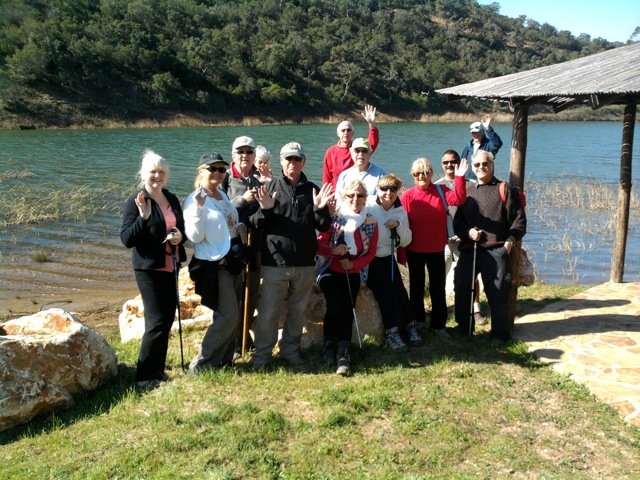
The Happy Band of Walkers Enjoying the Sun in Aljezur : This is the Life


Why not join in the fun every TUESDAY & FRIDAY – See Notice Board at the Amovate for details, or the AMOVATE  Website  

Susan & Brian’s Arabian Nights – Part 1


By Matt D’Arcy


Part 1

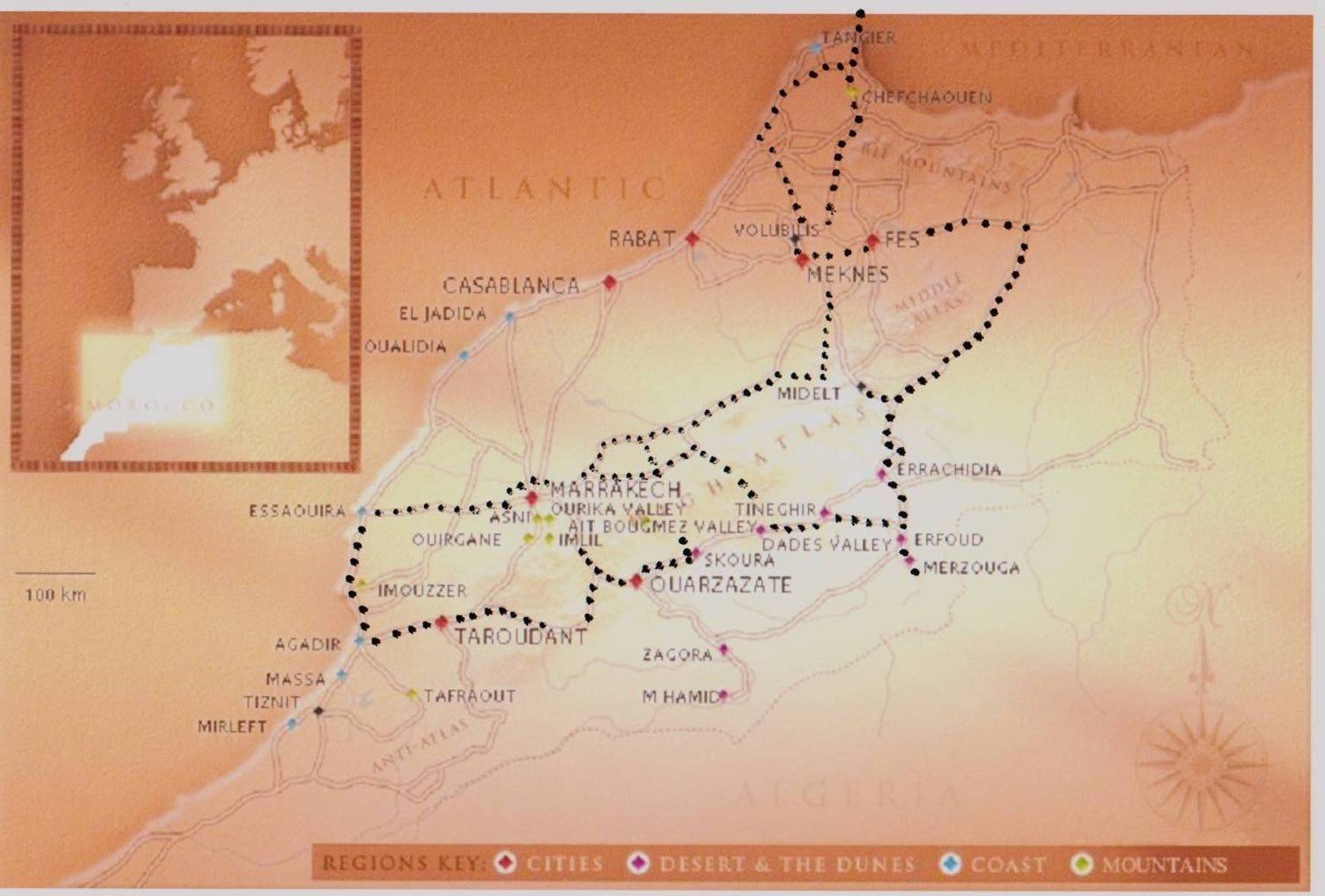
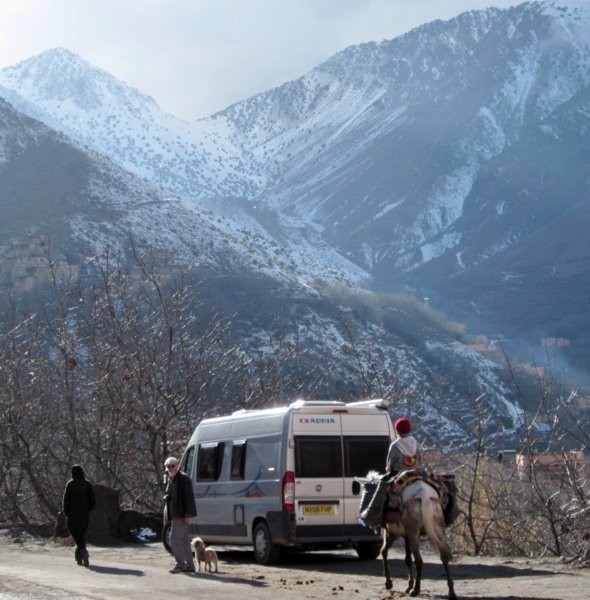
SUSAN AND BRIAN JUTSUM recently spent almost two months experiencing the Arabian culture and lifestyle of Morocco, becoming immersed not just in the tourist-friendly big city centres but also living, eating and sleeping amongst the tribal peoples of the High Atlas, the deserts and the Deep Gorges.

Susan & Brian's Route

The Amovate members, who live on Vale da Telha, made the crossing from Spain to Ceuta in Morocco on December 27th and returned home mid-February after the ambitious adventure in their motor home, accompanied everywhere by their dog Sofie.

Susan kept a daily diary of their travels and also took thousands of photographs, enabling us to post this story of their Arabian Adventures here on the Amovate website.

The changes in culture across this short distance over the Straits of Gibraltar made a huge impact on the Jutsums—but in a more positive way than they had imagined.

“We had a truly memorable time, made even better by the people we met, the truly magnificent scenery and the diversity of Morocco; sand, snow, heat and cold,” they said. “It was probably more of an experience than a holiday.”

The overriding memories of the encounter with such a different culture, beliefs and values which they took away are: “Children, donkeys, markets, camels, mud houses, carpets, scenery, to name but a few.”

They added: “It was colder than we had expected and contrary to what we had been led to believe, very much safer.  Not once did we feel unsafe or threatened, and we could never say that about the UK or Spain!

“Food for thought, perhaps; no alcohol helps?”

On arrival they camped in Maril, on the seaside near Tetouan, south of the ferry port of Ceuta where their first impressions were:

“It was all so clean, street cleaners everywhere and no litter. You could eat your dinner from the pavements. Every man seems to smoke but no tab ends anywhere. It feels a lot safer than last night in Spain near the Port.”

But those impressions of cleanliness were to change as they moved away from the tourist areas, Susan explaining:

“The rubbish and litter problems everywhere else were overwhelming and I think by the time we were on the way back home we had become anaesthetised to the litter; Portugal is so clean and immaculate by comparison.

“The litter problem in Morocco is horrendous especially with plastic bags they are strewn across fields everywhere you go. Largely Morocco has no infrastructure and no education so big problems are being stored for the future.

“Would we recommend Morocco for a holiday? NO!  The only way to see the real Morocco is as an independent traveller, under your own steam, not as a tourist. Not many people we know would cope with the sanitary arrangements and the rubbish.”

But Susan and Brian emphasise that this, albeit literally, was the only blot on the landscape of a country where the people were warm-hearted, friendly and hospitable, where the scenery was spectacular and spellbinding and where a mere seven weeks has left the legacy of a lifetime of happy and vivid memories.

+++

Here, Sofie the dog insists she has something to contribute to this recollection.

“I loved all the amazing smells—after all we dogs don’t recognise bad smells, we just appreciate the thousands and thousands of scents we can explore.

“But Morocco was a canine culture shock for me, too. I was terribly confused because we dogs like to scent other dogs when we need to wee-wee or have a little poo but no-one there keeps dogs, so I had no scents to sniff out. I just had to leave my own.

“Muslims apparently don’t keep dogs (what strange people!) and not only did some of the Arab people avoid me, some of the children screamed.

“But when we went deeper into the country with the Berber people it was really nice place because the Berbers, and especially the children, all smiled at me and petted me. I became quite an attraction but then what would you expect as I am a very nice dog, even though I do say so myself.

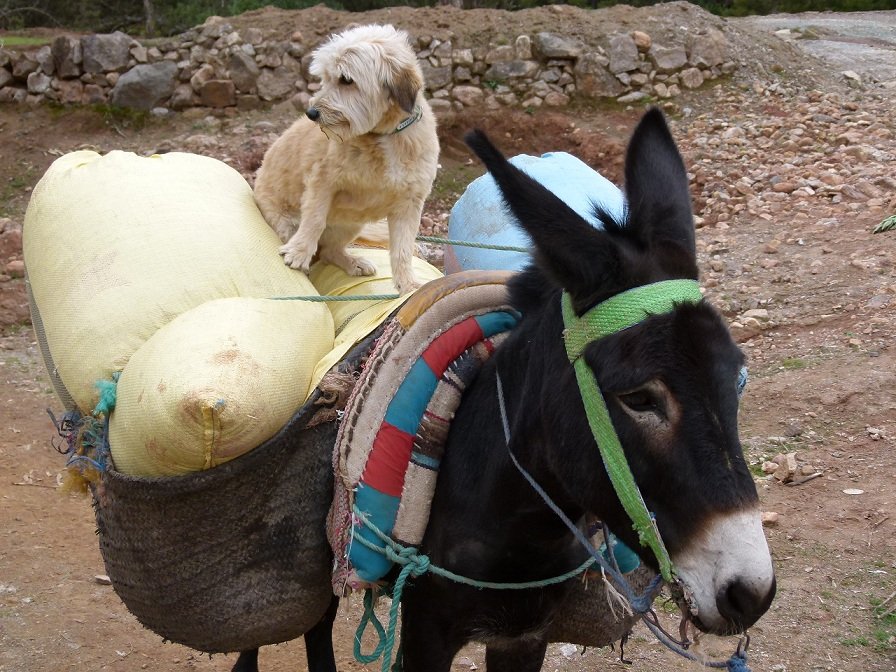
Sofie On A Donkey

“I was quite a celebrity there and my owners, Susan and Brian, just about coped with the hordes of Berber children who are not frightened of me unlike the Arabs.

“So they have to tell them I bite or they would have no peace and no Sofie, because the children all wanted to hold me and lead me away.

“At one point I even had a ride on a donkey which was quite nice as it gave me a rest and a new vantage point to watch this wonderful new world go by.”

+++

The Jutsums first full day in Morocco saw them head off to Chefchaouen, a town tucked away in the Rif Mountains and a place where hashish and cannabis is grown.

In Moulay Idriss, fabulously situated between two hills they bought top quality fillet steak for 7 euros a kilo. In the small intimate Medina they went inside an olive oil pressing shop where the olives are pressed in a similar way to the way Susan and Brian press apples on the land they own in Rogil, but with mats between the olives. The waste skins are then used as fertiliser.

Susan recalled: “The workshop looked quite Dickensian with the Berber watching over proceedings and of course they would allow no photographs to be taken.

“Everyone here owns a donkey, and you would not want to be a woman – they work so very hard, and the men drink mint tea all day. But people look happy.”

From there they moved on to Volubilis, the World Heritage site of the best-preserved Roman town in Morocco, where, for one euro each, they spent a good 3 hours wandering in the sun looking at mosaics and the remnants of houses.

They then saw in the New Year in Fes, where they were in bed for 11pm, with nothing at all happening on their campsite, 7 km from the town.

From there they visited the Medina, which was huge about 1 1/2 k diagonally across.

“We had to have a guide to show us the tanneries where the animals are taken for skinning and the hides made into leather,” said Susan. “We saw all the processes, and the workers still use their feet to press the hides. “Apparently by about 45 years-old they have to pass the job on to another family member as they develop arthritis in the feet and toes.

“The Petite Taxi back was to say the least interesting, like a chase scene from a film, cars everywhere, horns going and the taxi going up the wrong side of the road in 40 minutes of excitement we could do without, and all for 2.4 euros.”

Next port of call was Taza, Susan admitting: “I read a blog on the Internet saying don’t go to Taza so we did—not to the town, but to the National Park, Jbel Tazzeka, which meant 139 fabulous kilometres of driving around 6,000 ft high middle Atlas gorges.

“We stayed one night wild camping, no phone, no Internet just us, no problems whatsoever, except for the cold! It is 24 degrees in the day and -5 at night and not a breath of wind anywhere.

“The cold at night gets into your bones; it really penetrates. We had to sleep in the van with the heating on all night

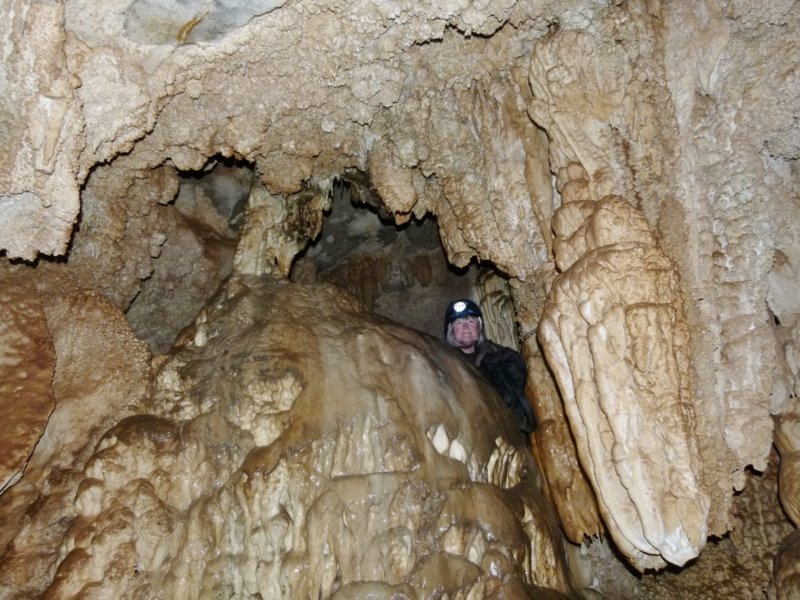
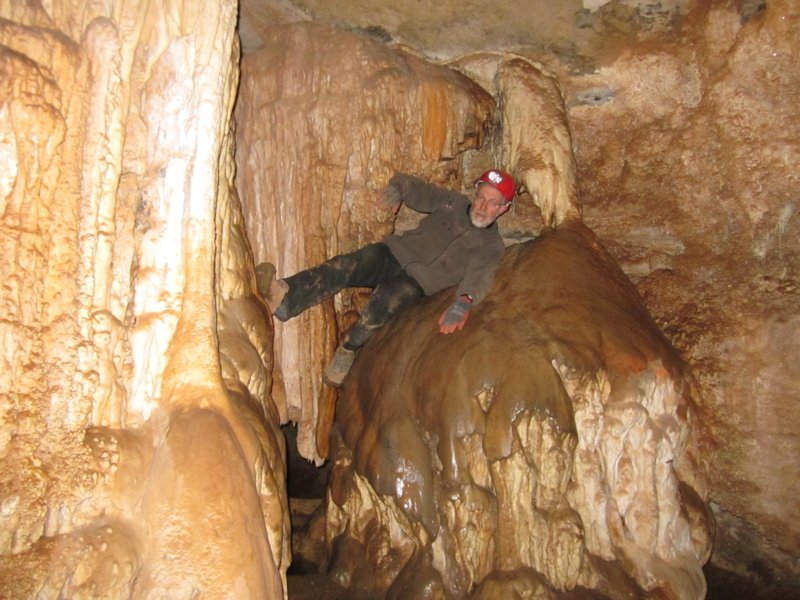
Cave Interior

“We visited a fabulous cave here, not a show cave, really beautiful with a depth of half a mile, and no artificial lighting. If you know Alum Pot in Yorkshire this knocks it into a cocked hat so to speak.

“It was quite gruelling managing almost 600 stone steps carved out of the walls, some 18ins deep and wide and some 3 ins deep. It also meant crawling under deep overhangs, pitches and ladders—lots of clean underwear required after this!

“After one hour when we got to the bottom of the first section (the 580 steps) we had to do a strenuous climb. I pulled a groin muscle and started feeling faint, and as I did not want to stop Brian seeing the only thing he wanted to see they went on without me.

“The descent took us down and down over planks across water and more ladders and pitches. We had our own caving equipment—we wouldn’t have been allowed in without it—but had to have a guide. He was a great kid only 15, and a member of the family who owned the cave.

“I waited in the dark for an hour and managed to get down from my perch and climb up alone until a difficult under climb where I waited again for their return one hour later.

“It was exhilarating and the climb up tough, the spirit is always willing but the bones are a little older than when we did a lot of this in our 30’s in Yorkshire. Emerging back out into the sunshine was lovely.

“Three days later we were both still aching, but it was worth it.”

Susan continued: “Around this national park people don’t even have a donkey as they are too poor.

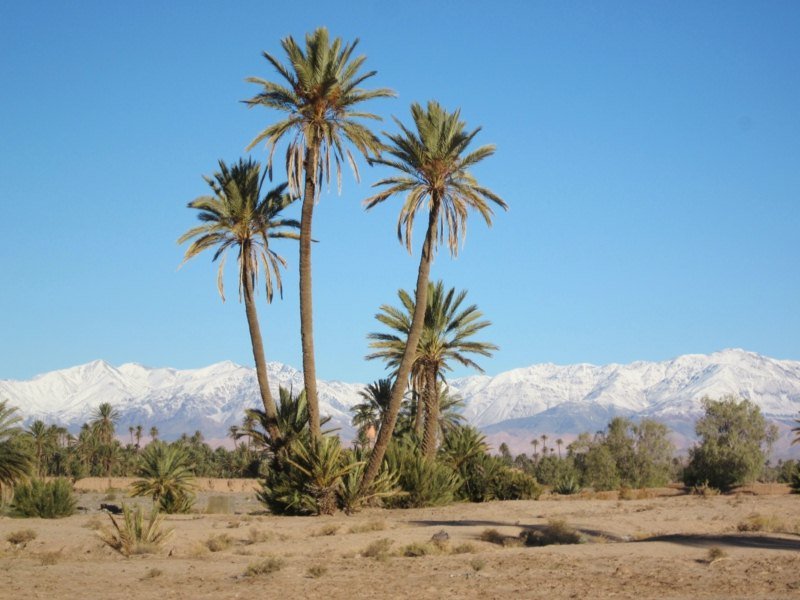
1st Snowfall In Skoura Desert For 30 Years

“From Taza we drove down a desert road passing Guercif and down to Midelt in the foothills of the High Atlas. This was a

High Atlas at Ain Leuh

long road but lovely scenery passing only goat and camel herdsmen. They all give you a wave and a salute, and seeing our first grazing camels was a lovely sight.

“In Midelt the carpet traders here speak English. Our French is coming on nicely as, up until now, there was no English spoken at all, apart from in Fes. People are more used to tourists here.”

The following day Susan and Brian began their journey to the High Atlas and Deep Gorges, starting in the town of Rich.

“This is where our holiday will really start,” she wrote.” We can camp in the desert with the tribespeople, which sounds great.”


READ PART 2 For the next instalment…………………………..


~~~~~~~~~~~~~~~~~~~~~~~~~~~~~~~~~~~~~~~~~~~~~~~~~~~~~~~~~~~~~~


Susan & Brian’s Arabian Nights – Part 2

By Matt D’Arcy


Part 2

Susan’s next e-mail was dated January 12 2012, and she reported:

“Since my last post the last six days, as expected, have been the best of the trip.

“We left Midelt and travelled to Rich and then Gorges da Ziz, not as spectacular as we have seen in other countries.

“We continued on southward to Ar-Rachidia, Erford  and took a small road to Dar Kauoua. But then the road became inaccessible, except for serious 4×4 driving.

“We went down a track to a village and saw a walled property. I asked a Berber man if we could stay for a night he said yes and invited us up onto the terrace where he served us tea olives and bread.

“The next morning we walked for about 30 minutes until we came to where people were digging minerals, fossils etc. This is an important area for fossils; places selling fossils are everywhere.

“We said goodbye to our host and his family and had to go back to Erford to go round to Rissini to pick the road up to the Erg Chebbi, a large sand dune.

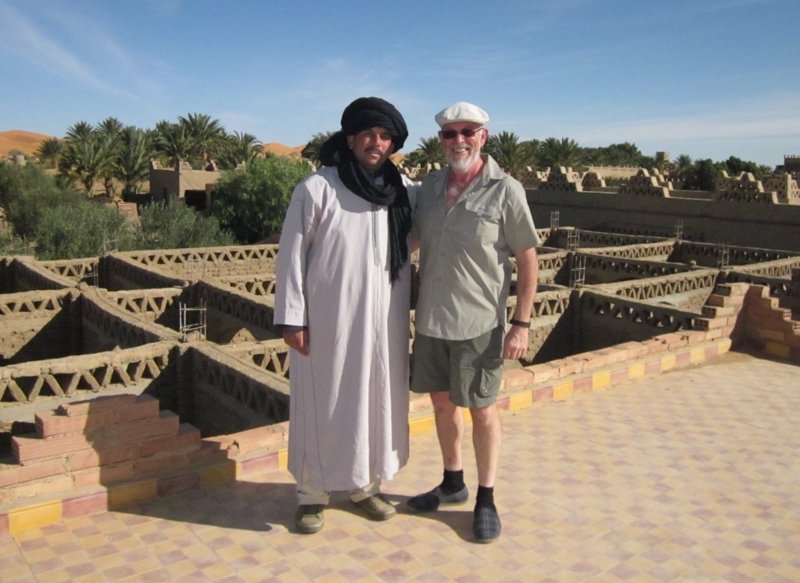
Brian & The Justsums Berber Friend at Merzouga

“We went into the village of Merzouga and parked up deciding what to do. A handsome looking Berber turned up and asked us if we were looking for somewhere to camp.

“We followed him to the village of Adrouine and he took us to an Aubuge (a desert hotel). It was lovely and the staff were fabulous; they had no one staying in the hotel, just 4 campervans—ours, and three from Germany.

“The Aubuge was called Haven in the Desert and it sure was—I could have stayed for ever!

“I never understood why people raved about the desert, thinking that surely it is just sand. But, no, it is much more, peace like you have never known, stars so bright and no wind. We have struck so lucky with the weather and the area and the village were enchanting.”

Susan recalled: “We learned a lot about the desert. When you see palm trees, you assume there is water somewhere. Wells are dug and the water is only 6 metres deep.

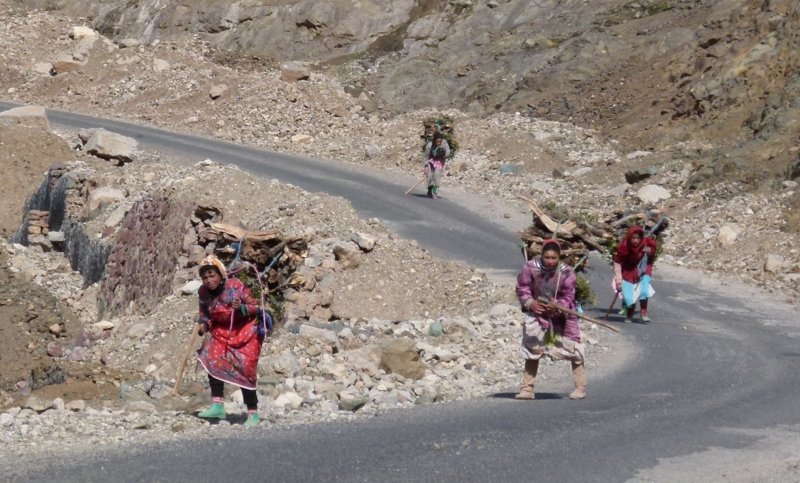
Girls Collecting Wood on High Atlas, Day Before Snows Came

“The Berber women across Northern Africa grow crops under the palm trees, mainly in summer but here they grow them all year round. The women were digging up carrots, white turnips, broad beans and coriander, and of course mint; unbelievable in such a hostile environment of 28 degrees in the day and -2 at night, climbing in summer up to 50 in the day and -14 at night.

“Here apart from bread they eat what they grow. The villagers make lavages and have allotments, each about 6×10 meters and all well watered.

“Walking around the village was great. We were invited into a Berber school for women, all aged about 18 to 40 learning how to write, sew and some in a Spanish class.

“Everyone was so welcoming. We saw a lady sitting on a carpet sorting out grain and she showed us how she had to sort the grain, grind it and make bread every day for a family of 8.

“She also had to go and collect the dead palm leaves to use for fire to cook the bread. How easy do we have it?

“She invited us in for tea and gave us some of her lovely bread. In the houses they have nothing except bench seating covered in carpets and 1 table/ tray for the mint tea.

“One of her little girls aged 8 walked with us back to the village centre where there was one shop. We bought her and her two friends sticky lollies. They were great kids and tried to teach us some Berber language.

“We stayed here three days and could have stayed much longer. I would love to come back here. We had all the facilities of the Auberge, even a swimming pool, for just 4 euros a night, and the best showers and toilets so far.

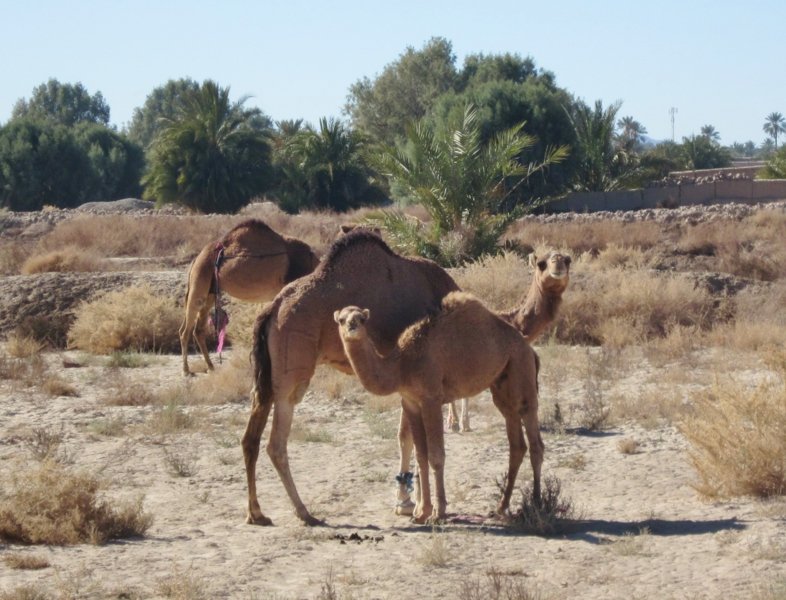
Desert Dromedaries near Merzouga

“Before we set off for this trip I wanted to see camels, and I have now seen so many. But of course they are not camels they are dromedaries, only having one hump.

“It’s best when you see them grazing with their babies feeding, not harnessed or in attire for trips with rich tourists. That’s not us—no rides thank you!”

The following morning Susan and Brian retraced their steps to Ar-Rachidia, stopping at the weekly souk (market) in Rissini.

“This was by far the best to date,” said Susan. “It was a very old locality with narrow alleys and so many stalls, not a tourist in sight, all aimed at the local people.

“They sold everything from camels’ hooves and intestines to spices and silks. In a dark alley we saw about 25 bundles and as we walked by we realised they were women covered in black crouched down; quite spooky.

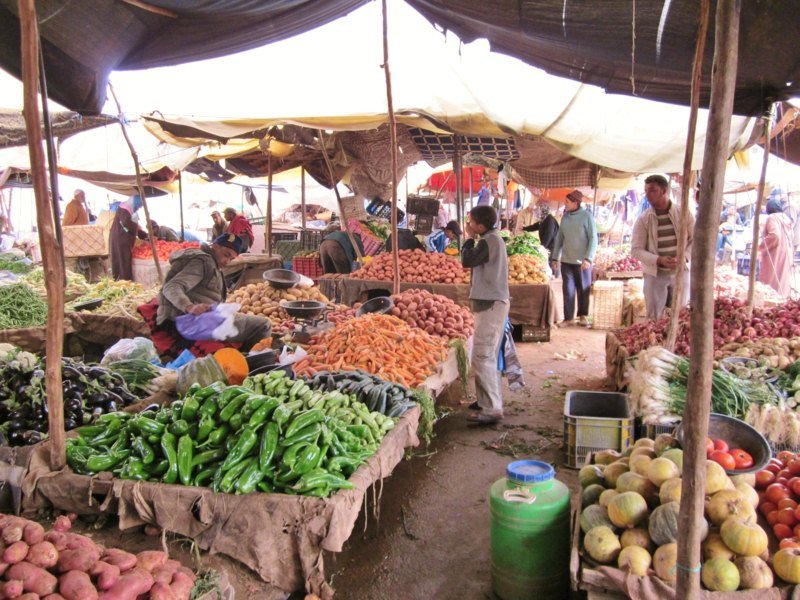
Local Market Vegetable Stalls

“Then, we headed back to Ar-Rachidia and on to Goulmima and Tinerhir. This was on our way to the Todra Gorge staying in a small village on a campsite at Z-S-Abdelali.

“Next morning we set off for the Gorge. The sheer rock face at the start of the gorge is 1000ft straight up and the mountains behind 10,000ft—quite a sight and hard to photograph.

“We walked for about a mile to get the feel of it before our long drive up the Gorge reaching 9,000ft. After about 3 hours we dropped down to the village of Agoudal, about 8,000 ft. high, where yet again we struck lucky.

“It is a place of 2,500 people and we did not see a single vehicle. On the way we are mobbed by children and then we see a small Auberge. As we slow down the proprietor, Ibrahim, comes out to meet us.

“We had not intended to stay here, but we did for 2 nights and it was again fantastic, better than we could have imagined. We should have stayed longer.”

When Susan and Brian went into the Auberge, Ibrahim had lit a fire for them and they saw a picture of a cave they told him they would like to explore.

Susan recalled: “The next morning Ibrahim took us through the village in the van—we would have never found the route

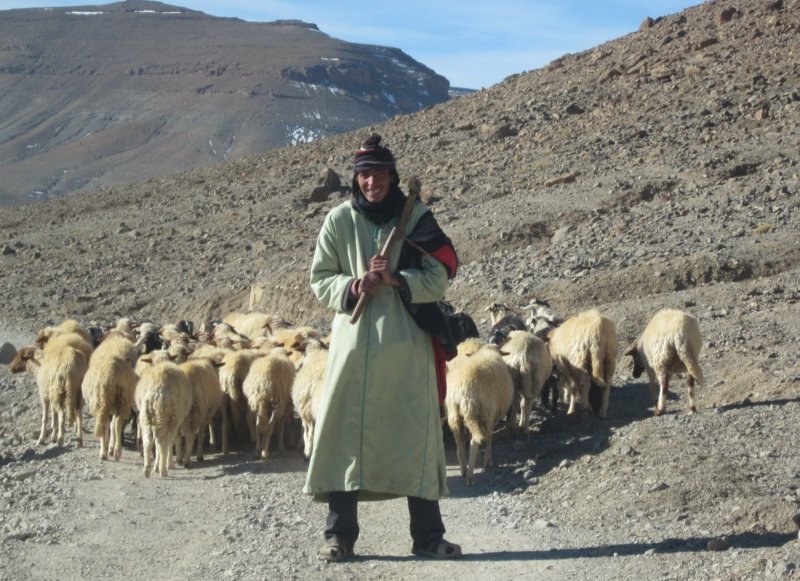
Shepherd En Route To Agoudal Cave

without him. The roads were terrible and he told us to drive “off piste” for about 5km. We passed a few shepherds, who stopped and asked for food; one of them is in the pictures.

“When we arrived at the point Abram had told us to leave the van, near a stream, we started our 5km walk to the cave, leaving the van in the middle of nowhere.

“This area was so bleak little or nothing growing and all the sheep herders carried axes!

Brian In Cave Near Agoudal

“The cave when we eventually found it was fantastic. We had walked uphill through ice fields and frozen waterfalls, until we were at 9,000ft. We found a water point where cleaned sardine tins had been left to drink from.

“After about 3 hours exploring we stared our descent and as the van came into view we could see smoke and a fire, plus goats, a dog—and a shepherd.

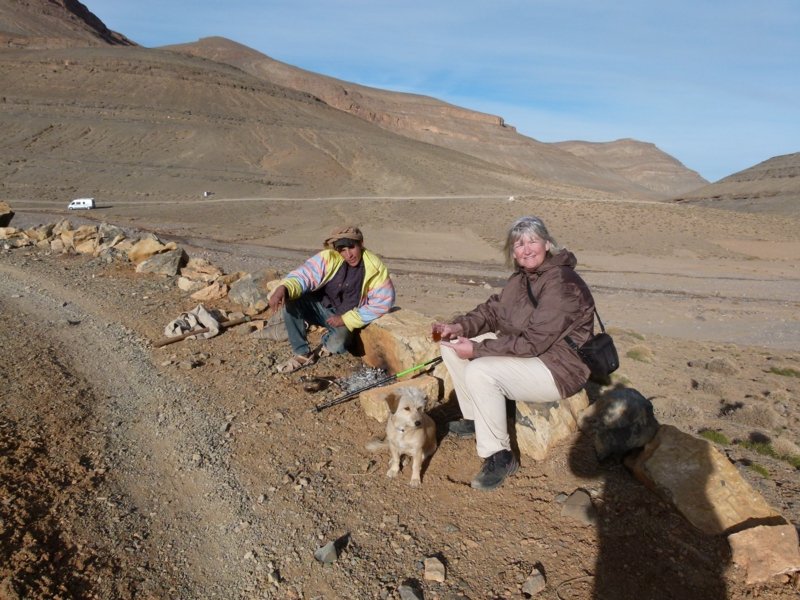
“As we approached him he had water boiling in an old tin tea pot and had made us tea, even though he had just one glass to share between the three of us.

“He had open-toed sandals and it was freezing cold!

“He was a lovely young chap who only spoke Berber, but you can do a lot with a smile and a little sign language. He demonstrated that the axes were to cut what little vegetation there was for the goats to get to the roots.

“He walked back with us to the van where we had made a curry for supper. So gave him a take away and offered him socks but he refused these.

“However, he WAS delighted with his supper and he went over to a bush and set fire to it, beckoning us over to warm our

Susan With the Shepherd

hands.

“At this point I thought perhaps this is where the burning bush in the Bible came from?  Certainly, there were lots of shepherds in the bible!”

Susan wrote that they were still struggling to cope with the way temperatures plummeted at night.

“We have started wearing about 4 layers and 2 pairs of trousers,” she explained. “Our first night here was -4 in the van at 8am and outside at 10am, when the sun had been up two hours, it was still -8.

“We don’t make for early mornings.”

Susan and Brian’s memories of their trip conjure up images as much of the people—particularly the children—as it does about the culture, the scenery, the landscape, the cities, towns and villages.

“The children hunt in packs of about 15 at a time and I just love them,” she wrote.

“Many have faces I will never forget—I could adopt them all.

“Today I met a lady with 14 children and another on the way. She looked so haggard and she showed me the baby had no clothes on under her wrappings.

“Now I know why they are always washing in freezing cold streams—they have to. This is the poorest area we have been to, no donkeys here.

“We both will return with children’s clothes. They don’t want money, as they have nothing to spend it on. This village has only had tarmac for 2 years and it took us 3 hours to drive from Todra.

“We are having an enlightening experience as much as a holiday.

“Morocco is changing fast and much of it will not continue in its present form. What must the people here think of us in our van and warm clothes?”


READ PART 3 for the next installment……………………..


~~~~~~~~~~~~~~~~~~~~~~~~~~~~~~~~~~~~~~~~~~~~~~