



 This week’s Portugal News is available for collection to Amovate MEMBERS outside the office.

This week’s Portugal News is available for collection to Amovate MEMBERS outside the office.


by Matt D’Arcy
It’s The Good Life—transplanted from Surbiton to Sector E in Vale da Telha!
Amovate members Susan and Brian Jutsum are our own versions of TV’s Barbara and Tom Good who quit the rat race to become self-sufficient by living off the land.
There are some slight differences—while the Justums enjoy their own pork, fruit and vegetables at their villa on Vale da Telha, it doesn’t come from their own back garden, but from their 16-acre smallholding up in Rogil.
But let’s start at the beginning….
Susan, who is 59, is from Sheffield and Brian, 58, from Nottingham, enjoyed a successful business life in Yorkshire that owed much to Brian’s phenomenal skills not just as a carpenter but as an artistic carpenter, and Susan’s culinary and hospitality accomplishments.
Brian has been a keen spelunker (potholer) from the age of 14 and this led them to buying a seven-bedroom country house in Wensleydale—the Yorkshire Dales boast Britain’s largest collection of caves in terms of size and numbers—which they converted into a hotel so successfully that in 1988 it was voted Hotel of the Year,
(Brian’s interest in caving has never abated and he recently joined a caving club based in Lagos to continue the hobby here in Portugal).
They also subsequently had a squash club and for three years ran a friend’s hotel, all the while keeping a house in the Dales. Brian then returned to his artistic roots and became a furniture maker, creating a thriving business making bespoke oak furniture for clients like the late Richard Whiteley of Countdown fame and Janet Street-Porter.
They also segued successfully into antiques for five years or so but began to find it increasingly more difficult to turn a decent profit as the plethora of antique shows on TV began to educate the customers to become more knowledgeable….and to haggle down to the bare bones of profitability!
They came out here on a permanent basis in 2009, having bought a plot of land in Vale da Telha in 1998, completing their villa in 2000 to use purely as a holiday home, with no intention at that time of living in it on a permanent basis.
But they did have a longer-term plan. They had been coming to this part of the Algarve since the ‘80s and from very early on decided that at some point they wanted to own a property somewhere along the N120, preferably to buy the land without any buildings as a project and eventually construct their own property.
“We never stopped looking right from our first visit here,” said Susan. “We knew we had to do something to keep ourselves busy and active and we wanted to be self-sufficient if that was at all possible.”
And, after building the house on Vale da Telha they would come out for up to 12 weeks a year (sometimes sneaking in an extra week or two!) and spend much of that time looking for a good-sized tract of land to enable them to live the dream.
Eventually, they did find the perfect opportunity to fulfil this desire for self-sufficiency, discovering and purchasing 16 acres of land outside Rogil, three kilometres from the sea, and set about creating their own Good Life, Portuguese-style.
They had an open well which was used, via a pumping system, for irrigation. But in 2010 they had a borehole drilled to a depth of 85 metres, which flows freely at the rate of more than 300 litres an hour non-stop. This does away with the need for pumping and also means they have more fresh water than they need!
That’s good news for their pigs, because the animals have their own swimming pool, and the flow of water then runs out into a stream forming one of the boundaries of their land.
Susan and Brian started off with five pigs, but after three were butchered and eaten they were left with one pair, a male and female, aka Mr Pig and Mrs Pig. And on November 17 the female gave birth to a litter of six piglets, although one died within a couple of days.
Sadly by that time it was too late for Mr Pig to see his offspring, as he had been despatched to the freezer two days earlier.
Unlike Barbara and Tom from TV’s “The Good Life” who called their pigs by the somewhat unimaginative names of Pinky and Perky (their cockerel was Lenin and their goat Geraldine) Susan and Brian refuse to name their pigs.
They say if the relationship became that familiar it would be difficult to slaughter animals with whom you were on first name terms.
So Susan’s “christening” of the five surviving piglets as A, B, C, D and E is an ominous sign for their long-term survival!
The decision to shuffle Mr Pig off this mortal coil two days before his family was born was not as heartless as you may think. First of all, boars don’t treat their offspring too well, and secondly no-one knew Mrs Pig was pregnant, as the signs that a sow is about to give birth are not always apparent until about six to eight hours before the piglets pop out.
Besides, as far as future litters are concerned—production will be limited to two litters per year, fewer than the normal Portuguese rate of three or four—Mr Pig’s participation will no longer be needed.
Mrs Pig will be impregnated by artificial insemination, which works out considerably cheaper than keeping a boar to do the job. (And you ladies need not get any similar ideas about replacing your menfolk!).
When each litter appears Susan and Brian plan to keep two piglets for fattening, and will sell the others as they reach the age of 12 weeks.
 The Jutsum’s land, which has a 3km perimeter, is home to a broad variety of wildlife, such as wild boar, hares, foxes, buzzards, snakes and a family of lizards. There are also donkeys and horses belonging to neighbouring smallholdings which occasionally pay a visit as they wander across the Jutsum’s land.
The huge selection of fruit trees include 115 orange trees which between them bear five varieties of orange plus apple, apricot, pears, nespera, (similar to the loquat or Japanese medlar) and figs, all of which help them make their own cider and wine—including fig wine.
The land also produces a huge variety of vegetables, like potatoes, green beans, peanuts, peppers, squash, sweet corn, pumpkins and onions to mention just a few.
One of their neighbours, a German, has a fruit crushing machine and once a year they all get together, strip the apples off their trees and press out the juice, which then lasts them all year.
And after seven years of clearing one big area they can now enjoy harvest time, which this year has produced 88 bales of hay, some of it used for feed and for flooring in the stables of their neighbours, and some now forming a pen for their pigs.
Only recently, towards the end of November. Susan was on their tractor ploughing the field to prepare for the next harvest, in May.
The Jutsums are helped on their land by Vale da Telha friends and neighbours, Jeanette, Gene and Gina.
Susan and Brian, Jeanette and Gene and Gina each get a third of the produce—and pork!—they help to farm.
And it really is hard work! Susan and Brian now spend at least three days a week—and sometimes more—working the land as they process plans and planning permission to eventually build a house there.
And perhaps one day they will live ON the land they live OFF.
(Many more photos in the Gallery Below)


* * * *
BBC’s The Good Life–Self-sufficiency in Surbiton. What do you remember?
On his 40th birthday, draughtsman Tom Good decides that he’s had enough of the rat race and that he and wife Barbara will become self-sufficient.
They convert their garden into a farm, get in the chickens, pigs (Pinky and Perky), a goat (Geraldine) and a cockerel (Lenin), grow their own crops and on one memorable occasion, try to dye their own wool with nettles.
Tom and Barbara would just be lone loons were it not for their neighbours, the henpecked Jerry Leadbetter and wife Margot, a social climber who cannot bear chickens wandering the back garden.
Over its 30 episodes from 1975 to 1978 The Good Life attacked the middle class and the ‘alternative’ lifestyle at once, showing Margot’s snobbishness as blindness, and Tom’s fanatical self-sufficiency as going too far.
Examples of Tom’s pursuit of natural alternatives leading down the wrong path include his attempts to make a methane-powered car that continually breaks down, as well as the problems Barbara and Tom have trying to kill their chicken, forcing them through pride to make a ‘sumptuous feast’ of a single egg.
The Good Life was remarkable for the consistent characterisation. Though initially dominated by Tom, Barbara was soon balancing his mad schemes with pragmatism and comforting his occasional lapses into depression.
Jerry’s mocking derision of Tom’s step sideways become grudging respect, and even snobbish Margot was human and real.
The series showcased the talents of Richard Briers, Felicity Kendal, Penelope Keith and Paul Eddington and made all three of the latter into solo stars afterwards, with Kendal becoming a sex-symbol (still is, let’s face it), while Keith in To The Manor Born and Eddington in Yes Minister created roles that were to become even better known than their Good Life creations.
Briers went on to create possibly the saddest small-screen comic character of all time, Martin Brice in Ever Decreasing Circles.
The thirty episodes of The Good Life became household favourites, and are still enduring icons of their time.
In a good-natured, light-hearted way, they showed how hard it was, and is, to be different to those around you, and the kind of courage it takes to be so.
Voted Britain’s 9th most popular TV sitcom of all time.
Cast
Felicity Kendal Barbara Good
Richard Briers Tom Good
Penelope Keith Margo Leadbetter
Paul Eddington Jerry Leadbetter
John Esmonde writer
Bob Larbey writer
John Morgan, who supplied us with so much information and photographic records for our article “The History of Vale da Telha” has allowed us to reproduce another of his prized possessions, an original sales brochure from the launch of the Vale da Telha project, published probably around 1980.
It is an eight-sided “concertina’ pamphlet and gives us an intriguing look at the original concept and sales pitch by the initial developers, Somundi, whose grand scheme ended in the company’s bankruptcy.
Many of their grandiose ideas simply failed to materialise—like the golf course and the cinema.
We have left the original text unedited so you can see that the brochure did lack a degree of professionalism in this English version aimed at the UK and Irish markets.
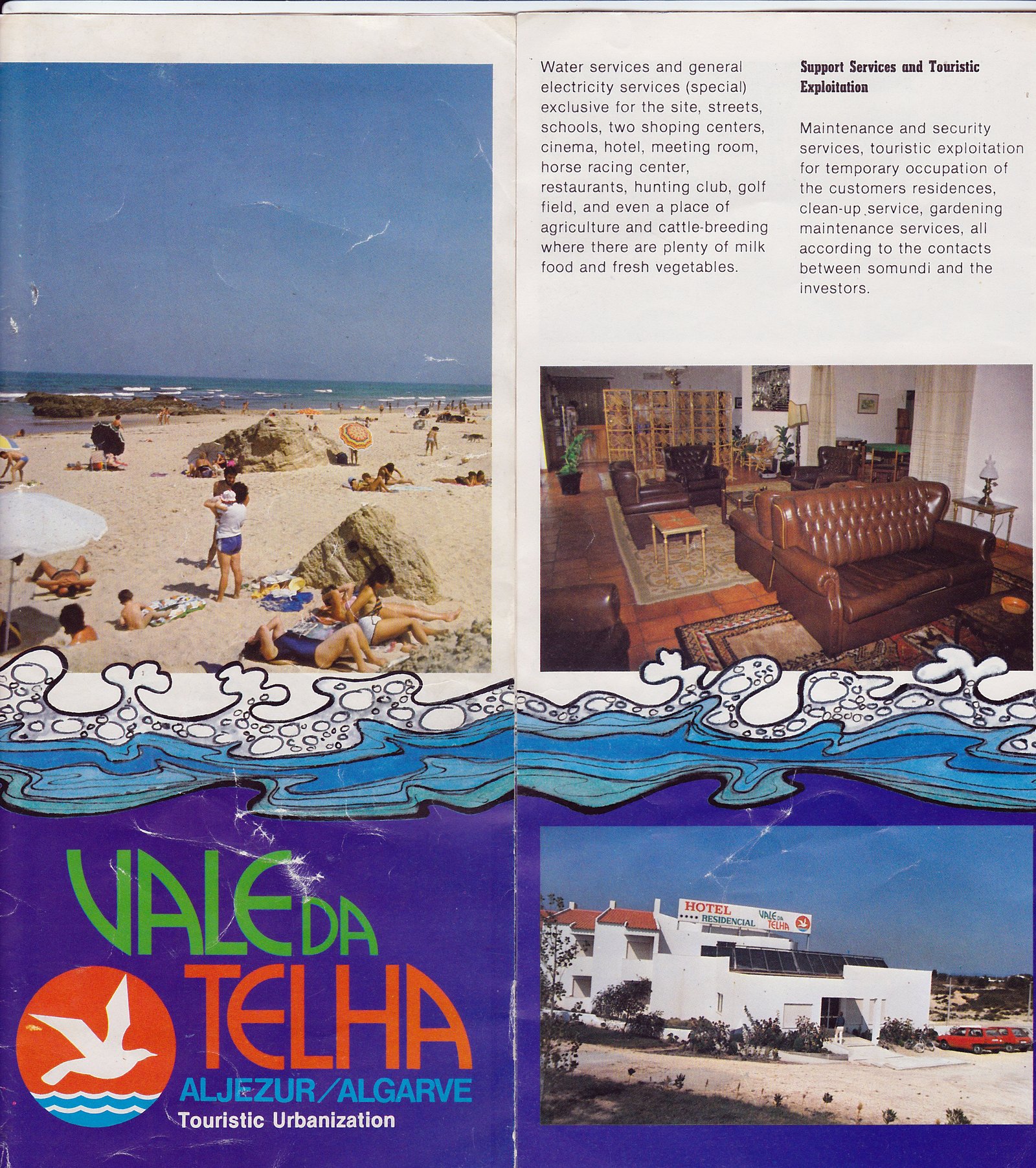
Page 1 & 2
Page One:
Photograph of what we assume is Monte Clerigo beach. Under which are the words:
Vale da Telha, Aljezur/Algarve.Page Two:
A photograph of the hotel and the hotel bar (?)
Text:
Support Services and Touristic Exploitation
Water services and general electricity services (special!) exclusive for the site, streets, schools, two shopping centres, cinema, hotel, meeting room, horse racing centre, restaurants, hunting club, golf field and even a place of agriculture and cattle-breeding where there are plenty of milk, food and fresh vegetables.
Maintenance and security services, touristic exploitation for temporary occupation of the customer’s residences, clean-up service, gardening maintenance services, all according to the contacts between Somundi and the investors.
Page 3 & 4
Page Three:
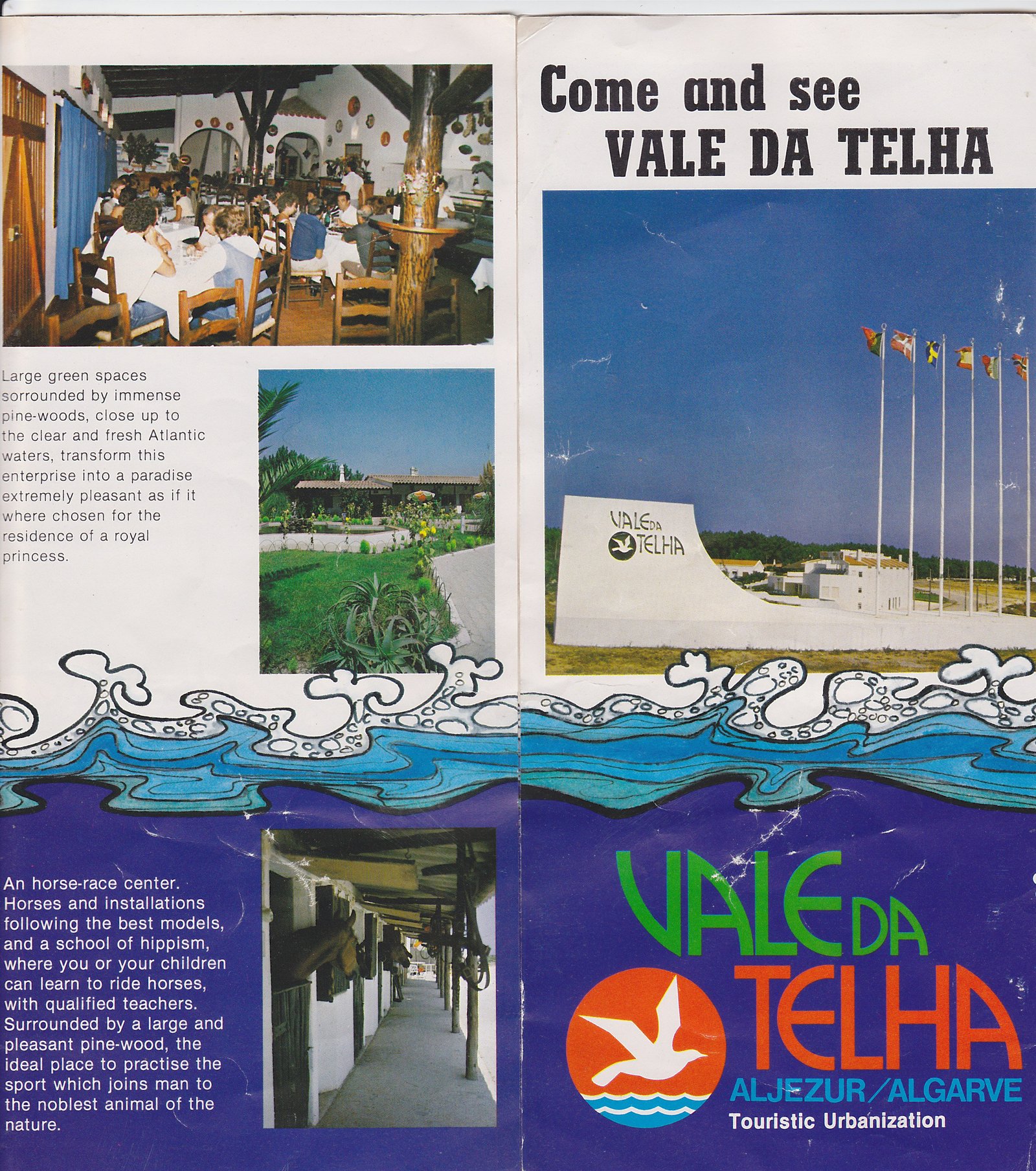
Interior photograph of a restaurant ( now Restaurant Vale da Telha), another of the outside of the Restaurant Vale da Telha, and a third of the stables, with horses poking their heads out of every door.
Text:
Large green spaces surrounded by immense pinewoods, close to the clear and fresh Atlantic waters, transform this enterprise into a paradise extremely pleasant as if it where (sic) chosen for the residence of a royal princess.
An (sic) horse-race centre. Horses and installations following the best models and a school of hippism where you or your children can learn to ride horses with qualified teachers. Surrounded by a large and pleasant pinewood the ideal place to practise the sport which joins man to the noblest animal of the nature.
Page Four:
Photograph of the wall—with seagull inset and flagpoles—which greets arrivals at the entrance to VdT
Text:
Come and see Vale da Telha.
Page 5 & 6
Page Five:
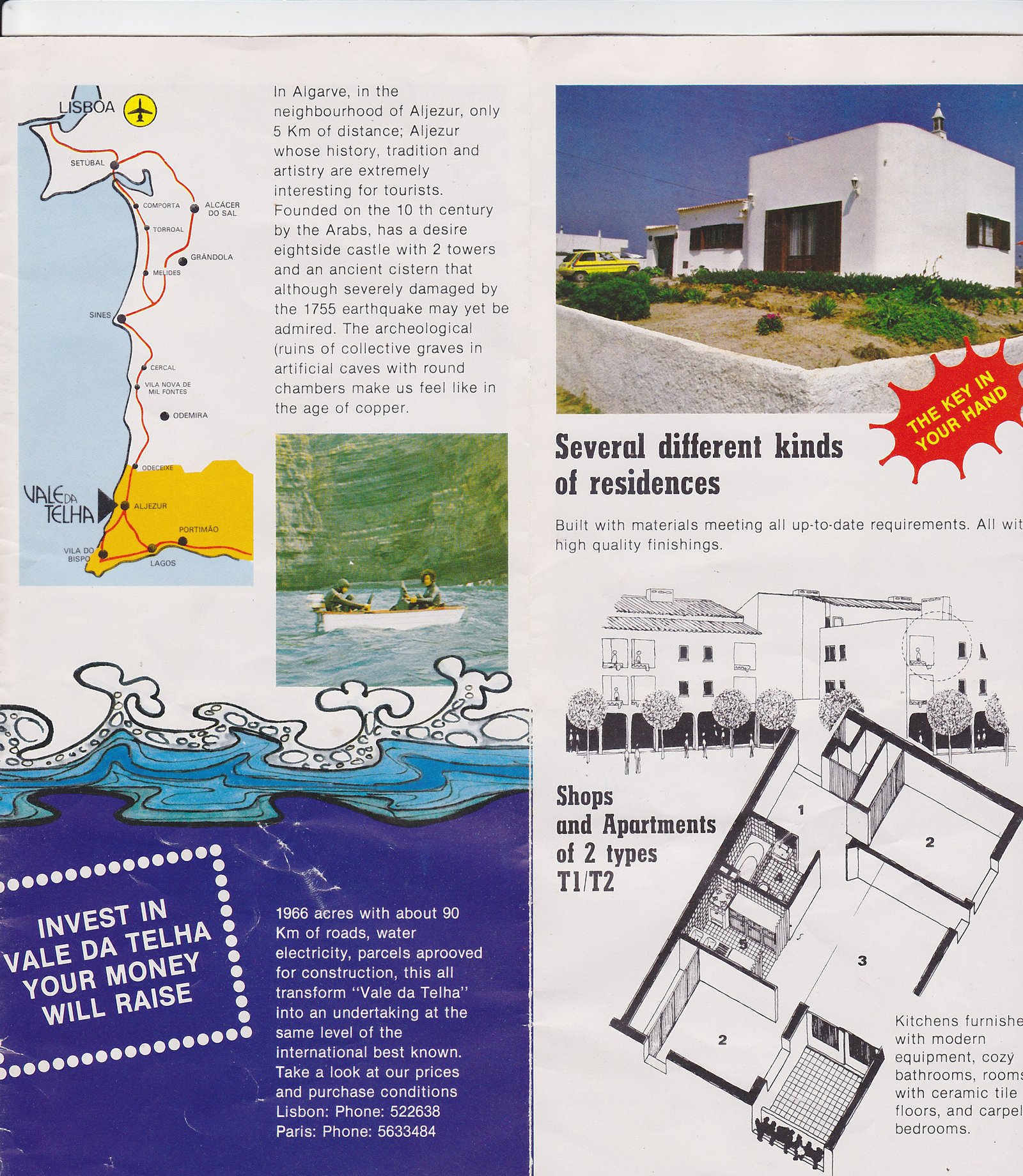
Map of Portuguese coast south off Lisbon, showing the locality of Vale da Telha, plus a photograph of fishermen in a small dinghy
Text:
Invest in Vale da Telha.Aljezur whose history, tradition and artistry are extremely interesting for tourists.
Founded in the 10th century by the Arabs, has a desire eight side castle with two towers and an ancient cistern that although severely damaged by the 1755 earthquake may yet be admired.
The archaeological ruins of collective graves in artificial caves with round chambers make us feel like in the age of copper.
1966 acres with about 90km of roads, water, electricity, parcels approved for construction this all transform Vale da Telha into an undertaking at the same level of the international best known.
Take a look at our prices and purchase conditions.Page Six :
Picture of a villa, drawing of the commercial centre and the plan of a house.
Text:
Several different kinds of residences.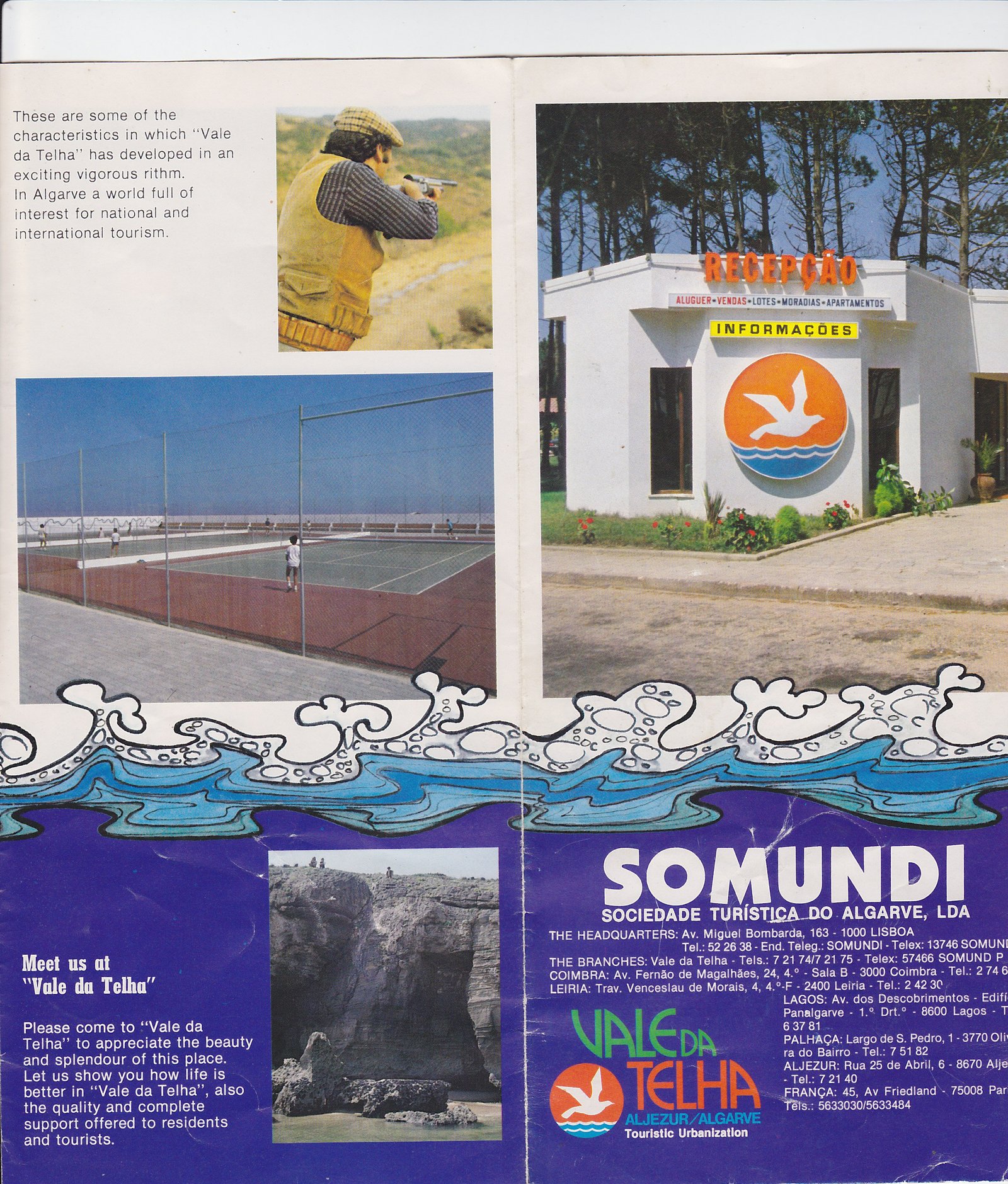
Page 7 & 8
Page Seven:
Photographs of a hunter shooting, the tennis courts and the beach.
Text: These are some of the characteristics in which Vale da Telha in an exciting vigorous rithm (sic). In Algarve a world full of interest for national and international tourism.
Meet Us At Vale da Telha
Please come to Vale da Telha to appreciate the beauty and splendour of this place. Let us show you how life is better in Vale da Telha also the quality and complete support offered to residents and tourists.
Page Eight:
Picture of the round building at the hotel, on the Pines Roundabout, which was the Somundi sales office, along with details of Somundi, giving its addresses with the HQ in Lisbon, and branches in Vale da Telha, Coimbra, Leiria, Lagos, Palhaça, Aljezur and França.

The Teatro do Campo have asked Amovate if we could post this article on our website:
The Vale da Telha theatre group, Teatro do Campo, raised 400 euros for charity from their show in July at the Adega da Craveira in Vales. They decided to donate this money to the Aljezur branch of the St. Vincent de Paul Society.which was founded in Paris in 1833.This society now serves impoverished people in around 132 contries worldwide and is dedicated to assisting those in need.
Our photograph shows members of the theatre group at the St. Vincent de Paul Society’s premises in Aljezur. Deborah Kinloch, on behalf of the Teatro do Campo, presented the money to Fernanda Agapito who is the President of the Aljezur branch. Senhora Agapito was delighted with the donation and the ladies of the Teatro do Campo were very interested to be shown around the Society’s storerooms in Igreja Nova where clothes and foodstuffs etc. are kept for local families in need.
Matt D’Arcy found this article whilst researching some other material and it occured to him that it would serve as a nice introduction to people wondering what lies outside and around Vale da Telha…..
This entry was posted by the contributor ‘moveforward’ on July 30 2009 in the Cities & Towns section of the following website:
http://www.portugalforum.com/cities/aljezur-portugal-the-fertile-beachfront.html
Vale da Telha sits on a plateau accessed via a wide well-surfaced hill road just three or four hundred metres before the N120 coastal road enters the small and historic town of Aljezur.
You can read about Vale da Telha, its facilities and its history in other articles here on the Amovate website.
But what lies outside and around Vale da Telha….?
This article should provide some useful information.
Aljezur is located at a distance of thirty kilometers north of Lagos in a fertile valley filled with greenery and vegetation.
The valley has long been known for its sweet potato crops as the rich land is fed by the river that cuts the area.
The old town is located on one side while the new town is on the other side.
The old town is built on a hillside, with the main street runs parallel to the river where there are many small cafes serving delights al fresco.

Aljezur Castle
A Moorish castle built in the 10th century is located high on the hill overlooking the old town with a full picturesque landscape.
Archaeological discoveries have confirmed that human had settlements in the area at about 4,000 BC. The oldest formally recorded civilization was established by the Romans, which was soon supplanted by the Moors who lorded over the area for six hundred years. In 1280, the town received its charter from the reigning King Dinis. The boundaries of the municipality are shaped as a rectangle delimited by the hills around it and the sea, making much of its landscape is greatly influenced by these two bodies. The coastal area is lined with high cliffs that nestle beach coves and untouched dunes. The inland is covered by rolling hills with receding vegetation lined up all in the row. In between these rows, vegetables, sweet potatoes and peanuts are grown over the centuries.
Largely untouched during the centuries succeeding this era, it is now one of the fastest growing areas in the 20th century.
All throughout its chequered past, agriculture was the main economic industry in the region. So overflowing was the produce that the farm products were shipped to the market via the port up the Aljezur creek.
Over time, siltation made the creek impassable to barges or boats and the road running down Lagos was used for economic traffic before the earthquake of 1755 caused much destruction and disease to the town.
But now tourism is bringing people and jobs back into the area.
The beaches of Aljezur are the most breathtaking as the sea had carved the cliffs to make for the fine white sand

Surfers at Arrifana
beaches, those same Atlantic waves now creating a “must-do” destination for the most intrepid of surfers.
On the cliffs, many migratory birds have built nests amongst the many wild flowers.
The bays face the sun with the long strip of beach separating land from the sea. The following are some of the famed beaches of Aljezur.
Odeceixe is known for its long beach cut by the mouth of the Seixe creek. There is a resort built near the mouth of the creek and is geared for great family fun. The resort provides the greatest views from the inland Miradouro da Ponta Branca.
The Quebrada beach is one of the least visited beaches as this small swath of sand is hugged by the sea and the cliffs. Some of the other virgin coves are the Samouqueira, Vale dos Homens and Carriagem.

Amoreira
The Amoreira and Monte Clerigo beaches are twin beaches separated by rock formations

Monte Clérigo Beach
that lead up to Ponta da Atalaia or Lookout Point.
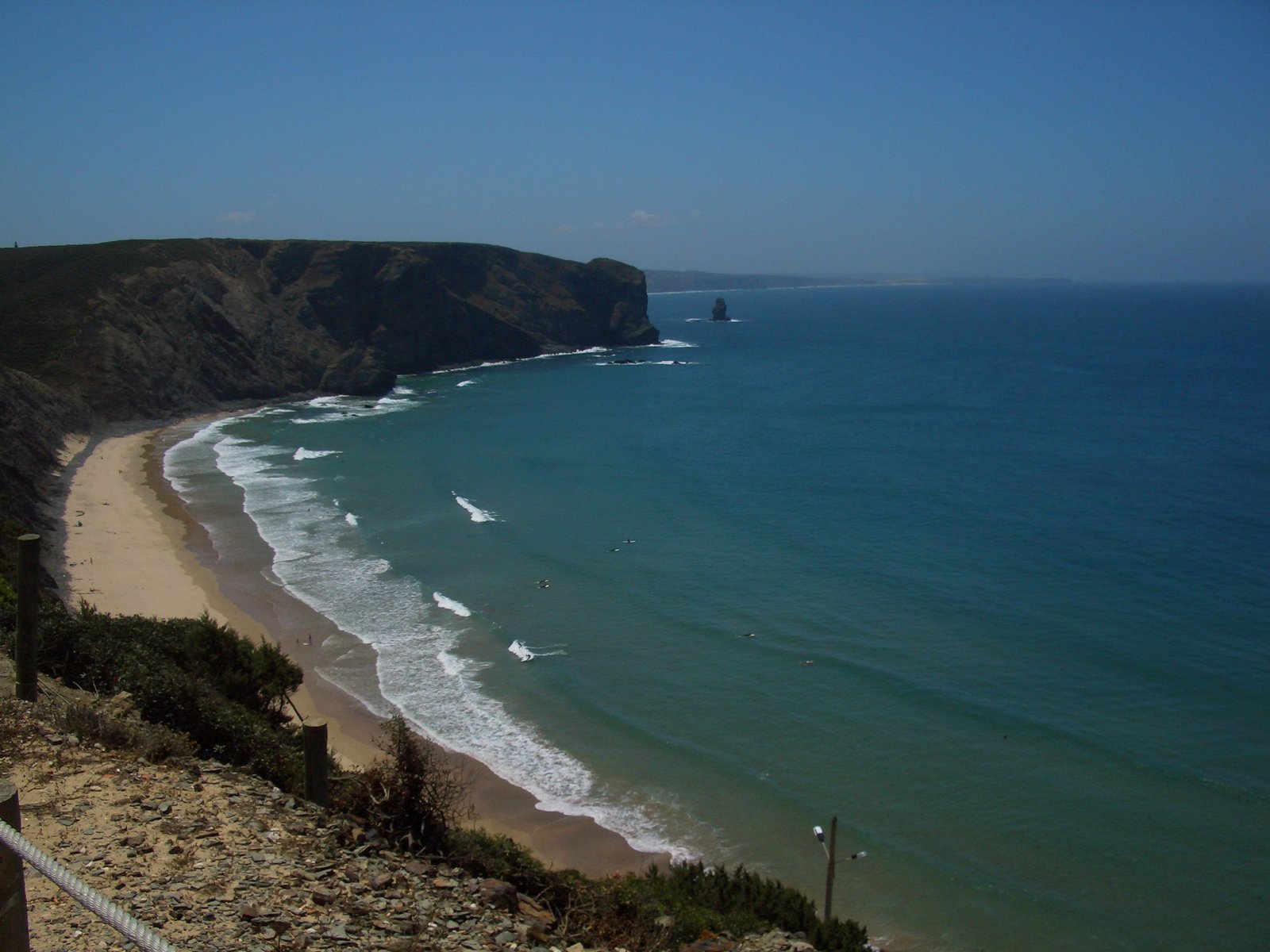
Arrifana Beach is a fishing hamlet with a long stretch of sand sheltered by cliffs.
This area is best attributed to the Moorish prince Ibn Caci in the 12th century. He lived in the area as a recluse while writing poetry.
There are also the remains of a fort built in the 17th century to protect the village.

Remains of the Fort at Arrifana
The Pedra da Agulha (stone needle) is located in this area and is a magnificent sight to behold.

Pedra da Agulha
The most well known beach in the Aljezur is Bordeira. The beach’s name comes from the Ribeira da Bordeira, which flows into the southern end of this swatch of sand.
There is a fort built in the 17th century to protect the bay from marauding pirates,
and also a small headland named as Pontal that provides the best view of the surrounding beaches.
There is also a large deposit of fossils from the Mesozoic era and can be reached by the use of a wooden footbridge over the stream.
Aside from enjoying the beach, there is a whole host of activities that can be enjoyed in Aljezur.

Fishing hamlet at Arrifana
Sports anglers can rent boats for the day and be hopeful of landing big game fishing in the area. The waters are overflowing with many species of fish such as sea bass, conger eels, snook, sea bream and dory.
The famed fishing grounds of Aljezur are Baia dos Tiros, Esteveira, Samouqueira, Vale dos Homens, Carriagem, Fonte Sala, Pipa, Vale Figueiras, Canal, Atalaia, Bordeira, Pontal and Amado.
You can also enjoy the waves and go surfing or body boarding as the waters in and around Aljezur are among the best in Europe.
There are also many historic sites in Aljezur. Lying atop the hill, the castle foundations have seen much conflict between Christians and Moors over the centuries. The castle was built in the 10th century by the Moors with a large courtyard surrounded by high walls punctuated by two towers. The castle was badly damaged during the great earthquake of 1755. Another historic site is the Fonte des Mentires or Fountain of Lies. It was called such because of its association with a beautiful Arab woman and the taking of the castle.
There is also the Pillory, an area where criminals were paraded in front of the townspeople to be scorned and humiliated. There is also the Misericordia Church, a church rebuilt twice, first in the 16th century and then again the 1755 earthquake. The doorway is in the Renaissance with a fraternity table.
 The Main Church of Aljezur was completed by the end of the 18th century and stood as the centre of the Igreja Nova area of the town. There are three main areas to the church with the magnificent main altar.
The church has a statue of the Nossa Senhora da Alva or the Lady of Daybreak made in the 18th century. Many of the religious images and artifacts come from the old church that was destroyed in the 1755 earthquake.
The side chapels are from the Nossa Senhora do Destiero or Our Lady of the Exile from Monchique. The baptismal font is in the Manueline style of the 16th century with crucifixes from the 18th century.
The finest treasure in the Church is a Eucharist box made of mother of pearl and gothic chalice, all housed in the Church’s ostensorium.
The municipality of Aljezur is a fascinating mix of the old and the new. Its natural surroundings and historic sites are must see places to be in, as one enjoys the development of the modern Portugal.