Author Archives: Sue

Atalaia Point Archaeological Discovery

ribat_1Atalaia Point Archaeological Discovery

900 Year-Old Cemetery at Atalaia investigated by archaeologists.

By Elisabete Rodrigues

Story and photographs from the website:

http://www.sulinformacao.pt/

====

Seven graves in the cemetery of the Ribat Arrifana (Fortress Arrifana), located at Ponta da Atalaia (Watchtower Point) in Vale da Telha on the coast of Aljezur, have been excavated by a team of archaeologists co-ordinated by Rosa and Mário Varela Gomes, in a short project during the last fifteen days of July.

Ponta da Atalaia has been described by the “Real Adventures” website as a “fantastic promontory where we can see many ruins and excavations of an ancient Moorish fortress (Ribat) controlled by Ibn Qasî around 1150”.

One of these graves belonged to the twelfth century Ibrāhīm bn bn Sulaymān Hayyān, perhaps one of the monks of this monastery, or an Islamic pilgrim who ended up dying there in 1148 AD.

Or perhaps, as surmised by Rosa Varela Gomes, “did he perish in battle and was buried here? “ribat_4

How do the researchers know the name of the man buried in just one of about seven dozen graves discovered in the necropolis situated alongside the ancient Ribat?

Thanks to a stele epigraph – ie a tombstone with an inscription carved in stone – which was discovered two years ago, still attached to the head of the grave they were able to identify the man whose skeleton was discovered there.

This and other stele discovered in the Islamic cemetery are considered a find of great importance and rarity. As archaeologist Rosa Varela Gomes explained: “The two epigraphed stelae we found here are the only ones known in situ in the Iberian Peninsula”.

Of the seven graves, another discovery is also said to be an oddity, since it is the skeleton of a woman. “We do not know if it was a woman who lived here,” said the archaeologist, which would be somewhat unusual, since this was a gathering place of Islamic warrior-monks.

Despite the heat, wind and strong sun beating down, the team was dedicated to digging with infinite care, around the skeletons buried in that little peninsula on the sea, nine centuries ago. Sometimes it meant these young archaeologists lying prone on the ground, with their heads hanging down into the pit inches from secular bones.

“There are so many well preserved graves here in this timeline,” explained Rosa Varela Gomes.

But the survey of seven skeletons in as many graves was not the only new discovery of the short fifteen days of the excavations during this summer campaign at Ribat Arrifana.

“The big news was the identification of a section of the wall, about 10 meters south of the Ribat,” explained Rosa Varela Gomes; one more piece in the jigsaw as they try to reconstruct the history of Ribat, which was last year classified as a national monument.
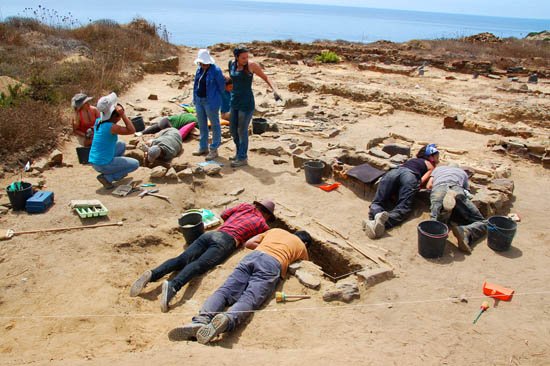
ribat_2The excavation campaign team coordinated by Rosa and Mário Varela Gomes included further ten students with a Master’s Degree in Archaeology from the New University of Lisbon, as well as the anthropologists Nathalie and Filipa Antunes Ferreira dos Santos Amado.

The presence of two anthropologists is essential for monitoring the survey and making further study of the osteological remains, ie the skeletons removed from the old cemetery. After the field work, “the osteological estates are now being cleaned and studied at the Laboratory of Archaeology FCSH UNL,” said Rosa Varela Gomes.

After the early years, the campaigns of archaeological excavations have relied on the logistical and financial support of the Chamber of Aljezur and the Gulbenkian Foundation. This latest project was only possible thanks to the research project funded by the Fondation Max van Berchem, Geneva.

This time, Mário Varela Gomes lamented, ‘the Board has not given us accommodation or transport, as in previous years, which is unfortunate. We are not asking for money, we just needed logistical support, namely that let us accommodate students in the sports gymasium’.

A Sufi master grappling with Christians

For the past twelve years, ie, since 2002, the archaeologists and Mário Rosa Varela Gomes have co-ordinated excavations at the tip of Ponta da Atalaia, a small rocky promontory, on the coast of Aljezur.

At its tip, in the troubled twelfth century, there was a Ribat, a kind of fortress-monastery, inhabited by Muslim warrior-monks who took a vow of poverty, led by the celebrated Ibn-Qasi, a Sufi master who then inhabited the community until the Moors were driven out of Portugal by the Christian Knights of D. Afonso Henriques.

During over a dozen archaeological campaigns, researchers have already uncovered several structures of the ancient monastery-fortress, namely the circular base of the minaret, with its mosques mihrabs (oratories facing Mecca), Koranic school ( madrasa ) and necropolis. Because these, by neccessity of cost and opportunity, are short archaeological campaigns, much work remains to ribat_6be done—in fact only about a third of all the Ribat is already dug.

The Ribat of Ponta da Atalaia is considered the most important structure of its kind in the Iberian Peninsula and its discovery has sparked the interest of researchers across Europe. It is, according stressed Rosa Varela Gomes, the “most western Islamic archaeological site of Europe.”

Classified as a national monument last year – the only one of the entire municipality of Aljezur – the Ribat is located on private land, but has not yet been purchased by the state, something that came to be expected in the first version of the Southwest Coast Polis Environmental Assessment Study of the Strategic Intervention for Rehabilitation and Improvement of the Southwest Alentejo and Costa Vicentina / Polis Coastal South,

Over the years of archaeological work, the Ribat Arrifana has been visited by many citizens of Islamic countries, some quite distinguished, especially princes, ambassadors and other dignitaries.

These contacts left the arachaeologists constantly hoping that they would generate some financial and logistical support, taking into account the historical importance of the site for Muslims. But so far none has been fortchcoming.

Amovate Charity Donations—The President’s Response


charityThis item appeared on the Vale da Telha website on August 20 2014, referring to the poster advertising Amovate’s Charity Gala on Saturday September 20:

Seen ads for this event all referring to funds for ‘a well deserved charity’ – might be an idea to actually mention what the charity is! Just a thought.

While all the charities are deserved of help it seems that whenever a committee member or friend of falls ill etc their hospital/hospice etc etc suddenly gets a donation -I’m sure they deserve it but surely not the fair way to divi up limited funds. Again just a thought!

Will be interested to hear which charity and when/why it was chosen by amovate- I’m sure it will be a worthy one and all in VDTwill dig deep.”

====

Amovate’s President has responded thus:

The “well-deserved cause” mentioned is Amovate’s charity fund, as the purpose of the organisation is to make charitable donations from the fund at the end of each year–our raison d’etre so to speak.

The fund benefits a number of charities and some events, like this one, are held to increase the total monies held in the fund prior to distribution.

Others are held to benefit a specific named charity, as was the case with the Family Fun Day and the Madrugada Charity which has helped several Vale da Telha residents currently and in the past—not all of them connected with Amovate.

This rather cavalier claim that we distribute the money to the charities that have benefitted “committee members or friends” is not just inaccurate, it is extremely unfair.

We should point out that in this rather small community pretty much everybody knows or has a passing acquaintance with everybody else and we do respond to any worthwhile charities drawn to our attention by anyone, including non-members—and in one case from a resident who was actively anti-Amovate at the time!

The final decision is then made from a committee that includes a number of respectable and responsible Portuguese residents including the local police commander, and all the details are reported to our members at the AGM, with the financial aspects scrutinised by an independent Fiscal Council, none of whom are Committee members.

For example, when the animal charity AEZA wrote to Amovate for a donation to their fence fund the letter was discussed by the committee and a cheque was issued, all within a matter of two or three days.

A large number of charitable causes have benefitted from Amovate’s cash distributions in recent years, and a wide spread of recipients have receive support through cash raised from activities that have also added greatly to the social life of Vale da Telha which, socially, was all but a barren desert before this committee began its work.

All of this has raised the profile of Aljezur and, more specifically, of Vale da Telha in a positive way. Since 2010 dozens of well-received articles about the area, many of them accompanied by photographs, have appeared in local and national newspapers and magazines, all of them written and placed by Amovate’s Public relations section; something which is much appreciated by the local Camara.

Through all of this, and the charitable donations, Vale da Telha has earned a reputation as a caring, considerate and thriving community.

In one instance which received extensive media coverage, an Amovate member needing orthopaedic treatment at Portimao Hospital for a broken leg learned that there were only a handful of serviceable wheelchairs in the department, some of which were held together by bandages.

She contacted us and we donated the funds to buy, and ship from the UK,  six standard wheelchairs (18-inch seat), 1 extra wide bariatric wheelchair (22-inch seat), 2 wheelchair commodes which can also be used over the toilet and 40 x flexible hot or cold koolpacks.

None of this directly benefitted either Cath or Amovate but at the time Portimão Hospital’s Orthopaedic Unit Director and Surgeon Dr Alvaro Botelho praised the people of Vale da Telha for the donation, telling the Portuguese and English-speaking media:

“It is difficult to put into words how much we not only appreciate, but rely on, the wonderful generosity of people like those who joined so enthusiastically in the fund-raising for these wheelchairs.

“Because of their generosity, we have received a wonderful gift that will help in a huge way both the patients of the orthopaedic ward and the professionals who take care of them.

“We are overwhelmed by this gift and everyone who contributed to it can be assured that these wheelchairs will be put to the best possible use and will be an everyday asset to the unit.”

Those wheelchairs are still in good order and are still being used for the benefit of patients at the hospital.

Over the years Amovate has given many charitable donations to causes totally unconnected with the association or even with members of the association

We supplied equipment for the baby unit and toys, plus a dvd player for the children’s ward, at Portimao Hospital at a cost of almost €1000.

We have handed over Christmas Gifts for the local schools, made donations to the St. Vincent de Paul Society (including a new washing machine bought from an Aljezur supplier), the cash to purchase a Ripple Bed to alleviate suffering, requested by a non-member, organised and orchestrated the donation of €50,000 worth of fire fighting and rescue equipmement to Aljezur Bombeiros which was instigated by an Amovate member who approached the Committee for help.

We make donations to BPI Bank for needy children, for the purchase of books to make sure that local children have at least one present to open at Christmas.

We made the donation of a new, state-of-the-art laptop for the use of nursing staff at the CMR Sul Rehabilitation Centre São Brás de Alporte, which has supported at least three residents of VdT – none of whom are or have ever been Amovate members, let alone connected to the Committee.

Recently we made that donation to the AEZA Dog Charity to assist with the cost of secure fencing around a field for exercising the dogs and a further donation to Madrugada Charity (yes, in support of an Amovate member).

And, of course, we have been deeply involved, along with the Quiz Group and numerous people across Vale da Telha and the surrounding areas, with the €4,500 purchase of Defibrillators, one for the use of residents of VdT and the other for the Bombeiros, a project instigated by an Amovate member who approached the Committee).

All of these activities and events were publicised and promoted solely by Amovate both here in Portugal and, on occasions in UK media, to ensure maximum exposure and Amovate’s committee members tirelessly work countless hours with no reward to ensure their success and smooth running.

We even arranged for a three-piece suite donated to us by an individual who has a holiday home here to be transported and handed over to the GNR for their rest room in the Police HQ!

We do appreciate and encourage suggestions and constructive criticism and we would ask anyone interested enough to offer such advice and criticism to do so from within the Amovate family.

As a member they will understand what Amovate does, they could help us continue the good works, and, who knows, they could even request a donation to their favourite charity!


Update on Vale da Telha Defibrillators

photo (7)

You will recall that the amazing generosity of the people of this area made it possible to purchase two defibrillators that will be such a life-saving asset to the Vale da Telha and Aljezur communities.

This incredibly warm-hearted district leapt into action once the project to raise €4,500 for these two machines and a piece of training equipment was announced.

Such was the incredible response from you, the people of this community, that the money needed to buy the defibrillators and an item of training equipment from the UK was raised WITHIN A MONTH both on Vale da Telha and from the surrounding districts.

On April 12 this year Amovate President Peter Johnson along with Dr David Quinton—the Vale da Telha resident who inspired the campaign—officially presented the machines to Aljezur Fire Chief, Mario Costa and three of his firefighters.

But, as some of you may be aware, we have been struggling through the Portuguese Bombeiros bureaucracy to register the defibrillators.

We are almost there. The newly appointed Bombeiros President in Lisbon should complete the process in next few weeks! The machines then can be placed in the Hotel Vale da Telha lobby and the other in the second Bombeiros Ambulance.

At the same time we will run another Basic Life Support course at the Amovate HQ, The Old School House, for the 8 remaining volunteers (and anyone else interested–see below). We will also start Defibrillation courses with the training machine for those who have already passed their BLS and the certificates then, at last signed by the President, handed out. E-mails will be sent out.

We should all thank the Bombeiros de Aljezur and especially the Captain and Davide Costa for their perseverance with the authorities.

More than 60 people immediately signed up for the original CPR training courses, with more registering their interest in the following weeks, and going on to complete the courses.

The classes were conducted by experts from the Bombeiros assisted by Dr Quinton, Vale da Telha resident Sue Kenyon, a UK-certified trainer and instructor in Hands-Only CPR and also use of AED (automatic devices), and Amovate committee member Steve Baker, a former UK police officer.

If you have not yet applied but wish to take part, please contact us atinfo@amovate.com or to Sue Kenyon direct at diversue@gmail.com We will add you to the list, letting you know in due course when your training session is to be held.

Amovate President

photo (5)As from the Committee Meeting on 7th August 2014, Peter Johnson has resigned as President after 6 successful years.  We thank him for his enthusiasm and hard work during this time.

John Bergstrom-Potter has put a team together and hopefully, as that is the only team deposited before the 31st July, they will be voted in at the AGM in October (date to be announced).

Although Peter will continue with running the Tennis Club and hire of courts, all other business should be relayed through Ian Bedford the Administrator or any of the current Committee Members.


Aljezur—The Untouched Algarve

Aljezur

by Matt D’Arcy

More and more people, attracted by such innovations as the Rota Vicentina and the growing popularity of the Algarve’s west coast for surfing enthusiasts, are flocking to Aljezur which has rarely before been a “must-see” destination for the hundreds of thousands of tourists arriving on the Algarve each year.
Indeed, more and more house hunters are now looking to the area, particularly to Vale da Telha, for their dream home in the sun, either as a holiday home or as the ideal place to live out their retirement, as word begins to spread about the natural beauty and the wonderful quality of life to be found in these elysian surroundings.
So, what will these newcomers discover in what has been described as “the untouched Algarve” and “a medieval treasure chest”?
Perhaps this introductory guide will help:
====

Aljezur—The Untouched Algarve

(This article first appeared in the portugal-live.net website at):

http://www.portugal-live.net/

Nestling among the rolling hills of northwestern Algarve, Aljezur represents the untouched Algarve, an area of beautiful natural landscapes where donkeys work the land, cowbells tinkle on the plains and some of the best beaches in Portugal await you.

Aljezur River

The River at Aljezur

Situated in the Parque Natural do Sudoeste Alentejano e Costa Vicentina, the large natural park that extends along the western coast of the Algarve, Aljezur is a small agricultural town lying on the fertile plains that border the Aljezur river.

But, equally as important to the visitor and the tourist, Aljezur has been described as a medieval treasure chest which has survived more or less intact to the present.

Aljezur Castle

Aljezur Castle

The hilltop ruins of a 10th Century Moorish castle dominate the historic town centre and afford beautiful panoramic views of cork oak and pine woods, fields sprinkled with wild flowers and the sea in the distance.

The old town that spreads down the hillside is a charming mix of cobbled streets and whitewashed houses with the characteristic colourful trimming around the windows. The newer part of town was established in the 18th Century to relocate the population after the destruction caused by the 1755 earthquake and lies at a short distance from the hill on the other side of the river.

Outside the town, it’s hard to decide what is more appealing: countryside or coastline.  Nature treks, mountain biking tours and donkey or horse rides around the hills offer the opportunity to admire wild boar, foxes and badgers in their natural habitat while Aljezur’s 40 km (25 mile)-long coast is a treasure trove of rich marine life, numerous species of local and migrating birds and a beautiful mix of virgin beaches and peaceful river valleys.

The Costa Vicentina, as this south-western coastal strip is referred to, contains some of the most beautiful unspoilt beaches in

Arrifana Beach

Arrifana Beach

Portugal, many of which feature broad expanses of sand dunes flanked by towering cliffs and with hardly a building in sight.

The swell size at beaches such as Arrifana and Praia do Amado attracts surfers and bodyboarders while Odeceixe, Bordeira and Amoreira are situated at the mouth of rivers, making them especially popular with families and offering a choice of river or sea to swim in.

Attractive, natural lagoons also form in these beaches, making them a favourite with children. In Odeceixe, canoes can be rented for scenic trips upriver while, at Amoreira, the change from dunes into estuary marshland opens up a whole new natural world inhabited by kingfishers, otters and grey herons. The cove of Praia das Adregas, just south of Odeceixe, is an official naturist beach.

Aljezur - CopyIn an area so equally dependent on land and sea, it is no surprise that the fruits of both form the basis of its mouth-watering cuisine. Aljezur is the largest producer of sweet potatoes in Portugal so these are present in its soups, stews, pastries and during the Sweet Potato Festival, held in October. The sea produces another of the regional delicacies; the gooseneck barnacles that thrive on the surf-pounded rocks and that are bravely harvested by the intrepid local fishermen. Grilled fresh fish and a hearty selection of shellfish, including mussels, sea urchins and crab go into the tasty shellfish stews.

Places to see:

Historical sites and religious architecture

Castelo de Aljezur (Aljezur Castle) 

This 10th Century Moorish castle was built to guard the ancient river port that once provided direct access to the sea and was one of the last Moorish strongholds in the Algarve to be captured during the Christian re-conquest in the 13th Century. Two towers, ramparts and a cistern are still standing and its hilltop position affords beautiful panoramic views of the surroundings.

Igreja da Misericórdia (Church of Our Lady of Mercy)

Situated in the historic town centre, this original 16th Century church was rebuilt in the 18th Century after the 1755 earthquake. It retains its original Renaissance doorway.

Igreja Matriz de Nossa Senhora da Alva / Igreja Nova (Church of Our Lady of Dawn / New Church)

This 18th Century church was built by order of the Bishop of the Algarve to replace the original main parish church that was destroyed in the 1755 earthquake. Its most noteworthy features are the 18th Century statue of the patron saint of Aljezur, Our Lady of Dawn, behind the main altar; a 16th Century Manueline font and two 17th Century statues in the side chapels which originated from the Monastery of Nossa Senhora do Desterro in Monchique.

Museums

Museu Municipal (Municipal Museum)

Housed in the 19th Century former town council building, the museum exhibits art, archaeological findings unearthed in the region and an ethnographic section containing examples of agricultural tools and a reconstruction of the inside of a traditional Aljezur house.

Museu de Arte Sacra Monsenhor Manuel Francisco Pardal (Sacred Art Museum).

Adjoining the Igreja da Misericórdia church, this museum is named after an important local canon and exhibits a fine collection of religious art.

Casa Museu Pintor José Cercas (José Cercas Museum)

This museum contains the various antiques and works of art that belonged to local artist, José Cercas, bequeathed to the town after his death.

Archaeological sites in the Aljezur region

Ribat de Arrifana (Arrifana Fortress)

Situated above the cliffs of Ponta da Atalaia and commanding panoramic views of the coast, this 12th Century Moorish fortress/convent is one of the largest found on the Iberian Peninsula. Built for defensive and religious purposes, excavation has revealed the existence of various mosques, a minaret and a prayer wall facing Mecca.

Povoado Islâmico Sazonal de Pescadores (Islamic seasonal fishing settlement)

The remains of this 12th Century Moorish fishing settlement are located in Ponta do Castelo, near Carrapateira. Various fishing instruments, pottery and fish and animal remains have been discovered.

Necrópole de Corte Cabreira (Corte Cabreira Necropolis)

A Bronze Age burial ground near the town of Aljezur thought to date back to 1800 BC. Most of the objects found on the site are exhibited in the Municipal Museum