

Author Archives: Sue

Amovate & UK Charities Arrange €50,000 Equipment Gift To Aljezur Bombeiros

Kit Arrives at Bombeiros HQ Aljezure

Aljezur Fire Chief, Mario Costa, declared as he and his men unpacked the huge shipment from UK Fire Services Charity Operation Florian: “This is going to save lives.

“Some people who would have died in accidents and fires will live because we now have this equipment with us as we deal with life-threatening emergencies.”

The huge operation to source and deliver this equipment to the Aljezur Bombeiros began as a collaboration between Amovate and the Shepperton Aurora Rotary Club in the UK, one of whose members—Dave Good—is also a member of Amovate.

The equipment—some of which is already being used—was officially being handed over today (September 26th) at a special ceremony.

It will include a demonstration by the Aljezur fire fighters showing the recovery of people trapped in crashed cars using rescue equipment supplied from the donation.

Guests will include the Presidents of Aljezur Camara and its four associated Juntas, The District Commissioner of the Bombeiros, Doreen Pipe, President of Shepperton Aurora Rotary, Mike Thomas and Steve Darby of Operation Florian, GNR Commander Gabriel Reis and Amovate President Peter Johnson with Committee officials and members, and Nadia Cann and Wendy Hallam of Direct Transport.

Amovate (Associação Dos Moradores e Amigos do Vale Da Telha, or the Association of Residents and Friends of Vale da Telha), through secretary Ian Bedford, and Amovate member Dave Good of Shepperton Aurora Rotary in Surrey, began working together last February to bring the equipment over from the UK as a gift for the Aljezur fire fighters.

They immediately called on Operation Florian, a world-renowned charity set up by British fire fighters in 1995, which donates surplus or part-used UK fire-fighting and rescue equipment to fire services in less well off countries—but only after careful research to ensure the equipment is going to a worthy cause and will be used safely and efficiently.
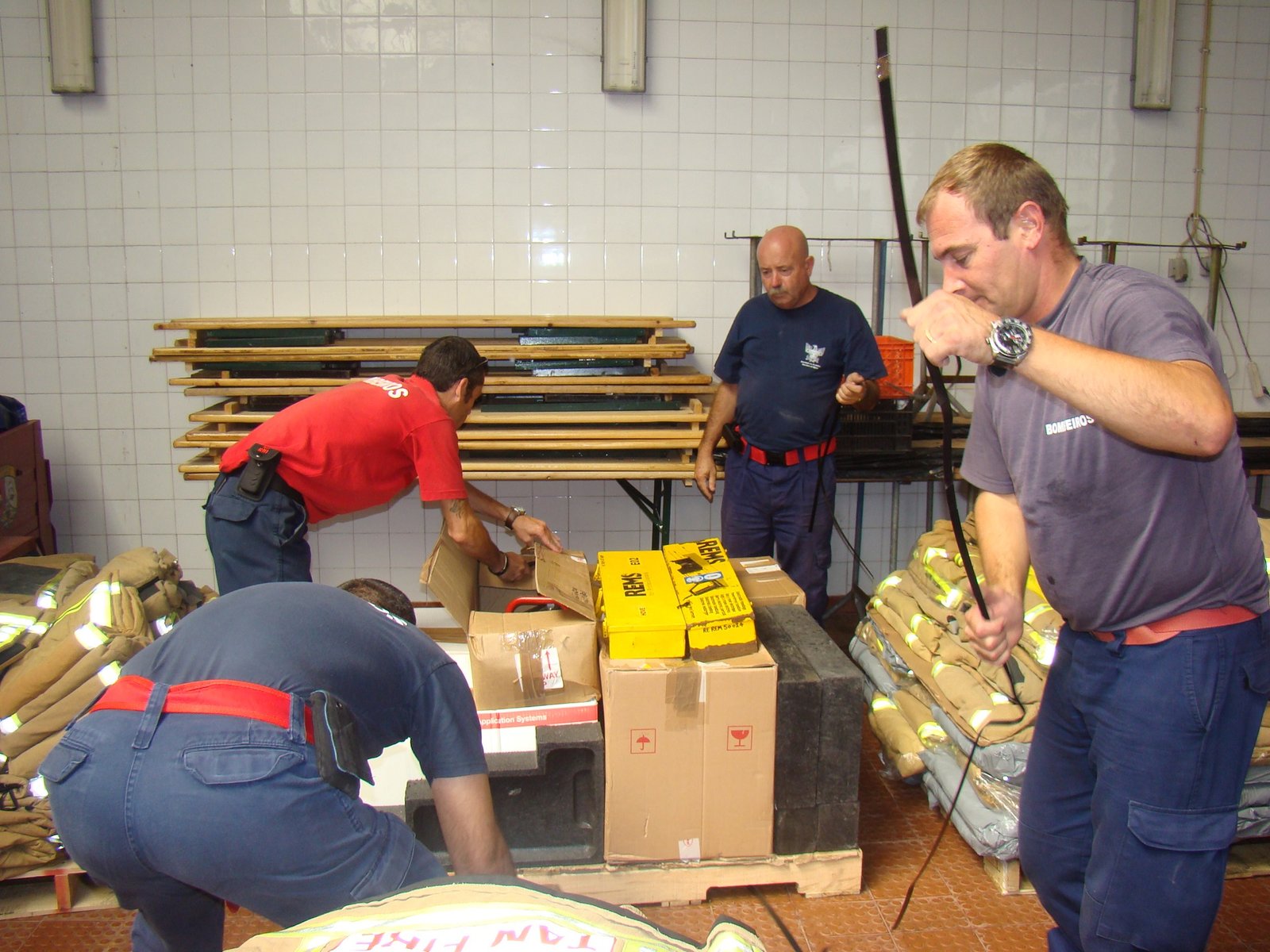
Aljezur Bombeiros were deemed fit to qualify for this equipment which includes 100 uniforms; fire coats and Bunker pants (trousers), 100 pairs of fire boots, 50 helmets, generators, pumps, “jaws-of-life” cutting tools, all of it state-of-the-art, the highest quality available anywhere.

The timing was perfect for Amovate, as a fire service had just rolled out a new contract for personal protection equipment, and Florian were gifted the large stock they had left, which they then earmarked for the Aljezur Bombeiros.

Florian relies on donations from UK Fire Brigades and sometimes that will include new or nearly-new kit, as was the case here.

Once they received the kit Florian had detailed discussions with the Bombeiros in Aljezur to ascertain the measurements and boot sizes of all the station’s firefighters.

The Shepperton Aurora Rotary’s Dave Good, who has a holiday home in Vale da Telha, was first to get the ball rolling early this year.

He suggested to Amovate that they should explore the possibility of arranging the donation of equipment to the local Bombeiros, who operate under tight financial restraints in one of the poorest of the Algarve Camaras.

From that suggestion grew that overwhelming co-ordinated response from Florian, Shepperton Aurora Rotary, Amovate, Lancashire Fire & Rescue and Algarve-based shipping and removals company Direct Transport.
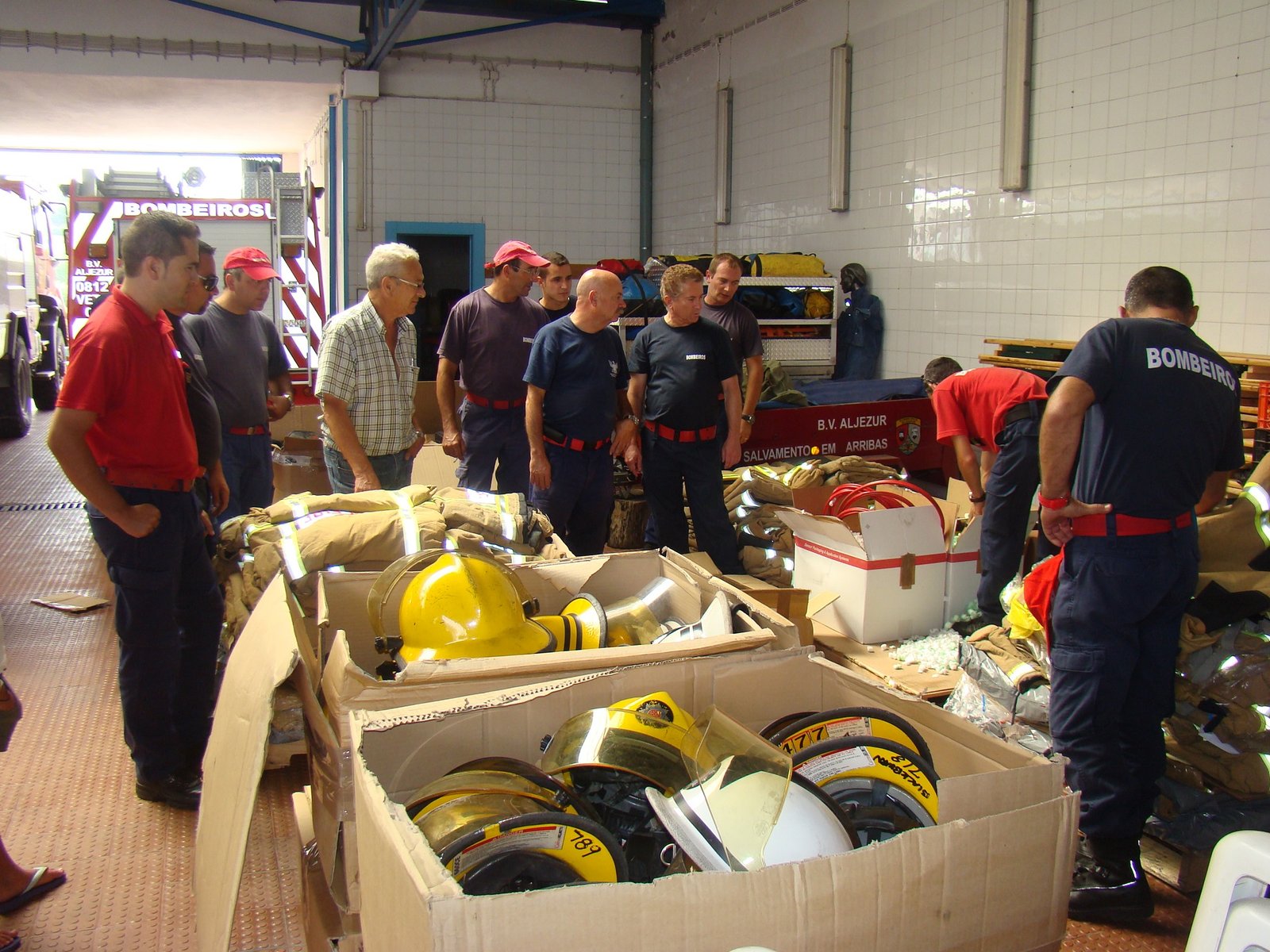
Once collected, the equipment was stored at a Lancashire fire station with agreement of the Fire Authority and its Chief Fire Officer, under the supervision of Lancashire Fire & Rescue’s Steve Darby and on private property in East Grinstead by Matt Hitman from Operation Florian South, before being prepared for shipment to Portugal. Both organisations play a crucial part in allowing Florian to deliver their mission of saving lives across the world.

The arrangement was that Shepperton Autora Rotary were to then arrange collection of the equipment and make a donation to Florian, whose Treasurer Tony Burscough enabled the funding allocation for this project, whilst Amovate would cover the costs for shipping this equipment from the UK to Portugal.

Amovate contacted Direct Transport in Porches to handle the transportation. But once the company heard what was involved and that the Bombeiros would be the beneficiaries they immediately and generously waived 50 per cent of the costs.

Nadia Cann, co-owner of the company, declared: “We wanted to play our part in this amazing project because the Bombeiros is an organisation that is very close to my heart and I am always in awe of their achievements and attitude”.

So, following almost seven months of planning Aljezur Bombeiros became the beneficiaries of what Florian’s Mike Thomas believes is the first time in 10 years that so much brand new kit has been given in one donation.

“More than 80% of the fire coats and trousers are brand new, and these alone cost around €400 a set!” he revealed.

According to Fire Chief Costa those uniforms, plus all the safety and rescue equipment, would cost the Bombeiros in the region of €50,000 if they had to purchase everything themselves.

Portugal does not have a central buying/purchasing unit for the fire service. Each fire station buys the basic equipment from different suppliers—what counts most is the price. The only common items to be shared by different fire stations are hose connectors.

Mr Thomas, who backed what he called called The Florian Project from the start and scrupulously determined the amount and type of kit donated for maximum benefit, added:

“As far as I can remember this is the first time we have given so much brand new kit in one donation. It will last for around 10 years if looked after and cared for, which I am sure it will be by these very professional fire fighters in Aljezur.”

Shepperton Aurora Rotary Club President Doreen Pipe added: “This has been a fantastic outcome and we are proud to be part of this amazing project with Florian and Amovate to provide this vital equipment for the Aljezur Bombeiros.

“Their bravery and professionalism will have saved many lives and much property over the years, and we thank them for that.”

Amovate have also arranged for transport to and from Faro Airport for the guests from the UK, and we would also like to thank Bruno at the Hotel De Vale da Telha for generously providing their accomodation free of charge.

 =======================================

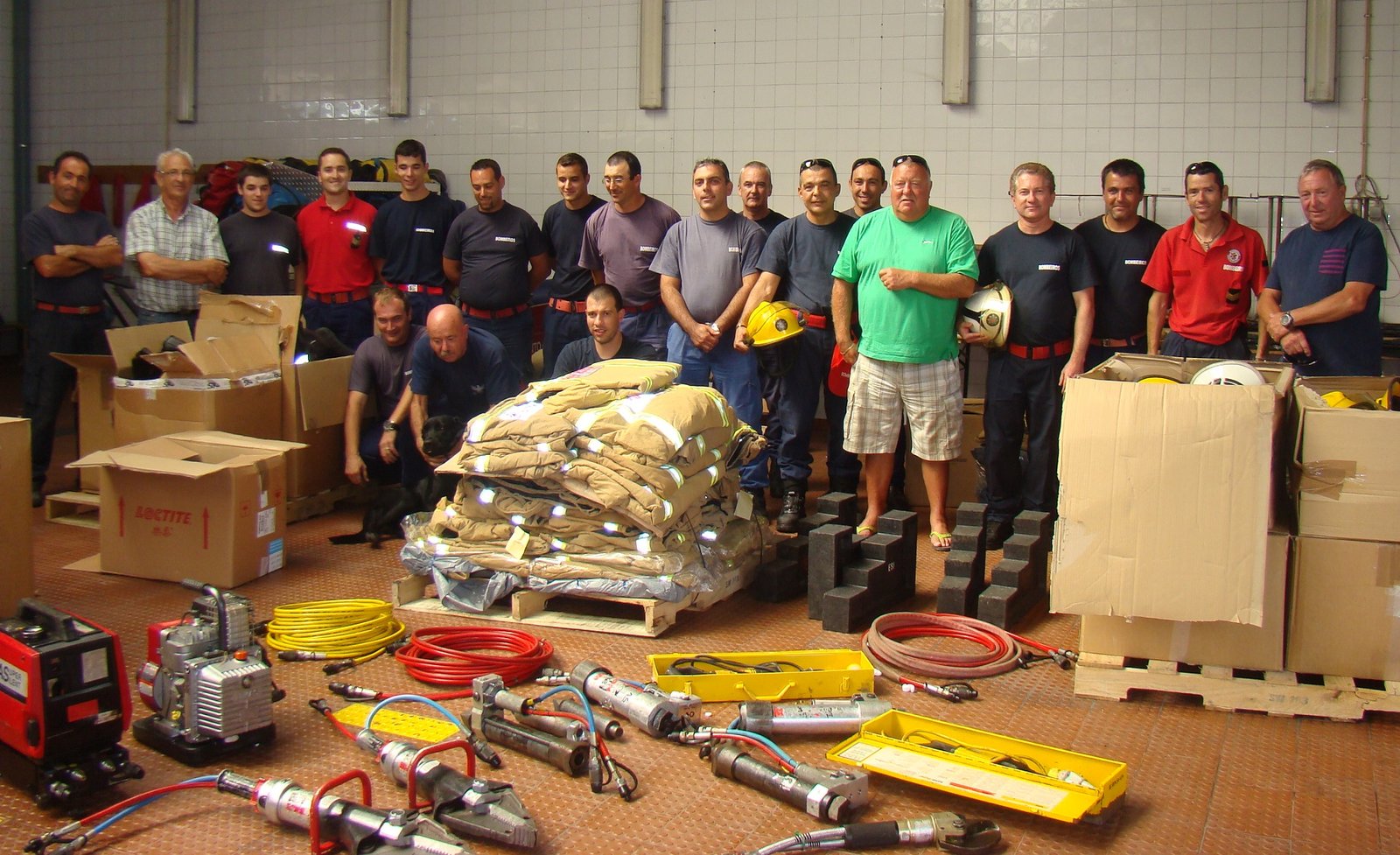
The fire and rescue equipment arrived at Aljezur Bombeiros HQ on Wednesday August 21st 2013.

The staff at the fire station could hardly wait to open the crates—it was like Christmas, with Amovate President Peter Johnson, Secretary Ian Bedford and Public Relations Officer Matt D’Arcy in the roles of Santa Claus!
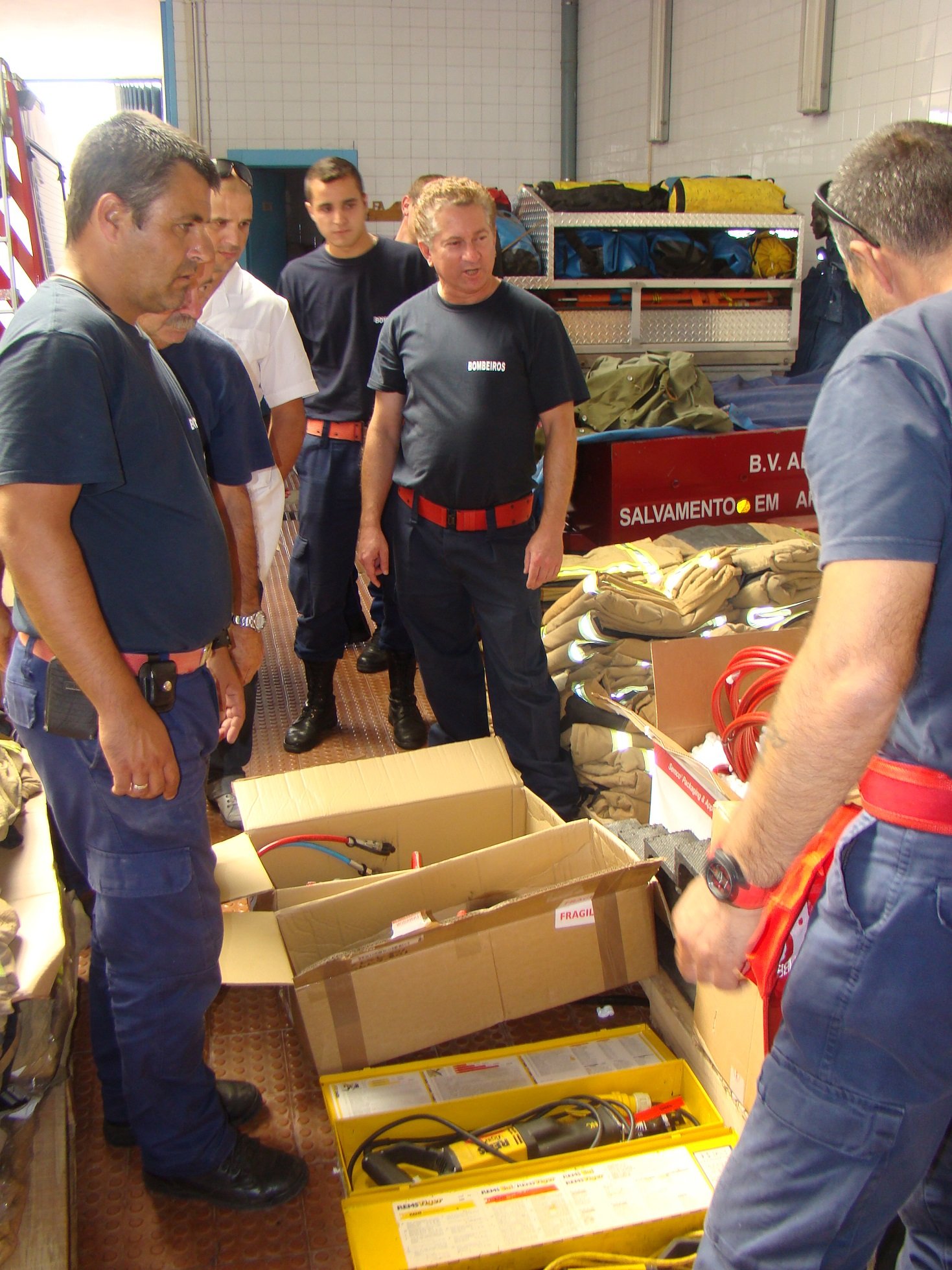
Fire Chief Mario Costa, surveying the array of equipment lain out across the floor of the fire station, said with some wonderment: “This is an incredible moment for the firemen and paramedics of Aljezur.

“If we had to buy all of this equipment—and it goes without saying that this is something we are not really in a position to do, financially—it would cost somewhere in the region of €50,000.

“So you can understand why we are so grateful that Amovate and its members, and the people back in England who have all made it possible, have worked so hard and done so much to make this happen.

“The people of Aljezur owe you all a huge Obrigado!”

Sub-section leader Davide Costa (a rank equal to an army sergeant), who works with both the bombeiros and the force’s paramedics, added: “This really is a life-saving gift.

“For example, we had just one tool for cutting people free of cars and in a multiple pile-up—which unfortunately is something we do have to deal with every now and again—we have to make a choice of which vehicle to deal with first.

“Now, with these extra cutting tools we can get people quickly out of three vehicles all at the same time. Alternatively, we can now deploy the equipment to several incidents, if we have reports of accidents occurring at the same time in various widespread parts of our area.

“We owe Operation Florian, Amovate, the Rotary club of Shepperton and Direct Transport a huge debt of gratitude.

“For Amovate it is not just about this donation but for all the help and friendship over the years, something we know we can always count on.

“We make a good team with the spirit of co-operation between us. We need you—and you need us. It is a good partnership.”

Before this huge consignment of kit and equipment arrived the Aljezur Bombeiros owned just 15 fire-fighting suits, jackets, trousers, helmets, which had to be passed between the firefighters as they ended and started their shifts.
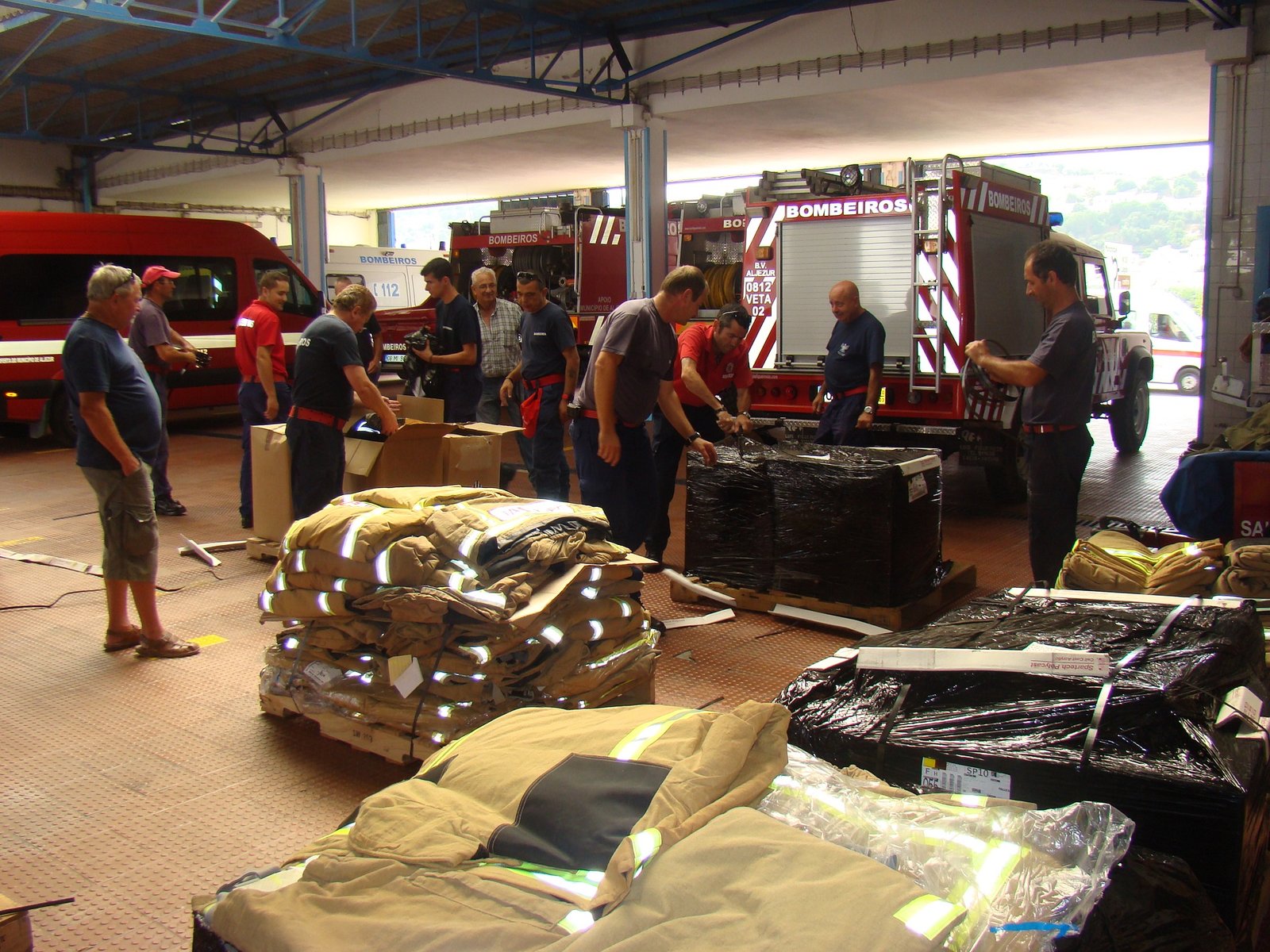
Now, said Davide, each firefighter will have his own set of equipment which means an even more efficient way of dealing with major fires that require a much larger number of personnel to be tackling the blazes simultaneously.

Although the entire municipality of Aljezur has just 5,884 inhabitants, the Bombeiros have to cover a huge area of 324sq kilometres across four parishes, from Odeceixe in the north (with 966 inhabitants in 8,015 hectares), Rogil (1,117 inhabitants, 3,408 hectares), Aljezur itself (3,370 inhabitants, 16,736 hectares) to Bordeira (431 residents, 8,015 hectares) in the south.

That’s a distance of around 32km, or just about 20 miles travelling along the N120 and the N268.

SUMMARY OF EQUIPMENT DONATED:

The PPE (Personal Protection Equipment—fireman’s clothing) consists of 100 pairs of boots (various average sizes plus outsizes), 100 sets of PPE leggings & tunics, again in various sizes, 50 helmets (all this handled by Lancashire Fire & Rescue’s Steve Darby), plus three fire hoses.

From East Grinstead there are 2 x Clan Lucas Hydraulic Cutter kits (for Car Crash Recovery) each with a power pack, 2 combi tools (combination rescue tools are rescue tools that can be used for both cutting and spreading and can be powered by hydraulics or batteries offering rescue teams two functions with one tool), 2 large rams and 2 small rams (used to force apart a crushed vehicle) and two ram extensions.

The donation also includes two 110volt Remscat reciprocating saws, electrically-driven universal saws capable of cutting through steel, brickwork, timber etc, using the interchangeable blades provided. They are to be used with the generators also provided.

The shipment also included some several sets of step chocks which are wedged around parts of a car to prevent it from moving while fire fighters are using the rescue equipment.

There is also an RTC kit (road traffic Collision Kit) and in addition to the cutters and spreaders, there are a number of other small tools on board the fire engine to help fire fighters deal with rescuing people from vehicles.

These include a windscreen glass protector, sharp object covers to warn fire fighters there is a hazard underneath, pedal cutters (to cut car pedals), and a knife specially designed to cut seatbelt straps.

===========================================

Operation Florian

Operation Florian is the charity set up by British fire fighters to save lives overseas by donating reconditioned fire engines and emergency equipment.

We are an international humanitarian charity providing fire engines, equipment and training to the world’s poorest regions who lose millions of lives every year to fires and disasters.

Operation Florian was established as a charity in 1995 (Charity Number 1054657). It is a UK Fire Service Humanitarian Charity working to promote the protection of life amongst communities in need, worldwide, by the provision of equipment and training to improve fire fighting and rescue capabilities.

The charity’s volunteers devote vast amounts of time, fundraising and carrying out other activities so that the charity can continue to provide its vital service all across the globe.

We receive regular requests for assistance worldwide and we are only limited by the funding we can generate and the donations we receive from the UK Fire and Rescue Services and Corporates.

Operation Florian has a Board of Trustees/Directors which is responsible for the management and direction of the charity.  We also have very good Project Managers who are responsible for the delivery of our projects and forming a competent team.

How Operation Florian works

The charity is run purely by volunteers and any member of the emergency services can help. Funds for the charity are made up of fundraising events and donations.

Just about 100% of the funds raised are converted into aid. However, as a registered charity, the demands to meet the exacting rules and expectations has recently required the charity to adopt a more professional basis for support and now employs a consultant, to oversee the administration and fundraising.

More recently, the charity has been able to secure funds by becoming the delivery partner for the UK Ministry Of Defence, itself, part of a much wider international effort concentrating on securing peace across the region. This work has allowed Florian, to deliver significantly more aid in recent years whilst maintaining its operational autonomy and decision making. Even though it is delivering to joint aims, it is able to maintain its own profile and presence.

There is no doubt that the success of the early years has provided a profile and access for Operation Florian, that few, if any other governmental or non governmental agencies have been able to achieve.

As with all charities, raising funds remains the single biggest focus, for without them we are not able to deliver our prime purpose. What we offer, is a significant profile for companies, who wish to be associated with a successful charity that has proven international success and recognition.

Operation Florian’s uniqueness, lies within its ability to provide a local focus for delivery of local needs and priorities. Often the earliest mission is to carry out a scoping visit, to learn as much as possible about the environment and needs. It is this that forms the backdrop, to identifying the type of aid needed. This also provides the opportunity to build local relationships and awareness of what Florian is all about.
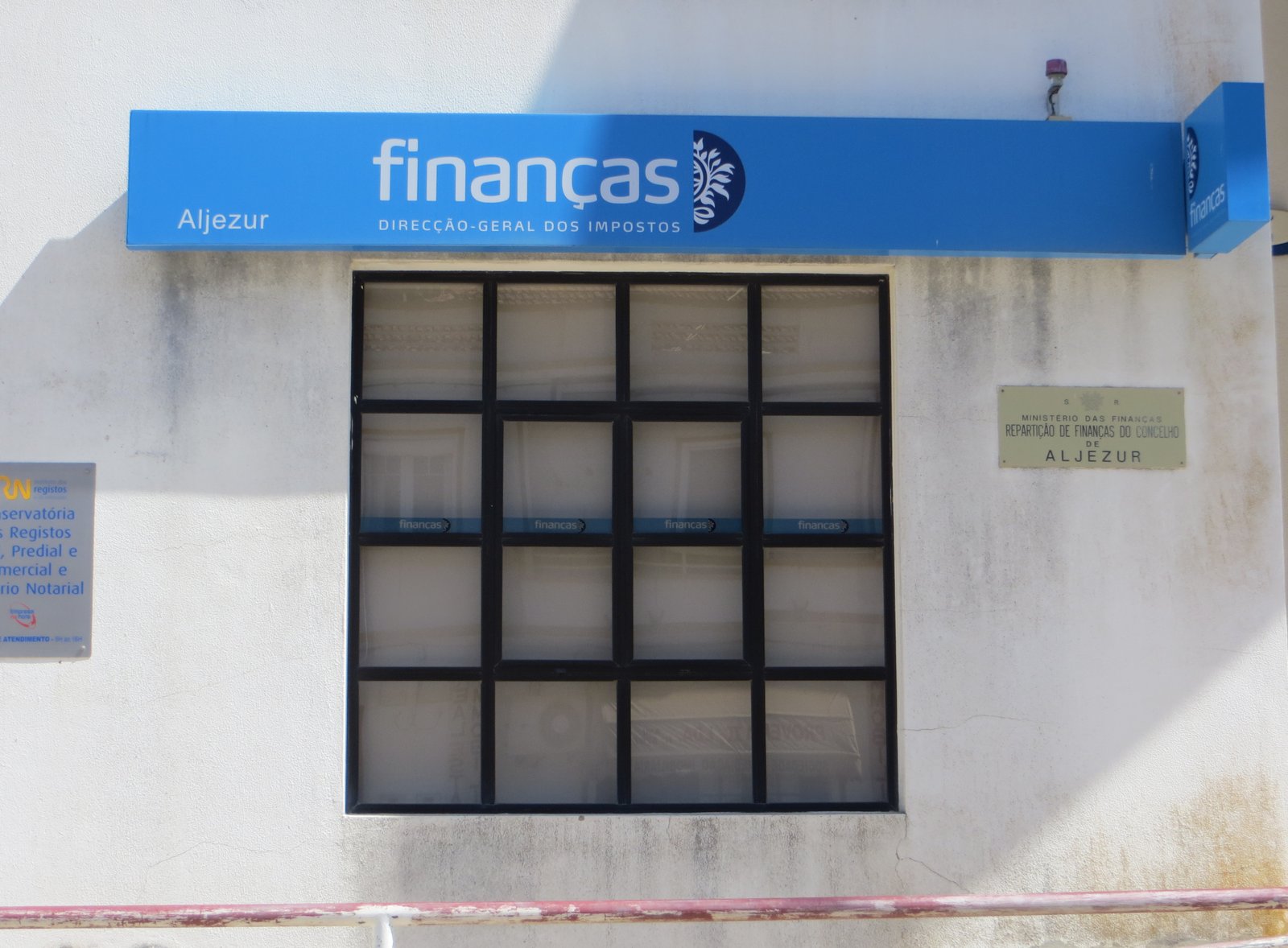
Aljezur fights tax office closure


From The Algarve Daily News

http://algarvedailynews.com/


The Municipality of Aljezur has condemned the planned closure of the local Finanças office.

A statement from the President of the council José Amarelinho confirms that the Directorate General of Taxation intends to close several local Finanças offices in the Algarve, including the tax offices in Alcoutim, Castro Marim, São Brás, Monchique, Aljezur and Vila do Bispo.

“This information makes us seriously concerned that we may be facing another strong attack on local autonomy and the quality of life of our people, contributing to the exodus from these areas of low population densities,” criticized the mayor of Aljezur.

According to Amarelinho this situation is even more severe for Aljezur,  given that “our municipality has an elderly population, with a large percentage of residents having limited mobility and who can get to major urban centres by themselves.”

“We believe that the process of reorganising Finanças’ services should be a process done in a transparent and participatory way, negotiated, explained and never imposed,” says the Mayor of Lagos, promising much opposition to the closure of the tax office – after the local elections.

ALJEZUR’S AMAZING ALPACAS

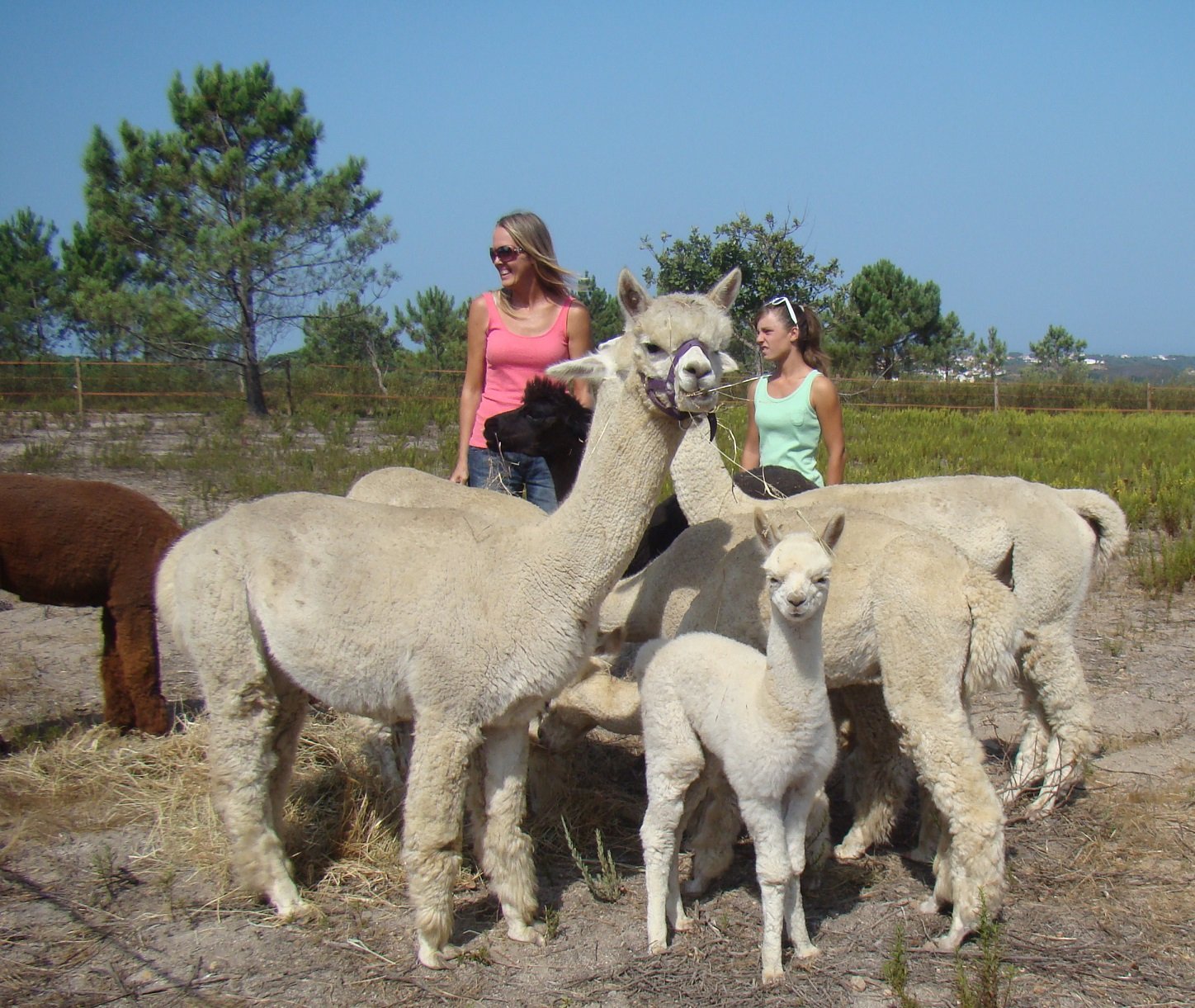
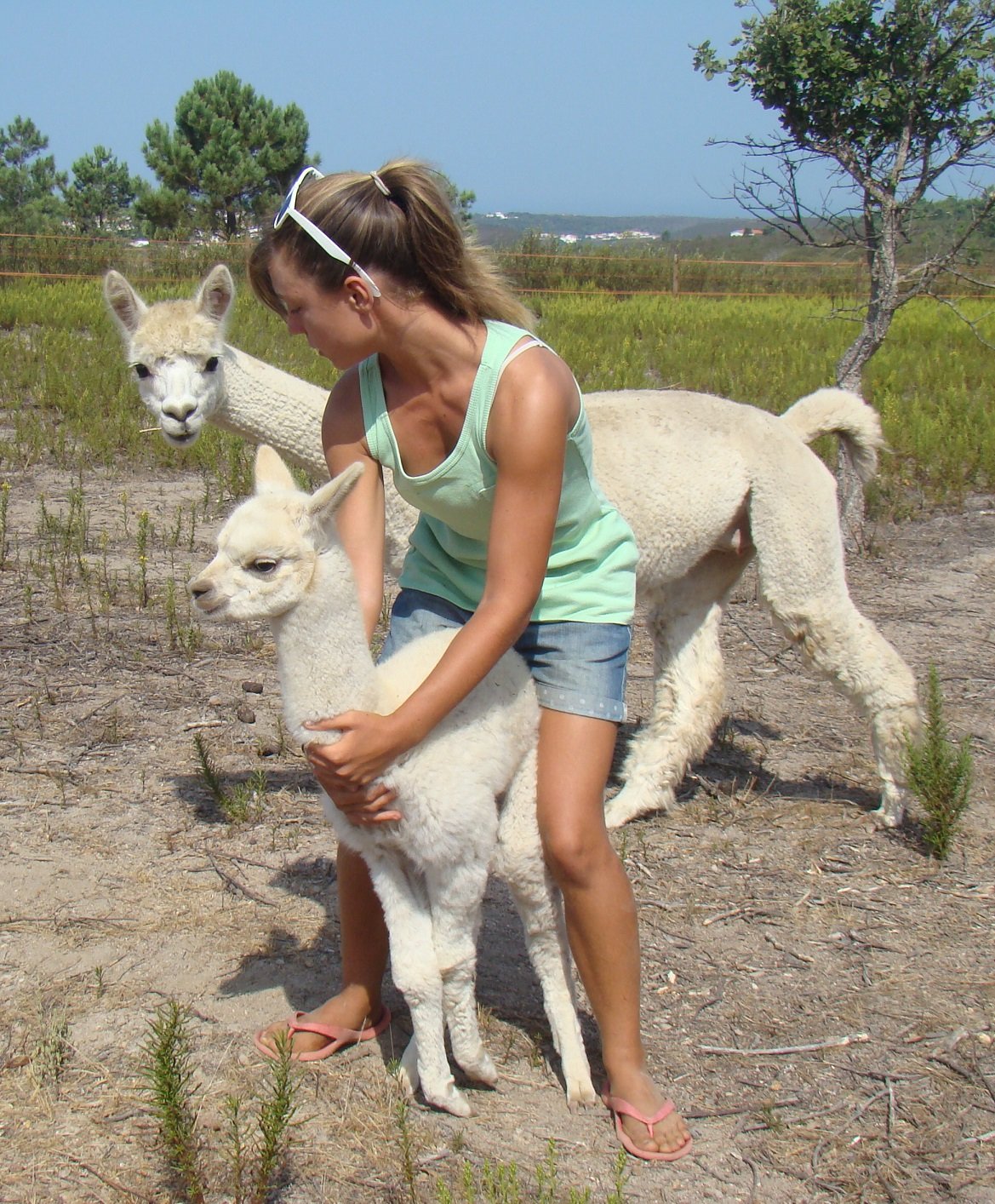
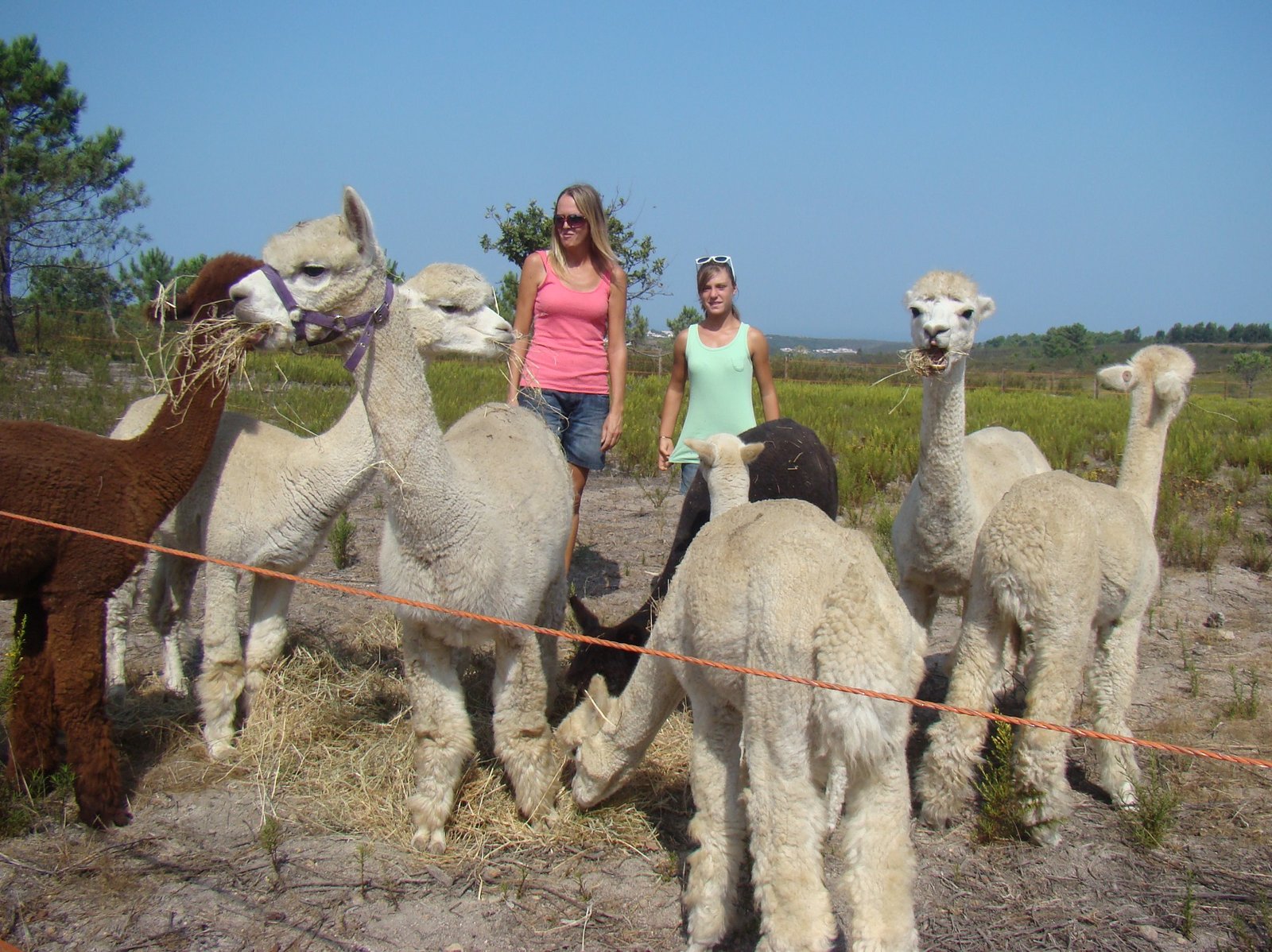
Sally And Selina With The Alpacas

     By Matt D’Arcy


The Algarve’s west coast is not the Andes, nor does it soar 5,000 metres above sea level.

But it is now home to a herd of animals which originated in those high plains of west-central South America; the alpaca.

Matt and Sally Henman have created “Aljezur Alpacas” here on the Vale da Telha plateau.

And although their paddocks are capable of sustaining up to 100 alpacas, they intend to increase their current herd from eight to a maximum of 50 through a careful breeding programme in association with other pedigree farms including the nearest such breeder, based in Andalusia in Spain.

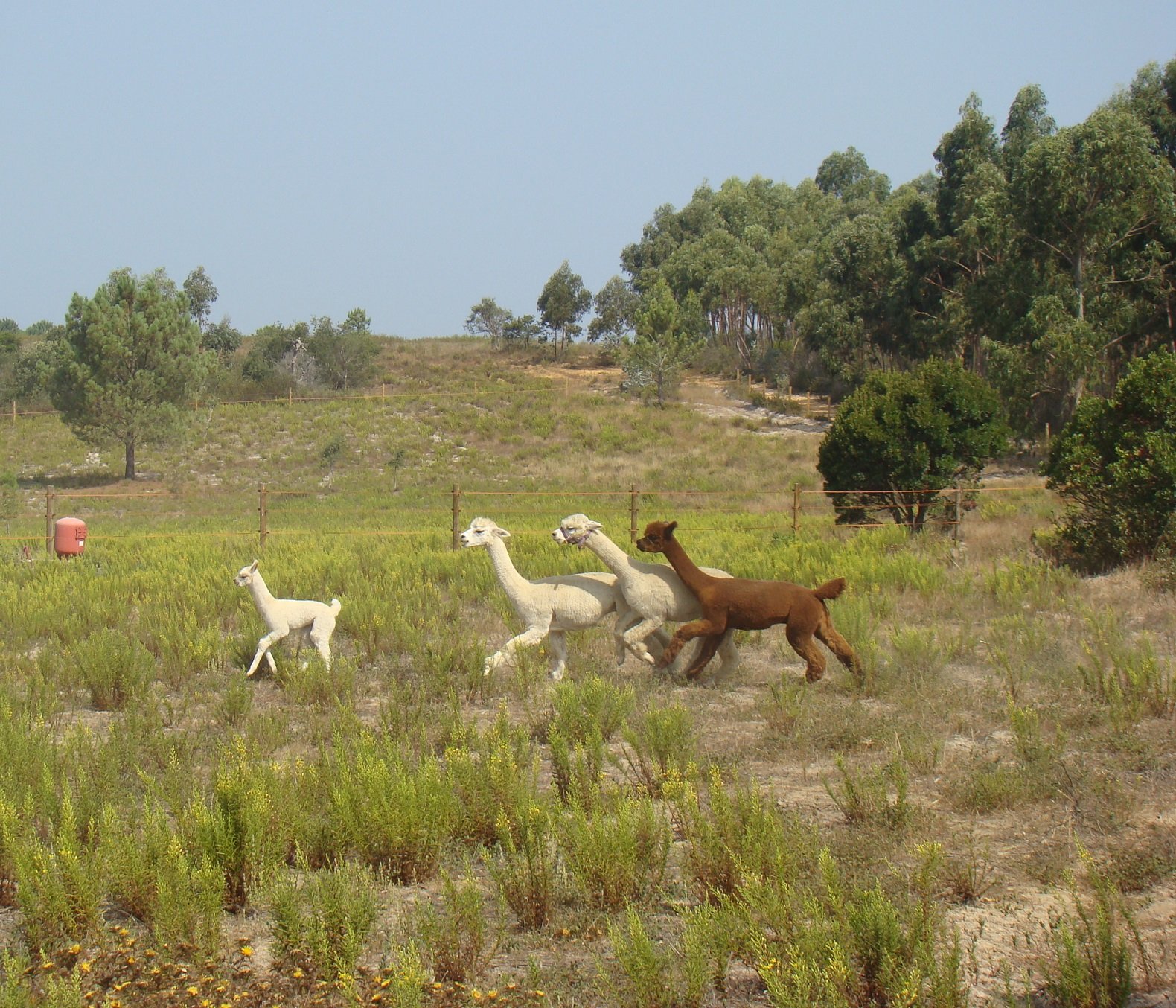
In fact, they have already had their first Aljezur-born cria(the name for baby alpacas, much like foals to horses) who now goes by the name of Dumbledore, so the

Dumbledore Leads The Charge

project is already healthily under way.

Although alpaca meat is seen in some quarters to be healthy and flavourful, high in protein, Matt and Sally plan only to breed a stock with a 100 per cent pedigree bloodline to sell to other breeders, and to use the animals’ sumptuously soft fleece, or fibre, for commercial purposes.

Alpaca fibre is widely recognised as one of the most luxurious fibres in the world, and comes in 22 officially recognised colours and every shade in between. It is used for making designer clothes as well as knitted and woven items similar to, but much superior to, wool; items that include blankets, sweaters, hats, gloves, scarves, socks, coats and even bedding.

Dumbledore Leads Them On A Merry Chase

Aljezur’s alpacas are already very much at home in the Henman family’s paddocks to the east of Sector E in Vale da Telha, out towards the top of the hill leading up from Aljezur, despite their forebears being ideally suited to life 16,000ft above sea level!

Matt and Sally moved here from Edinburgh where Sally was in the Travel and Tourism Industry and Matt was working in Insurance and Pensions. They felt that their three children, Selina (now 13), Aiden (11) and 6 year-old Jamie would have a better lifestyle and quality of life growing up in rural Portugal than growing up in the UK.

The couple have long been intrigued by the possibilities and prospects of alpaca farming and breeding and, as they already owned a property in Vale da Telha, they felt this would be the perfect area to follow the dream.

The Henmans had been visiting Portugal for almost 20 years, mainly around the

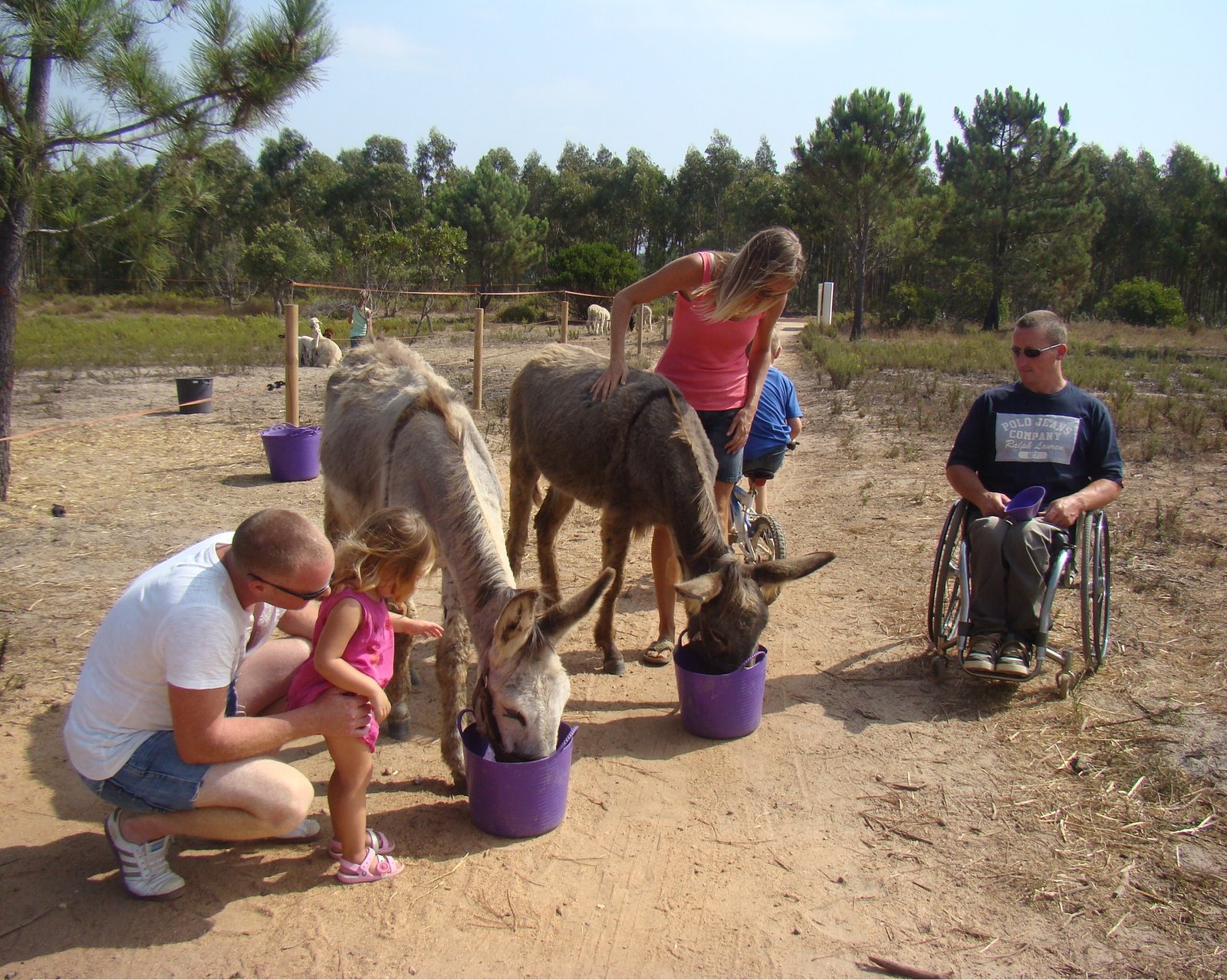
Sally & Matt (Right) Feed The Donkeys, With A Little Help

Almancil area, but found the southern Algarve increasingly noisy and uncomfortably busy to consider making their home there.

Once they visited the West Coast and the Costa Vicentina, they fell in love with the peace and tranquillity of this vast but undeveloped area, and its possibilities, which prompted them to buy a villa on Vale da Telha.

From that anchor-point they began working towards bringing their dream to fruition, firstly by buying 18 acres of land not far from Quinta da Lago Silencioso, with trees, pastures and a stream running along the edge of the property.

They then applied for—and got!—planning permission to build a new house and a storage building on the land. They lived in their older property for two years before finally their habitation licence came though and they officially moved into their new “estate” in July 2013.

By that time they had already been acquiring pedigree alpacas in Suffolk, where they were kept in livery with their breeder.

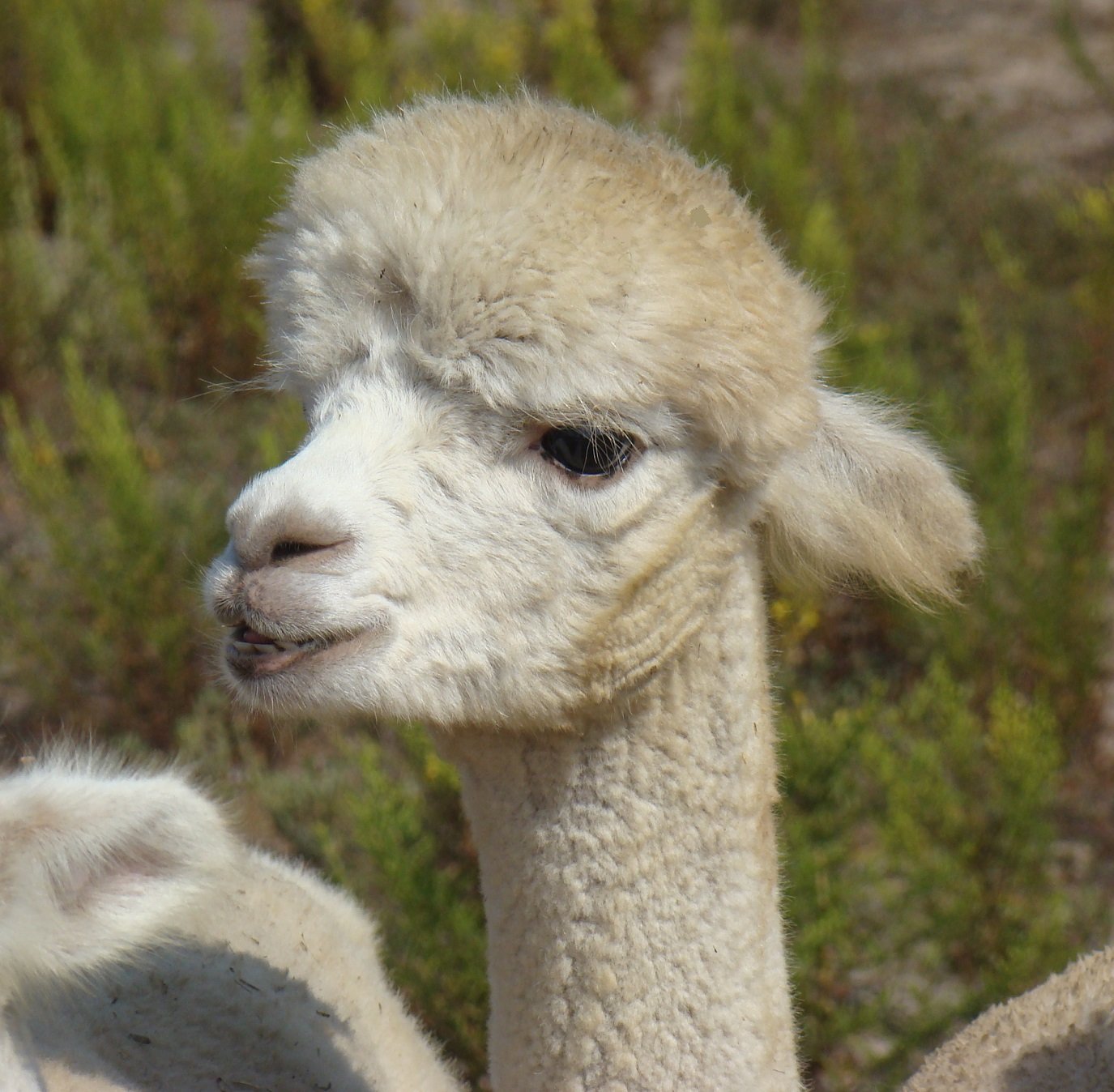
One Of The Alpacas 'Poses' For A Portrait

And when it came to shipping them over to their new home outside Aljezur in the summer of 2013, the “Aljezur Alpacas” totalled seven animals, one of them (named Elektra), already pregnant.

Right at the outset, in 2010, the Henman children had the privilege of naming each alpaca as it came into the family.

They decided to name them after cartoon characters or some of their literary favourites, beginning with the letter “A”, the initial then changing from ‘B’, to ‘C’, etc., each year. This meant the new cria’s name would begin with the letter “D”…and so little Dumbledore was the first of the Aljezur Alpacas to actually be born in Aljezur.

There are other Alpaca farms in Portugal but Matt and Sally decided from the outset that the Aljezur Alpaca bloodline would be 100 per cent pedigree. This means that their breeding programme would have to be scrupulously monitored and, once new blood needs to be introduced to the herd, they will be working with the nearest pedigree stock in Andalusia, in Spain

They decided to work towards creating a herd with a maximum of around 50 alpacas

Dumbledore Takes Centre Stage

to make handling the stock easier and more efficient. All of the veterinary needs, inoculations, vaccinations etc are handled by Matt and Sally themselves as there are no vets sufficiently qualified in this region.

The long-term aim is to breed and sell the stock to other breeders across Europe. Alpaca fleece is highly marketable and Matt and Sally will be looking for ways to best utilise the shearings, with the Middle East a major market for alpaca wool.

For example they displayed the sumptuously soft fleece from their alpacas recently at Fatacil, and a lady who makes soft toys using sheep wool is now interested in replacing that with the much softer and more tactile wool from the alpacas.

Eventually the Henman’s hope that Aljezur Alpacas will benefit the area by playing a key role in attracting more visitors to the area which is already attracting a great deal of media interest across Europe with the opening of the Rota Vicentina and a growing awareness of the natural beauty of the coastline.

Sally intends to build on her experiences of marketing in the tourism trade to promote the business and the attractions of the region, explaining:

“We want to build up people’s awareness of the desirability of alpaca fleeces and wool and to develop the product.

“At the moment people have to import the high-quality fleece of pedigree alpacas. We have it in the garage.”

Dumbledore's Mum Keeps An Eye On Selina With Her Offspring

Sally has also been in discussions with schools in the area to develop a relationship that would benefit the pupils.

The International School already plans to take some of the fleeces from the Aljezur Alpacas and develop a weaving project as part of their curriculum. And as the farm is located on the Costa Vicentina national park and along the route of the Rota Vicentina, with its accent on eco-tourism and sustainable green industries the Henmans hope the Park authorities, looking at “weird and wonderful” projects, will incorporate Aljezur Alpacas into its tourism programme.

Looking further ahead Matt and Sally are exploring the potential of Alpaca Trekking as the animals will happily submit themselves to a lead.

And even their by-products are sellable!

Alpaca manure is dry, formed in small pellets and is virtually odourless but is a highly efficient fertiliser. It can be placed directly onto plants or you can run water through a bag of the manure and use the water to feed the plants.

Sally claims this is every bit as good as more commercially available products like Baby Bio, and they now have a customer base of local people calling in to buy the bags, which are filled by the Henman children.

Matt laughed: “The kids get their pocket money this way.”

The Henman project is still in its early stages. But already the family has 18 ducks, to provide them with fresh eggs (“once they start laying,” Sally said a little ruefully) and a pair of pigs for breeding which will eventually produce all the pork and ham they need, as well as piglets to sell on to other breeders.

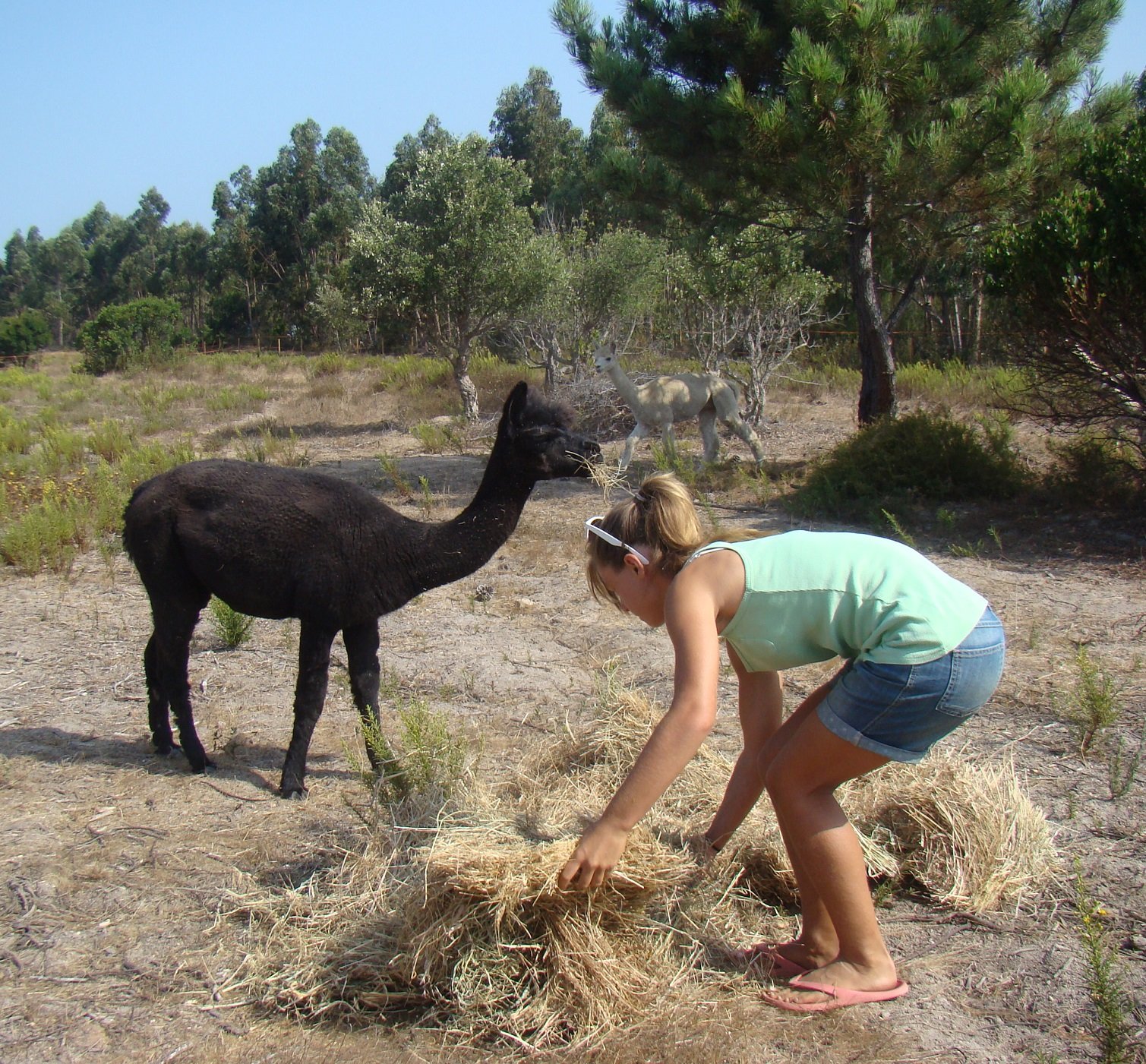
Selina Sets Out Lunch

They also own two donkeys and are currently establishing a boarding kennels for dogs which they say will have plenty of room for the pets to be comfortable, and good quality dog walks to give the boarders plenty of daily exercise, vital for their wellbeing.

Aljezur Alpacas and all its associated parts, is pretty much self-sufficient with the Henmans producing their own electricity from an expanse of solar panels, backed up in the winter by a generator, and all their water comes from their own borehole.

“It’s hard work, but so rewarding,” Sally said.

“It’s wonderful for the children to grow up in an environment like this and for Matt and myself to have a real sense of accomplishment and achievement as we see it all beginning to take shape.

“It is giving us all that we wanted and no-one can ask for more than that.”

Matt and Sally can be contacted by e-mail at:

ALL YOU NEED TO KNOW ABOUT ALPACAS

What are alpacas?

Alpacas originate from the Altiplano (Spanish for high plain) in west-central South America. Spanning the borders of Peru, Chile and Bolivia, this area of the Andes averages nearly 4000 metres. Alpacas are one of the camelid species, closely related to the llama. There are four species of South American camelid – Llamas (Lama glama) and alpacas (Vicugna pacos) are domesticated and vicuna (Vicugna vicugna) and guanaco (Lama guanicoe) remain wild and are protected species. All four are found mainly in Peru in the Andes, with smaller numbers in Chile and Bolivia.

It is believed that the alpaca and the llama were domesticated from the wild species vicuna and guanaco over 6000 years ago. The alpaca was developed primarily as a fleece producing animal with meat as a secondary product.

The llama was developed primarily as a pack animal and has the ability to carry about 25kg of weight on its back and travel 10-12 miles per day up and down the mountains of the Andes.

Alpaca fibre

Its most remarkable quality is its softness – alpaca fibre is inherently soft. This is due to the fact it has less scales on each individual fibre, compared to sheep’s wool which has many, and more prominent scales on each individual fibre. (Suri alpaca have less scales than huacaya alpaca so their fibre is even softer.) Even at its coarsest, alpaca is inherently softer than sheep’s wool and often a certain percentage of alpaca fibre is added to sheep’s wool during the woollen process to enhance the handle or feel.

The lack of scales and smoothness of the fibre also gives alpaca a natural brightness as the smoother surface reflects the light better. Suri alpaca (because it has less scales) reflects the light like a mirror and is renowned for its deep lustre, as well as its luxuriously smooth handle.

History

Alpaca has been a must have item ever since Sir Titus Salt introduced it into the UK marketplace in around 1836. Alpaca coats, gowns and materials were very fashionable during Queen Victoria’s reign – in fact they were so prized and so hardwearing that they were bequeathed in the wills of the deceased to the next generations. Sir Titus became the largest employer in Bradford, West Yorkshire, building the model industrial village of Saltaire in 1851 on the back of this success.

Today, many UK breeders process their own alpaca fibre and sell the yarns and products direct to the public. BAS members are making and selling all kinds of alpaca products, ranging from insoles for boots and wellingtons with coarser fibre, to babywear and exclusive luxury fashion items at the other extreme.

Knitters adore alpaca and rapidly become addicted to it once they have felt the softness and quality of the yarns. South Americans use a lot of heavy bright dyes on their yarns which suit the garments and products they want to make for their home market.

However, here in Europe the attraction is the vast range of natural colours. The natural, subtle but expansive colour palette offered by the alpaca is one of its main attractions. In its natural state, undyed, it also comes with an environmental cache, making it very attractive to the ‘green’ market.

Properties of alpaca

Alpaca is a dry fibre with a minimum lanolin content which means it does not need to be scoured prior to spinning. It can be spun into yarn straight from the fleece and is often washed at the hank (a coiled bundle or yarn) stage of processing.

At its finest alpaca fibre gets as low as 15-16 microns (the mean of the fibre diameters or average diameter) which is very fine indeed, in fact it is often described as a hard wearing cashmere. At its finest it is used like cashmere to produce high quality, luxury garments in both the woollen process for knitwear and weaving and in the worsted process for fine suiting and materials.

Suri fleece

The fibre from the huacaya alpaca (those that look like teddy bears) is more suited to the woollen process and the fibre from the suri alpaca is a lot like silk and more akin to the worsted process. At its finest, women’s lingerie can be made from suri fibre.

However, even on a global scale, alpaca fibre is still very much a niche market. There are roughly three million kg of alpaca fibre produced in South America every year and this still only represents .04% of all the fibres processed in any given year. The average alpaca produces around 2.4kg of alpaca fibre per annum, with some having the potential to produce around 4-6kg per annum.

Why keep alpacas?

Alpacas are a niche market livestock enabling owners with small acreages the ability to trade and earn income from their land. There is growing demand for quality alpacas developing throughout the UK and Europe. Quality alpaca fleece is a rare commodity and alpacas that can produce this throughout their lifespan will always command a premium.

The breeding of the alpaca as a luxury fibre producing animal has seen dramatic improvements. As breeders worldwide return the alpaca to its pre-Conquest quality, the potential becomes more apparent with each breeding season.

However, some geneticists consider that even the best alpaca in the world today is still only 50% of what it once was.

Excitingly in the UK, alongside a very sophisticated breeding industry, a vibrant marketplace for alpaca fibre is emerging. This will only improve as alpaca yarns and products gain popularity and command more of a market share from the other niche fibres.

As a unique niche fibre that has a fixed growth potential in South America due to limitations in grazing and husbandry, as well as climactic restrictions, the production of quality assured alpaca fibre outside of South America has huge potential in the European marketplace.

Attracted by the softness of the fine yarns and the abundance of shades in natural undyed colours, the modern world is embracing alpaca with a passion. And although the industry will always be subject to the whims of fashion, it is worth considering that the total alpaca production in the world today represents only .04% of the world production of processed fibres – the potential for alpaca is huge.

Information sourced from The British Alpaca Society at: http://www.bas-uk.com/

Refugio Social Nuphar Lutea / Associação – POSTPONED


THIS EVENT HAS BEEN POSTPONED


Amovate have been asked to advertise this local event on behalf of this charitable organisation.

REFUGIO SOCIAL ­ NUPHAR LUTEA / ASSOCIAÇÃO – has a heart for the homeless and needy and has acquired premises in Vila Real to be used as a feeding station, but it lacks any kitchen equipment –  fridge, cooker, etc. This event is to raise funds for this. The association also has plans for a permanent social refuge in Lagos.


~~~~~~~~~~~~~~~~~~~~~~~~~~~~~~~~~~~~

Note from the President of the Câmara

Amovate have today received an advisory note from the President of the Câmara. We have obtained a computer generated translation into English and attached is both the original and the translation.

The main purpose of this note is to advise members that the Court of Appeal in Evora has overturned the Judgement made by the Lagos Court in June 2012

The President is unsure that people are aware of this decision and he wanted people to know the facts:


Estimados:

Em anexo nota que remetemos à imprensa em Maio do corrente ano, no âmbito do recurso que haviamos apresentado para o Tribunal da Relação de Évora e que declarou NULO o acordão/sentença do Tribunal de Lagos, a propósito do processo de Vale da Telha, facto que pode ainda não ser do conhecimento de alguns de vós.

Com a habitual estima e consideração, apresento os meus respeitosos cumprimentos.
03/09/2013
José Amarelinho

Tribunal da Relação Évora, declara NULO acórdão proferido!

No âmbito do processo 592/03.2TAEVR, no qual eram arguidos, entre outros, Jose Manuel Velhinho Amarelinho e Manuel de Jesus Marreiros, demos conta em junho de 2012, do acórdão, proferido pela Meritíssima Juíza Presidente do Coletivo do Tribunal Judicial de Lagos, que nos sentenciou como à altura tornámos público.

De igual modo queremos hoje trazer ao vosso conhecimento a decisão do Tribunal da Relação de Évora, para onde havíamos recorrido e que declarou nulo o acórdão então proferido.

Sem prejuízo da leitura integral do acórdão agora produzido, consideramos pertinente destacar as passagens que abaixo passamos a reproduzir/transcrever:

(…)”…,em momento algum foi comunicada aos Arguidos Manuel José de Jesus Marreiros e José Manuel  Velhinho Amarelinho a possibilidade de imposição da perda de mandato.

Deste modo, a imposição aos Recorrentes da perda de mandato prevista na alínea f) do artigo 29 º da Lei nº 34/87, de 16 de julho, constitui alteração da qualificação jurídica dos factos descritos na acusação sem que tivesse sido cumprido o formalismo exigido pelo artigo 358º do Código de Processo Penal.

O que acarreta a nulidade da sentença prevista na alínea b) do nº 1 do artigo 379º do Código do Processo Penal …”

(…) “As regras constantes do artigo 374º do Código de Processo Penal corporizam a exigência consagrada no artigo 205º, nº1 da Constituição da Republica Portuguesa – dever de fundamentação das decisões dos Tribunais que não sejam de mero expediente.

Dever de fundamentação que, reportado à sentença, abrange a matéria de facto e a matéria de direito, para que tal peça processual contenha os elementos que, por via das regras da experiência ou de critérios lógicos, conduziram o Tribunal a proferir aquela decisão e não outra.

Da conjugação dos mencionados preceitos legais decorre que a sentença deve ser fundamentada e que a sentença que não seja fundamentada é nula”(…)

(…)”Não basta, pois, uma declaração genérica tabelar – que lesaria as garantias de defesa  do arguido, por não assegurar a apreciação de toda a matéria da acusação e da defesa, permitindo julgamentos implícitos e subtraídos a toda e qualquer fiscalização -, sendo imprescindível que a fundamentação, como base de um processo decisório, se exteriorize em termos que permita acompanhar o percurso cognoscitivo e valorativo que explicite, justificando, uma concreta tomada de posição jurisdicional”(…)

(…)”Concluindo, a sentença recorrida exibe uma deficiente análise critica da prova produzida, não permitindo aos seus destinatários e também a esta Relação alcançar o raciocínio efetuado pelos julgadores subjacente à factualidade que consideram como provada e não provada.

Deficiência que equivalendo à ausência de exame crítico da prova acarreta a consequência prevista na alínea a) do nº 1 do artigo 379º do Código do Processo Penal – nulidade da sentença.”(…)

(…)”O volumoso acervo documental reunido nos autos” que, na perspectiva dos Julgadores, demonstra as atuações dos Arguidos, não foi objeto de avaliação, nem no local próprio onde deve ser feita(motivação ou fundamentação da matéria de facto) nem em qualquer outro lugar.”(…)

(…)”…Tribunal recorrido limitou-se a relatar o conteúdo dos depoimentos produzidos, na parte em que os considerou relevantes, sem os conjugar, em concreto, com os outros meios de prova.”

(…)”As deficiências apontadas, equivalendo à ausência de exame critico da prova, acarretam a consequência prevista na alínea a) do nº 1 do artigo 379º do Código de Processo Penal – nulidade do acórdão.”

A todos, em particular aos Aljezurenses, agradecemos toda a amizade, solidariedade e preocupação sempre reveladas desde a primeira hora. Bem hajam!

Melhores cumprimentos.

José Amarelinho

Manuel Marreiros

Aljezur, 28 de Maio de 2013

~~~~~~~~~~~~~~~~~~~~~~~~~

Dear Sirs:
Attached please note that reference is made to the press in May of this year, in the context of the appeal that we presented to the Court of Appeal of Evora which has declared null and void the sentence of the Court of Lagos, relating to the purpose of the process of Vale da Telha, a fact that may not be known to some of you.
With the usual esteem and consideration, I present my respectful greetings.
03/09/2013
José Amarelinho
===
This is a computer-generated translation of the judgement sent by the Mayor…
Court of appeal Évora, declares NULL judgement!
59203.2 process TAEVR, in which were the accused, among others, Jose Manuel Amarelinho and Manuel de Jesus Marreiros, realized in June 2012, the judgment, delivered by the Honourable President of the collective of Judges of the Lagos Court, of which the sentence given to us was immediately made available to the public.
Similarly we would like to bring your attention to the findings of the court of appeal in Evora, to which we appealed to against the original sentence, today and to bring your attention to  their decision of which they ruled that the original sentence was null and void!
Without prejudice to the full reading of the judgment now produced, we consider it pertinent to highlight passages below we come to reproduce:
(…)”… at no time was it communicated to the Defendants Manuel José de Jesus Marreiros and José Manuel Old Yellowing the possibility of losing their mandate.
Accordingly, the imposition on the Recurring loss of mandate referred to in paragraph (f)) of article 29 of law No. 3487, of 16 July, is changing the legal classification of the facts described in the indictment without had been fulfilled the formalism required by article 358º of the code of criminal procedure.
What entails the nullity of the sentence referred to in paragraph b) of paragraph 1 of article 379º of the code of criminal procedure. ”
(…) “The rules contained in article 374º of the code of criminal procedure are part of the requirement enshrined in article 205º, paragraph 1 of the Constitution of the Portuguese Republic – obligation to state reasons in the decisions of the
(…)”Not just a generic statement table – that would interfere the guarantees of the accused’s defence, not to ensure the enjoyment of all matter of prosecution and defence, allowing implicit judgments and subtracted to any oversight, being essential that the statement of reasons, as the basis of a decision-making process, if he touches in terms that may accompany the cognitive path and value which is self-explanatory, justifying, a concrete judicial stance “(…)
(…)”In conclusion, the contested sentence displays a critical analysis of deficient evidence produced, not allowing your recipients and also this relationship reach the reasoning made by judges behind the factuality that consider how proven and unproven.
Disability which equivalent to absence of critical examination of the evidence entails the consequences referred to in (a)) of paragraph 1 of article 379º of the code of criminal procedure – invalidity of the sentence. “(…)
(…)”The voluminous documentary collection assembled in the records “that, in view of the Judges, demonstrates the actions of the Defendants, was the subject of evaluation, nor on the site itself where it should be made (motivation or justification of matter of fact) nor anywhere else.”(…)
(…)”…Court defendant merely report the content of the statements made, in so far as it considered relevant, without the balance, in concrete, with the other evidence. ”
(…)”The deficiencies identified, equivalent to the absence of critical examination
Everyone, in particular the people of Aljezure, we appreciate all the friendship, solidarity and concern always revealed since the first hour. Thank you!

Best Regards.

José Amarelinho

Manuel Marreiros