



 By Matt D’Arcy
Part 1
SUSAN AND BRIAN JUTSUM recently spent almost two months experiencing the Arabian culture and lifestyle of Morocco, becoming immersed not just in the tourist-friendly big city centres but also living, eating and sleeping amongst the tribal peoples of the High Atlas, the deserts and the Deep Gorges.
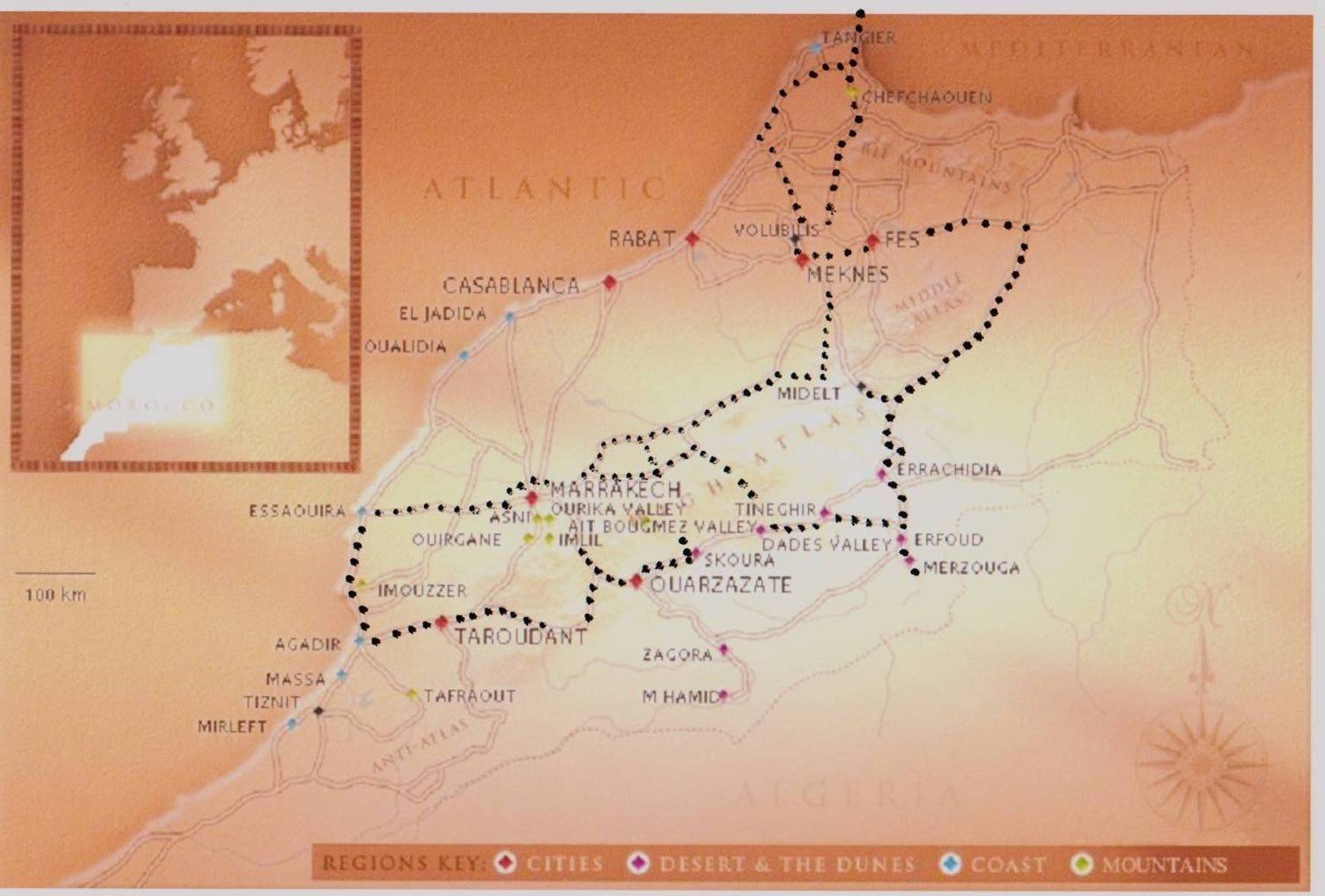
Susan & Brian's Route
The Amovate members, who live on Vale da Telha, made the crossing from Spain to Ceuta in Morocco on December 27th and returned home mid-February after the ambitious adventure in their motor home, accompanied everywhere by their dog Sofie.
Susan kept a daily diary of their travels and also took thousands of photographs, enabling us to post this story of their Arabian Adventures here on the Amovate website.
The changes in culture across this short distance over the Straits of Gibraltar made a huge impact on the Jutsums—but in a more positive way than they had imagined.
“We had a truly memorable time, made even better by the people we met, the truly magnificent scenery and the diversity of Morocco; sand, snow, heat and cold,” they said. “It was probably more of an experience than a holiday.”
The overriding memories of the encounter with such a different culture, beliefs and values which they took away are: “Children, donkeys, markets, camels, mud houses, carpets, scenery, to name but a few.”
They added: “It was colder than we had expected and contrary to what we had been led to believe, very much safer. Not once did we feel unsafe or threatened, and we could never say that about the UK or Spain!
“Food for thought, perhaps; no alcohol helps?”
On arrival they camped in Maril, on the seaside near Tetouan, south of the ferry port of Ceuta where their first impressions were:
“It was all so clean, street cleaners everywhere and no litter. You could eat your dinner from the pavements. Every man seems to smoke but no tab ends anywhere. It feels a lot safer than last night in Spain near the Port.”
But those impressions of cleanliness were to change as they moved away from the tourist areas, Susan explaining:
“The rubbish and litter problems everywhere else were overwhelming and I think by the time we were on the way back home we had become anaesthetised to the litter; Portugal is so clean and immaculate by comparison.
“The litter problem in Morocco is horrendous especially with plastic bags they are strewn across fields everywhere you go. Largely Morocco has no infrastructure and no education so big problems are being stored for the future.
“Would we recommend Morocco for a holiday? NO! The only way to see the real Morocco is as an independent traveller, under your own steam, not as a tourist. Not many people we know would cope with the sanitary arrangements and the rubbish.”
But Susan and Brian emphasise that this, albeit literally, was the only blot on the landscape of a country where the people were warm-hearted, friendly and hospitable, where the scenery was spectacular and spellbinding and where a mere seven weeks has left the legacy of a lifetime of happy and vivid memories.
+++
Here, Sofie the dog insists she has something to contribute to this recollection.
“I loved all the amazing smells—after all we dogs don’t recognise bad smells, we just appreciate the thousands and thousands of scents we can explore.
“But Morocco was a canine culture shock for me, too. I was terribly confused because we dogs like to scent other dogs when we need to wee-wee or have a little poo but no-one there keeps dogs, so I had no scents to sniff out. I just had to leave my own.
“Muslims apparently don’t keep dogs (what strange people!) and not only did some of the Arab people avoid me, some of the children screamed.
“But when we went deeper into the country with the Berber people it was really nice place because the Berbers, and especially the children, all smiled at me and petted me. I became quite an attraction but then what would you expect as I am a very nice dog, even though I do say so myself.
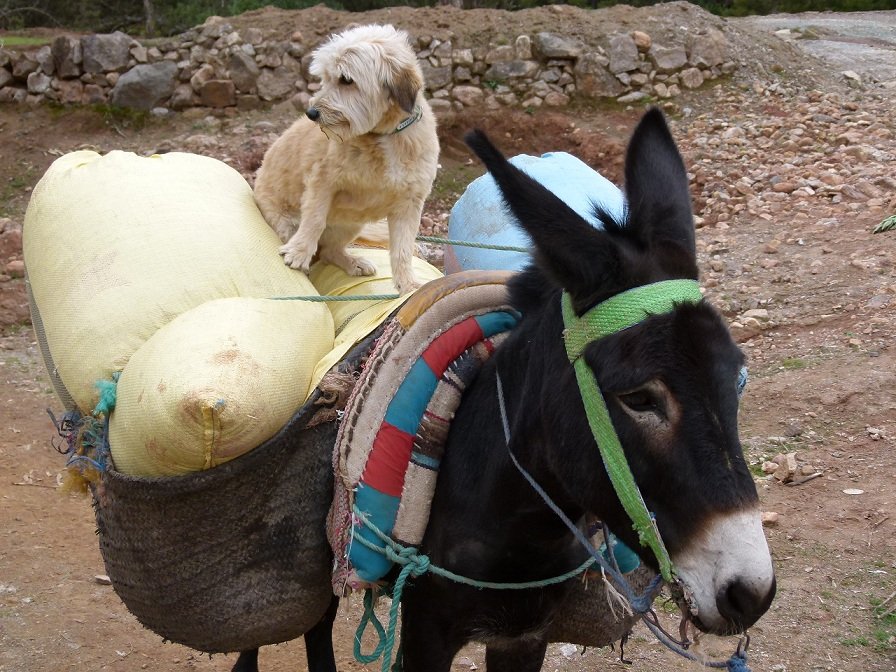
Sofie On A Donkey
“I was quite a celebrity there and my owners, Susan and Brian, just about coped with the hordes of Berber children who are not frightened of me unlike the Arabs.
“So they have to tell them I bite or they would have no peace and no Sofie, because the children all wanted to hold me and lead me away.
“At one point I even had a ride on a donkey which was quite nice as it gave me a rest and a new vantage point to watch this wonderful new world go by.”
+++
The Jutsums first full day in Morocco saw them head off to Chefchaouen, a town tucked away in the Rif Mountains and a place where hashish and cannabis is grown.
In Moulay Idriss, fabulously situated between two hills they bought top quality fillet steak for 7 euros a kilo. In the small intimate Medina they went inside an olive oil pressing shop where the olives are pressed in a similar way to the way Susan and Brian press apples on the land they own in Rogil, but with mats between the olives. The waste skins are then used as fertiliser.
Susan recalled: “The workshop looked quite Dickensian with the Berber watching over proceedings and of course they would allow no photographs to be taken.
“Everyone here owns a donkey, and you would not want to be a woman – they work so very hard, and the men drink mint tea all day. But people look happy.”
From there they moved on to Volubilis, the World Heritage site of the best-preserved Roman town in Morocco, where, for one euro each, they spent a good 3 hours wandering in the sun looking at mosaics and the remnants of houses.
They then saw in the New Year in Fes, where they were in bed for 11pm, with nothing at all happening on their campsite, 7 km from the town.
From there they visited the Medina, which was huge about 1 1/2 k diagonally across.
“We had to have a guide to show us the tanneries where the animals are taken for skinning and the hides made into leather,” said Susan. “We saw all the processes, and the workers still use their feet to press the hides. “Apparently by about 45 years-old they have to pass the job on to another family member as they develop arthritis in the feet and toes.
“The Petite Taxi back was to say the least interesting, like a chase scene from a film, cars everywhere, horns going and the taxi going up the wrong side of the road in 40 minutes of excitement we could do without, and all for 2.4 euros.”
Next port of call was Taza, Susan admitting: “I read a blog on the Internet saying don’t go to Taza so we did—not to the town, but to the National Park, Jbel Tazzeka, which meant 139 fabulous kilometres of driving around 6,000 ft high middle Atlas gorges.
“We stayed one night wild camping, no phone, no Internet just us, no problems whatsoever, except for the cold! It is 24 degrees in the day and -5 at night and not a breath of wind anywhere.
“The cold at night gets into your bones; it really penetrates. We had to sleep in the van with the heating on all night
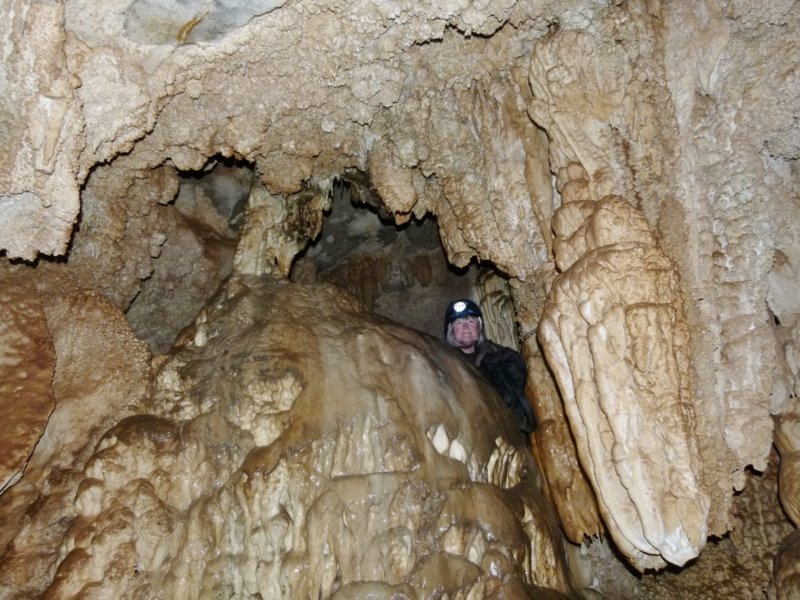
Cave Interior
“We visited a fabulous cave here, not a show cave, really beautiful with a depth of half a mile, and no artificial lighting. If you know Alum Pot in Yorkshire this knocks it into a cocked hat so to speak.
“It was quite gruelling managing almost 600 stone steps carved out of the walls, some 18ins deep and wide and some 3 ins deep. It also meant crawling under deep overhangs, pitches and ladders—lots of clean underwear required after this!
“After one hour when we got to the bottom of the first section (the 580 steps) we had to do a strenuous climb. I pulled a groin muscle and started feeling faint, and as I did not want to stop Brian seeing the only thing he wanted to see they went on without me.
“The descent took us down and down over planks across water and more ladders and pitches. We had our own caving equipment—we wouldn’t have been allowed in without it—but had to have a guide. He was a great kid only 15, and a member of the family who owned the cave.
“I waited in the dark for an hour and managed to get down from my perch and climb up alone until a difficult under climb where I waited again for their return one hour later.
“It was exhilarating and the climb up tough, the spirit is always willing but the bones are a little older than when we did a lot of this in our 30’s in Yorkshire. Emerging back out into the sunshine was lovely.
“Three days later we were both still aching, but it was worth it.”
Susan continued: “Around this national park people don’t even have a donkey as they are too poor.
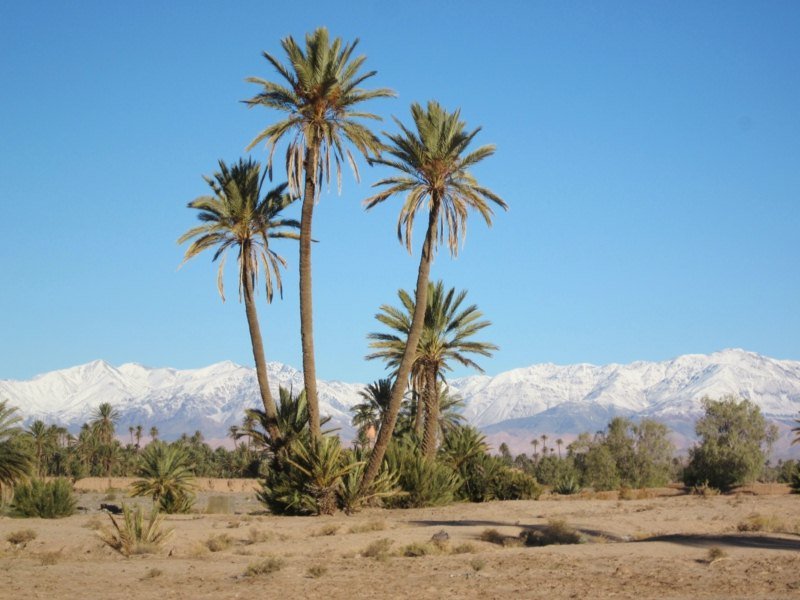
1st Snowfall In Skoura Desert For 30 Years
“From Taza we drove down a desert road passing Guercif and down to Midelt in the foothills of the High Atlas. This was a
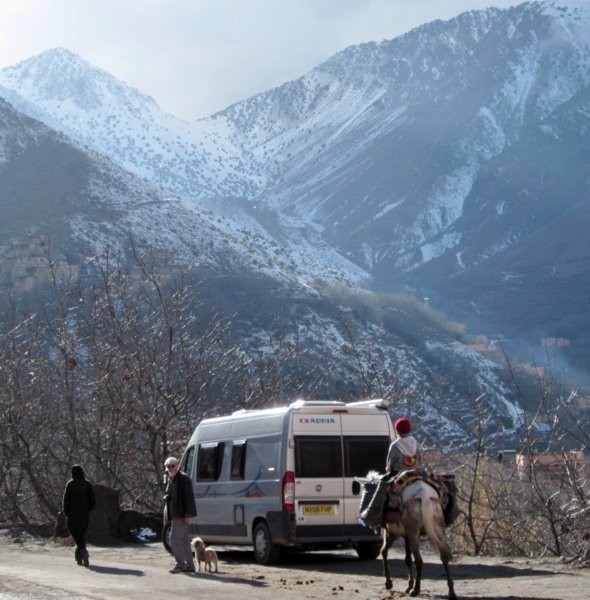
High Atlas at Ain Leuh
long road but lovely scenery passing only goat and camel herdsmen. They all give you a wave and a salute, and seeing our first grazing camels was a lovely sight.
“In Midelt the carpet traders here speak English. Our French is coming on nicely as, up until now, there was no English spoken at all, apart from in Fes. People are more used to tourists here.”
The following day Susan and Brian began their journey to the High Atlas and Deep Gorges, starting in the town of Rich.
“This is where our holiday will really start,” she wrote.” We can camp in the desert with the tribespeople, which sounds great.”
READ PART 2 For the next instalment…………………………..
~~~~~~~~~~~~~~~~~~~~~~~~~~~~~~~~~~~~~~~~~~~~~~~~~~~~~~~~~~~~~~