Yearly Archives: 2015

61 Years Ago This Month Snow Blanketed The Algarve

From:

http://www.sulinformacao.pt/2014/02/o-algarve-cobriu-se-de-neve-ha-60-anos/

Translated by Google software

By Aurelio Nuno Cabrita*
23/02/2014
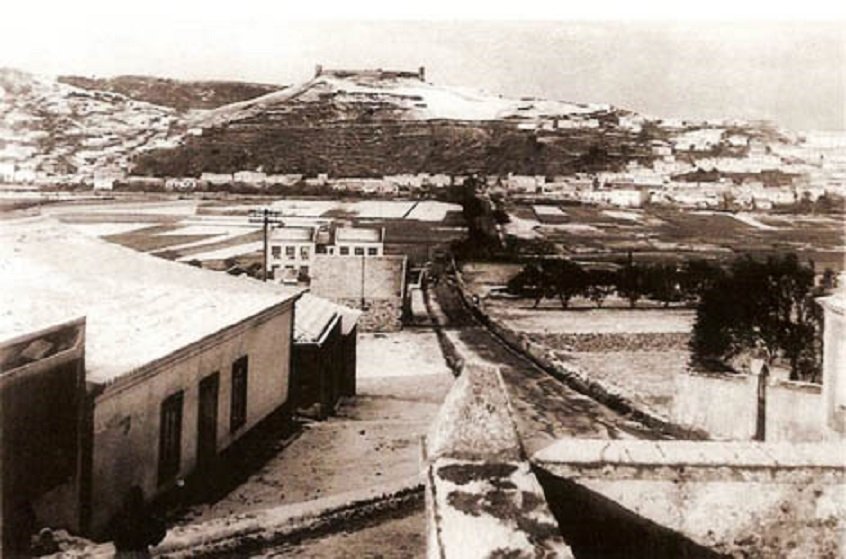
 

Snow In Aljezur

Snow In Aljezur

The month of February has been, over the past decades, rich in natural events.

On February 15, 1941, the country was hit by a violent storm and, in 1969, on the 28th of the same month, it was shaken by the largest earthquake recorded in the twentieth century, in mainland Portugal.

Scarcely fifteen years earlier, on February 2, 1954, another miracle happened – a big snowfall covered the country from north to south. (The snowfall affected our little town of Aljezur as you can see in the photograph, taken from Igreja Nova, what is now the GNR HQ the first building on the left).

Although experiencing a very intense cold, not only in Portugal, but also in the rest of Europe, nothing could foresee the unusual event. The Algarve, used to mild temperatures, despaired before the cold that had invaded and despite the harbingers of spring with the arrival of the swallows, lived through days of an icy winter that led to the fall of a heavy snowfall.

It was an unusual phenomenon, but not unheard of in the South, this arrival for a few hours of a rare Algarve snow – the snowflakes falling, it was said, like the petals of almond.

For its uniqueness, the snowfall was recorded in the memory of all who witnessed it and was widely spread by the journals of the time as the “Daily News” (DN), “The Century” and “The Voice”. It is through the annals of these papers that we revisit the region for those odd days.

On 1 February, the DN recorded snowfall in Lagos and Odiáxere, causing great confusion among popular. Also in Lagos, were seen a few flakes still January 31, but it was February 2 that the snow hit, there and throughout the region.

At its peak: “This afternoon [February 2] from 16 to 19 hours, snow fell with greater intensity, so the city was all covered in white. On the roads snow reached between 10 and 20 inches tall. There is no memory among the elderly people of the land of anything similar to what now witnessed and it is commented how strange a phenomenon it is in these parts. “The temperature dropped quite dramatically, reaching, in Portimão, 1 ° C.” according to The Voice.

In Bensafrim, snow fell for over an hour, changing the landscape: “The roofs, paths, and the fields have taken on a charming aspect, with its immaculate whiteness, never seen before in these areas. The snow cover reached a few inches thick and served as fun for the children”.

Lagos fell “under an icy cold”, along with drizzle. In Odeceixe, the phenomenon lasted for three hours, snowfall in some places, being more than 8 inches deep, leaving the fields “completely white”, an unprecedented vision.

Also in Lagos it snowed abundantly. The same happened in Porches, while in neighboring Pera Pera, just in almond snow caused admiration: “a wonderful spectacle never seen in this town.” “With a uniform shade of sky of lead and absence of wind, snow fell in the morning, on this location. The roofs and the fields were completely white and the show for the first time here observed, strongly impressed the population.”

About Alcantarilha was published: “The cold has been very intense. In the morning dropped a snowfall, which astonished many people, because in truth there is no memory of such a large amount of snow. The extremely light flakes, seemed petals of almond flowers.” In the railway junction of Tunes, the village “agreed under a thick blanket of snow. No memory of a snowfall so in the Algarve.”

In the old city of Silves, “snow fell on this city and surroundings all afternoon yesterday, providing a rare beauty show. No-one remembers such low temperature, nor so much snow,” as reported “The Voice”, referring again: “Today, because of the snowfall that fell during the night, the fields, rooftops, trees and streets were covered with great snow cover, whose appearance was charming as in some points the white layer reached 40 cm in height. The entire population rushed to higher ground, to witness so beautiful an aspect which remained until the sun broke everything. ”

The same happened in São Bartolomeu de Messines: “It snowed yesterday with such intensity that in just over two hours the snow reached at some points, more than 30 cm thick. It was lovely viewing of large alvinitentes extensions “.

In the capital district, Faro, a report dated 3rd stated: “During part of the day yesterday and last night fell on this town heavy snowfall, a fact which is recorded for the first time here and aroused the most lively curiosity, because the most people had never seen snow. This reached some points over a span of time and they stood for most of the day, which was very cold. ”

The same happened in Estoi, where the thermometer registered 0º C. Also in São Brás temperatures fell greatly, the thermometer registering, “two degrees below zero, which dropped to four to 19 hours, temperatures that there is only 23 years were recorded”, reported The Voice “. Snow fell in São Brás continuously for 10 hours, reaching the streets “30 cm high and, in some places, one meter”.

In turn, in Olhão, it snowed heavily during the afternoon, until about 9pm, leaving a white carpet 15 cm deep. On the street of Eng. Duarte Pacheco, drifting snow even blocked the doorways. The next morning, “the village appeared wrapped in a huge white blanket of snow and ice, giving Olhão the opportunity to witness a unique spectacle. During the day, people poured into the street, the accumulated snow on the terraces of the residences, which gave rise to thick blocks that despite the sun were slow to melt. Around, the almond blossoms mingling with snowflakes, offered a great show.”

In Fuzeta, wrote the newspapers, “there is no memory as stunning as the one that occurred in this village, whose streets and terraces were covered with snow.” In fact, by the sea and all along the coast, hundreds of boats and beaches themselves were covered in snow.

In Tavira, it snowed abundantly between 6pm and 11pm, accumulating about 40 cm deep in Martyrs of the Republic. As for the fields, referred to the DN, “all the trees seem almond blossom.”

In the parish of Cachopo, the snow was about 60 centimeters, also falling in earnest in Santa Catarina. The latter locations even called the fire department from Tavira to clear snow off roofs and balconies, because they were afraid that the weight would force them to collapse.

In fact, the idyllic and charming setting caused by the snowfall was accompanied by huge losses. The press did not stop to list this saying “in the Algarve, where the rarity of the white snow of the show lent greater importance to snowfall (…)” The other side of the coin is, however, the desolation of the farmers in presence of devastated crops. Many startups trees were damaged, almond crops were lost as incalculable losses for seed are the sad balance of this show,” reported the DN.

“The Century” listed some damage in Silves. “The collapsible theater of the Oliveira Rafael company, which is installed in Largo da Lady of Martyrs, collapsed with the weight of snow and volunteer firefighters could do nothing. One of the firefighters was dragged by the collapse, going to fall in the audience”.

In Falacho, a large eucalyptus fell under the weight of snow, not to mention olive and carob trees. Primary schools were blocked by snow, making it painful access of students and teachers. The roads were littered with accidents, on the hillside of St. Peter some vehicles were in ditches because they skidded in the snow.

The journeys of coaches to Armacao de Pera were interrupted for four hours and factories of the cork industry did not work as a result of intense cold which was felt. Recent seed that has not germinated will not suffer losses with snow, but the peas and broad beans were burned, which causes a great loss to the region.”

These losses were repeated throughout the Algarve. In Estoi, the favais were hidden under half a meter of snow, which also happened in Frame Guide, etc. There were still roofs to be swept, as in Moncarapacho or Olhão, broken poles and wires or electricity or telephone, interrupting the respective services.

In Faro, for example, reported the DN, “all last night and part of the day the supply of electricity to the city was interrupted and from the 4pm yesterday until 11am today telephone connections with Lisbon and the rest of the country were cut.”

The same happened in Olhão, where even workers repairing damage and clearing snow had to be rescued, paralysing the work. Roads were impassable, blocked with cars and buses.

In Tavira, jobs were suspended, while in Alcoutim only journeys between Vila Real de Santo António and Martinlongo took place, but in difficult conditions.

Rail connections were also affected, circling trains with delays. There were the countless pedestrian falls in the streets and with them many arms and legs broken. The cold of those days still killed many birds and swallows who had arrived the day before, hit by the cold, entered the houses in search of refuge.

However and despite all these setbacks and losses, the snowfall was marked in memory of those who witnessed by surprise and spectacle that created, causing still charm and wonder.

If the past 60 years, several times, small snowflakes have fallen in the region. But never to this day was repeated one of equal size to the snowfall that occurred in February 1954.

Author: Aurelio Nuno Cabrita is environmental engineer and researcher of Local and Regional History.


Burns Supper At The Karisma Sunday January 25 2015

Burns Supper At The Karisma Jan 25 2015 (4) By Matt D’Arcy (descended from the Clan Ferguson through his mother)

(By clicking on each photo,  it will present itself in a larger form)

Sunday January 25 saw what is thought to be only the second Burns Night Supper on Vale da Telha as Kate and Angus Lang organised this tribute to those three great Scottish institutions; Robbie Burns, whisky…and the haggis!

The event took place in the rear room at The Karisma. And as everyone knows, space there is at a premium which meant numbers were limited to just 30 guests.

But Kate and Angus—another great Scottish institution himself!—created a superb evening, not just because of the incredibly high quality of the food but also because of the way the whole evening was so skilfully managed.

The centrepoint of the evening was the classic, award-winning Macsween haggis which Kate and Angus had specially shipped over from Burns Supper At The Karisma Jan 25 2015 (1)Edinburgh. And, of course, after the welcoming whiskies on arrival there was more whisky to follow, to toast the cutting of the haggis.

With Billy “Braveheart” Hayes beautifully carrying off the traditional “Address To The Haggis” and Simon Axford providing the music of the bagpipes (unfortunately the pipers of the Royal Scots Dragoon Guards were held up by Portuguese Customs Officials at Faro Airport who wanted to know what was in their bagpipes, and what was under their kilts) the Taska turned Tartan for the night.

Burns Supper At The Karisma Jan 25 2015 (5)The classic Burns Night supper was highlighted by Billy’s wonderful and humorous rendition of the “Address To The Haggis”, spoken in an authentic Scottish accent and without the help of a teleprompter; a wonderful feat of memory.

It went like this:

Address To The Haggis By Robbie Burns—written in 1786 and spoken to the haggis in 2015 at The Karisma by Billy Hayes

Fair fa’ your honest, sonsie face,
Great chieftain o’ the pudding-race!
Aboon them a’ ye tak your place,
Painch, tripe, or thairm:
Weel are ye wordy o’a grace
 
As lang’s my arm.Burns Supper At The Karisma Jan 25 2015 (3)
 The groaning trencher there ye fill,
Your hurdies like a distant hill,
Your pin wad help to mend a mill
In time o’need,
While thro’ your pores the dews distil
Like amber bead.
 
(Now the speaker prepares to plunge his knife into the haggis)
His knife see rustic Labour dight,
An’ cut you up wi’ ready sleight,
Trenching your gushing entrails bright,
Like ony ditch;
And then, O what a glorious sight,
Warm-reekin’, rich!
 
Then, horn for horn, they stretch an’ strive:
Deil tak the hindmost! on they drive,
Till a’ their weel-swall’d kytes belyve
Are bent like drums;
Then auld Guidman, maist like to rive,
Bethankit! hums.
 
Is there that owre his French ragout
Or olio that wad staw a sow,
Or fricassee wad make her spew
Wi’ perfect sconner,
Looks down wi’ sneering, scornfu’ view
On sic a dinner?
 
Poor devil! see him owre his trash,
As feckless as wither’d rash,
His spindle shank, a guid whip-lash;
His nieve a nit;
Thro’ bloody flood or field to dash,
O how unfit!
 
But mark the Rustic, haggis-fed,
The trembling earth resounds his tread.
Clap in his walie nieve a blade,
He’ll mak it whissle;
An’ legs an’ arms, an’ heads will sned,
Like taps o’ thrissle.
 
Ye Pow’rs, wha mak mankind your care,
And dish them out their bill o’ fare,
Auld Scotland wants nae skinking ware
That jaups in luggies;
But, if ye wish her gratefu’ prayer
Gie her a haggis!

====

Ian Bedford provided a hugely entertaining 4-page menu card for the evening which went like this:

Burns Menu


Burns Menu Front & Back cover


Defibrillator Update

Do you know what to do if someone collapses next to you ?Publication1

The Bombeiros of Aljezur with life support trainers and the Amovate are pleased to announce the installation of  a new Defibrillator in an ambulance working in the Publication3Aljezur region. A second is now installed in Vale da Telha.

We have successfully trained 75 people in Basic Life Support and 24 in using the defibrillators. With the Bombeiros this improves your chances of surviving a Cardiac Arrest.


Publication2We will continue to train for FREE  anyone from Vale da Telha, Espartal and Arrifana on Simple Life support whilst awaiting the Bombeiros. As well as the quickest way to get help, this can save lives. Classes can also be in Portuguese or German if needed.

Contact through  diversue@gmail.com and Amovate, info@amovate.com at Caixa Postal 205, Vale da Telha, 8670-156

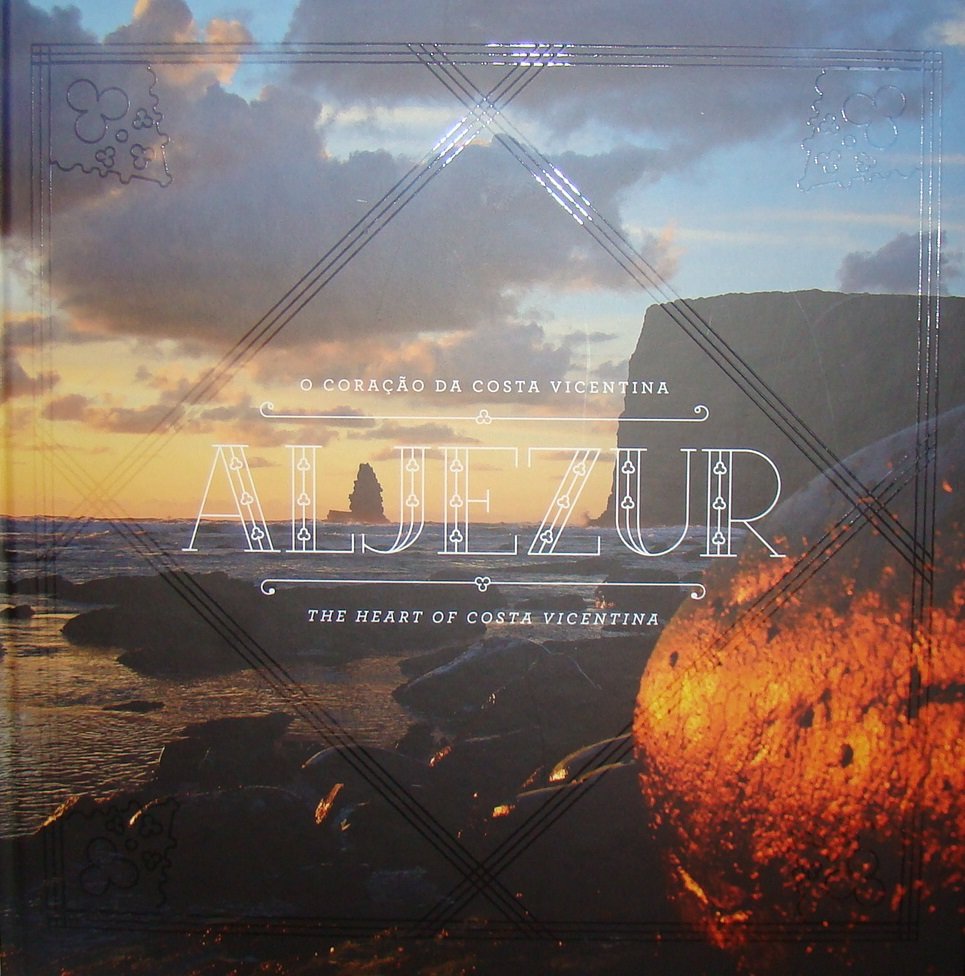
Aljezur: The Heart Of Costa Vicentina

By Matt D’Arcy

After a four-year journey through the history and the landscape of Aljezur two gifted men, photographer and writer, have produced the most stunningly exquisite illustrated book about the area in which we live: “Aljezur; The Heart Of Costa Vicentina”.

Described as “the book of Aljezur” and presented as “an expression of love for our home”, the impressive publication was unveiled at a ceremony in the town’s civic HQ on Friday.

Now, at €50 plus IVA, nobody is going to pop into the town’s newsagent for their morning paper, and buy a copy as an afterthought.

But it is the kind of coffee-table conversation piece that many people, both the Portuguese locals and those who have chosen to move across Europe to make their home on the Algarve’s west coast, will be proud to own.

Indeed the writer does say with complete justification that the final production would not be out of place in the high-class bookshops of cities like New York.

It would certainly make an ideal birthday, Christmas or anniversary present for anyone keenly interested in the history and culture of this area.

It is an outstanding book, sumptuously photographed and beautifully written as it takes us on a breathtaking photographic journey (with the text accompanying the photographs presented both in Portuguese and in English) that enables the reader to see the history, traditions—and, yes, the beauty—of this area in a new light.

Whatever your political persuasion you will find yourself agreeing with Aljezur Mayor José Amarelinho when he calls it “an expression of love for our home” and says “this book was made for the people of Aljezur, put together in such a way that even those people who have been born here will discover things they never knew existed.”

The book originated from an initiative by the Lisbon Government encouraging councils in Portugal to be funded in order to create such a volume promoting their council area.

Amarelinho says: “This is the best one I have seen on a national scale,” and in the words of Mandy Rice-Davies, he would say that, of course.

The Book Of Aljezur

The Book Of Aljezur

But it’s hard to imagine any better productions across the length and breadth of Portugal.

This collaboration between the Camara and local marketing company 1000olhos, IS a work of art with the superb photographs of João Mariano and the compelling, beautifully-written descriptions of João Paulo Sacadura.

Photographer Mariano is from this area but he admits his four-year journey led to discoveries of places he himself did not know existed!

He told a specially-invited audience, which included Amovate secretary Ian Bedford and Press Officer Matt D’Arcy: “The team was made up of people from Aljezur for this project that took four years searching and discovering and photographing to put together.

“I was able to go to places that even surprised me, by walking, cycling, travelling by boat or by car.

“I found that there was so much to be discovered and so many surprises. I had so much help from the locals, from gastronomy and the preparation of dishes, to being taken by boat to places, to traditional bread making, to areas that I didn’t know existed, many of them historical areas that were brought to life for us by the stories from locals who had passed them down through the generations.”

João Paulo Sacadura, who says he writes with the old Portuguese spelling of many place names to heighten the authenticity of this journey through the region, admitted:

“At first I wasn’t sure about taking on this project, as I am not from the area. But then I realised it was probably good for an outsider to write about these places.

“I encountered and discovered many beautiful things and interesting people and with the use of the amazing photographs and the sheer numbers of them, there could be many more volumes.

“This book has been done so well that it could be sold anywhere—from the high class bookshops of New York—to all the foreigners who visit this area. The council have done a fantastic job in maintaining the image and wonderful secret that is Aljezur.”

*          *          *          *

The Introduction to the book reads:

“The publication of this book is part of the numerous responsibilities bestowed on the town council; publication of works that interest and respect the history and identity of the municipality.

“In both the writing of João Paulo Sacadura and in the photography of João Mariano this work is a true journey around the council of Aljezur with its legends, history, heritage, ethnography, traditions, cuisine, biodiversity, fishing, farming, beaches, cliffs and our people.

“It succeeds in being disconcerting for the writer and he shows it! ‘On the one hand we should spread the word about Aljezur’s amazing landscape, share its wonderfulness, reveal the hidden enchantment; and on the other hand we feel like keeping it safe, guarding it, protecting it even more’.

“Either way we are opening another window of opportunity that shows we are different, able to reinvent ourselves by always asserting our identity, with a profound respect for our memory and by prospecting our future.

“The reality we show you is filled with the enchantment, romanticism, love and poetry that this land and its people enclose. A lot—and I mean a very lot—of what actually counts and distinguishes us is here.”

*          *          *          *

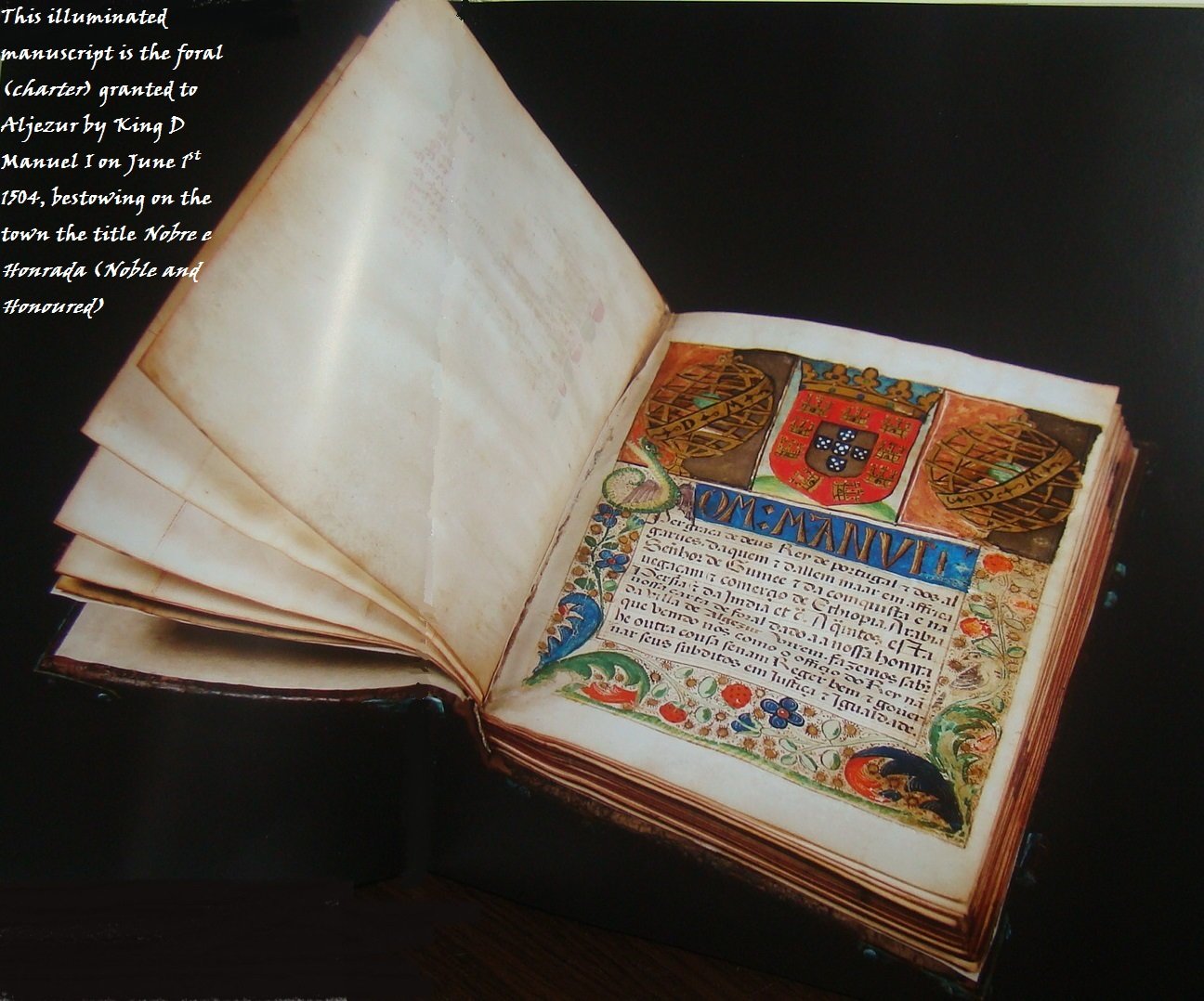
The first image in the book shows an illuminated manuscript, the beautifully illustrated Aljezur Charter granted to the town more than 500 years ago by King D Manuel I on June 1st 1504.

The publishers say the book’s graphic designer, Bruno Fernandes, was inspired by this document, explaining: “Of an unquestionable historic

Aljezur Charter Granted June 1 1505

Aljezur Charter Granted June 1 1505

and aesthetic value, these elements have been given a modern touch”.

NOTE: Aljezur first obtained a foral (charter) from 12 November 1280, issued by King Denis of Portugal, in Estremoz. It was the first charter issued by the king in the Algarve. On 1 June 1504, King Manuel reformed the diplomatic map issued by King Denis, and promoted the town with the title Nobre e Honrada (Noble and Honoured)

*          *          *          *
 
Some statistics contained in the book:
 
MUNICIPALITY OF ALJEZUR
 
Total area of the Council: 323sq km.
 
Coast: 58km.
 
Total perimeter: 136km.
 
Maximum altitude: 370 metres.
 
Population: 5,884 inhabitants (at census of 2011).
 
Boroughs: Odeceixe, Rogil, Aljezur, Bordeira.
 
Municipal Holiday: August 29.
 
Area of National Park in Aljezur Council:
 
Total area: 220.5sq km.
 
Total land area: 144sq km.
 
Close to half the council is covered by the Sudoeste Alentejano e Costa Vicentina National Park.
 

The Municipality of Aljezur Presents A Prestigious Book

Aljezur Book(Translated by computer software from the Camara website)

The Municipality of Aljezur will present at 3pm on Friday January 23 in the Grand Hall of the City Hall the “Book of Prestige, Aljezur, the heart of the Costa Vicentina”.

It describes the Camara’s jurisdiction through the publication of documents and records that preserve and perpetuate the history of the area.

This is the book of Aljezur, the result of a long photographic survey, conducted over the past four years; a project full of strong emotions and natural sensations that reflect the essence of Aljezur.

In recent years we have worked hard and diligently to identify, register and make known, the nature and personality past and current of the entire municipality of Aljezur: history and geography; natural heritage – landscape / nature / beaches; historical and archaeological heritage; gastronomy; traditions.

We have created a highly visual object through photographs, graphics and text, all linked in inseparable parts. The image to make the synthesis of a single municipality, disclosing it in a careful way. The decorative elements of the Foral de Aljezur, granted by King Manuel I on June 1, 1504, inspired the graphic design of this book. The elements were reinterpreted, so they now reflect the contemporary municipality. Likewise, the techniques and materials chosen seek to convey quality, innovation and the robust essence of the area.

This is a publication of the Municipality of Aljezur, Designed and Produced by 1000olhos – Image and Communication. Photography by John Mariano and the text by John Paul Sacadura.