by Matt D’Arcy
More and more people, attracted by such innovations as the Rota Vicentina and the growing popularity of the Algarve’s west coast for surfing enthusiasts, are flocking to Aljezur which has rarely before been a “must-see” destination for the hundreds of thousands of tourists arriving on the Algarve each year.
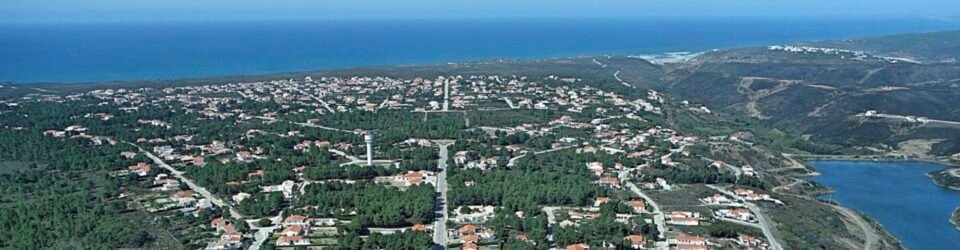
Indeed, more and more house hunters are now looking to the area, particularly to Vale da Telha, for their dream home in the sun, either as a holiday home or as the ideal place to live out their retirement, as word begins to spread about the natural beauty and the wonderful quality of life to be found in these elysian surroundings.
So, what will these newcomers discover in what has been described as “the untouched Algarve” and “a medieval treasure chest”?
Perhaps this introductory guide will help:
====
Aljezur—The Untouched Algarve
(This article first appeared in the portugal-live.net website at):
http://www.portugal-live.net/
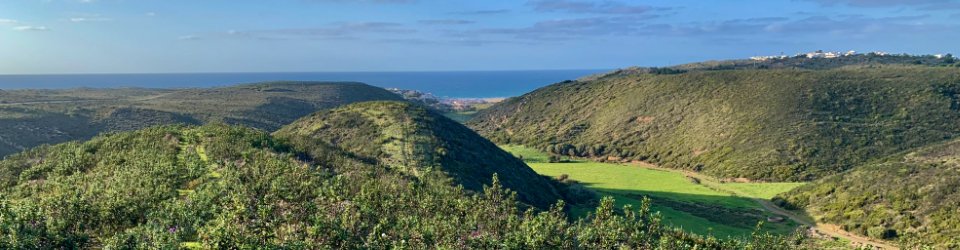
Nestling among the rolling hills of northwestern Algarve, Aljezur represents the untouched Algarve, an area of beautiful natural landscapes where donkeys work the land, cowbells tinkle on the plains and some of the best beaches in Portugal await you.

The River at Aljezur
Situated in the Parque Natural do Sudoeste Alentejano e Costa Vicentina, the large natural park that extends along the western coast of the Algarve, Aljezur is a small agricultural town lying on the fertile plains that border the Aljezur river.
But, equally as important to the visitor and the tourist, Aljezur has been described as a medieval treasure chest which has survived more or less intact to the present.

Aljezur Castle
The hilltop ruins of a 10th Century Moorish castle dominate the historic town centre and afford beautiful panoramic views of cork oak and pine woods, fields sprinkled with wild flowers and the sea in the distance.
The old town that spreads down the hillside is a charming mix of cobbled streets and whitewashed houses with the characteristic colourful trimming around the windows. The newer part of town was established in the 18th Century to relocate the population after the destruction caused by the 1755 earthquake and lies at a short distance from the hill on the other side of the river.
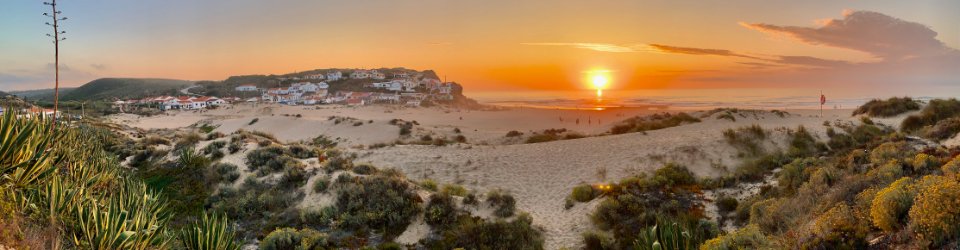
Outside the town, it’s hard to decide what is more appealing: countryside or coastline. Nature treks, mountain biking tours and donkey or horse rides around the hills offer the opportunity to admire wild boar, foxes and badgers in their natural habitat while Aljezur’s 40 km (25 mile)-long coast is a treasure trove of rich marine life, numerous species of local and migrating birds and a beautiful mix of virgin beaches and peaceful river valleys.
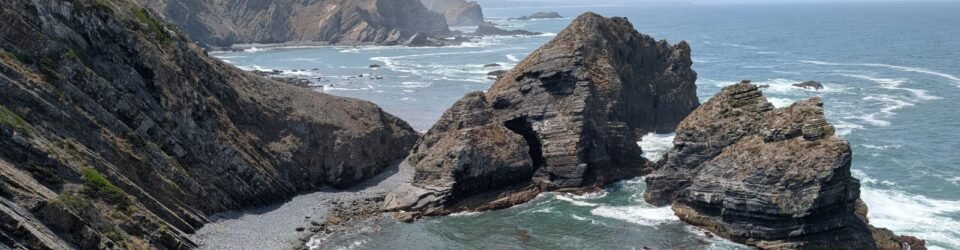
The Costa Vicentina, as this south-western coastal strip is referred to, contains some of the most beautiful unspoilt beaches in

Arrifana Beach
Portugal, many of which feature broad expanses of sand dunes flanked by towering cliffs and with hardly a building in sight.
The swell size at beaches such as Arrifana and Praia do Amado attracts surfers and bodyboarders while Odeceixe, Bordeira and Amoreira are situated at the mouth of rivers, making them especially popular with families and offering a choice of river or sea to swim in.
Attractive, natural lagoons also form in these beaches, making them a favourite with children. In Odeceixe, canoes can be rented for scenic trips upriver while, at Amoreira, the change from dunes into estuary marshland opens up a whole new natural world inhabited by kingfishers, otters and grey herons. The cove of Praia das Adregas, just south of Odeceixe, is an official naturist beach.
 In an area so equally dependent on land and sea, it is no surprise that the fruits of both form the basis of its mouth-watering cuisine. Aljezur is the largest producer of sweet potatoes in Portugal so these are present in its soups, stews, pastries and during the Sweet Potato Festival, held in October. The sea produces another of the regional delicacies; the gooseneck barnacles that thrive on the surf-pounded rocks and that are bravely harvested by the intrepid local fishermen. Grilled fresh fish and a hearty selection of shellfish, including mussels, sea urchins and crab go into the tasty shellfish stews.
Places to see:
Historical sites and religious architecture
Castelo de Aljezur (Aljezur Castle)
This 10th Century Moorish castle was built to guard the ancient river port that once provided direct access to the sea and was one of the last Moorish strongholds in the Algarve to be captured during the Christian re-conquest in the 13th Century. Two towers, ramparts and a cistern are still standing and its hilltop position affords beautiful panoramic views of the surroundings.
Igreja da Misericórdia (Church of Our Lady of Mercy)
Situated in the historic town centre, this original 16th Century church was rebuilt in the 18th Century after the 1755 earthquake. It retains its original Renaissance doorway.
Igreja Matriz de Nossa Senhora da Alva / Igreja Nova (Church of Our Lady of Dawn / New Church)
This 18th Century church was built by order of the Bishop of the Algarve to replace the original main parish church that was destroyed in the 1755 earthquake. Its most noteworthy features are the 18th Century statue of the patron saint of Aljezur, Our Lady of Dawn, behind the main altar; a 16th Century Manueline font and two 17th Century statues in the side chapels which originated from the Monastery of Nossa Senhora do Desterro in Monchique.
Museums
Museu Municipal (Municipal Museum)
Housed in the 19th Century former town council building, the museum exhibits art, archaeological findings unearthed in the region and an ethnographic section containing examples of agricultural tools and a reconstruction of the inside of a traditional Aljezur house.
Museu de Arte Sacra Monsenhor Manuel Francisco Pardal (Sacred Art Museum).
Adjoining the Igreja da Misericórdia church, this museum is named after an important local canon and exhibits a fine collection of religious art.
Casa Museu Pintor José Cercas (José Cercas Museum)
This museum contains the various antiques and works of art that belonged to local artist, José Cercas, bequeathed to the town after his death.
Archaeological sites in the Aljezur region
Ribat de Arrifana (Arrifana Fortress)
Situated above the cliffs of Ponta da Atalaia and commanding panoramic views of the coast, this 12th Century Moorish fortress/convent is one of the largest found on the Iberian Peninsula. Built for defensive and religious purposes, excavation has revealed the existence of various mosques, a minaret and a prayer wall facing Mecca.
Povoado Islâmico Sazonal de Pescadores (Islamic seasonal fishing settlement)
The remains of this 12th Century Moorish fishing settlement are located in Ponta do Castelo, near Carrapateira. Various fishing instruments, pottery and fish and animal remains have been discovered.
Necrópole de Corte Cabreira (Corte Cabreira Necropolis)
A Bronze Age burial ground near the town of Aljezur thought to date back to 1800 BC. Most of the objects found on the site are exhibited in the Municipal Museum




 As from the Committee Meeting on 7th August 2014, Peter Johnson has resigned as President after 6 successful years. We thank him for his enthusiasm and hard work during this time.