Yearly Archives: 2012

Poor Old Uncle George – by the Algarveans

Poor Old Uncle George –

At the moment we are in full rehearsal for our next production, a comedy called Poor Old Uncle George, written by David Butler-Cole, which will be performed at the Lagoa Auditorium on May 17th, 18th and 19th. Tickets (€10) can be reserved on 282 789608, 966 507 308, 282 358126, or via algarveantickets@hotmail.com.

Cast is as follows:

Alec Latitude, (Trevor Herrington) Private Investigator who is instructed to investigate the death of his wife’s Uncle George aged 73, (killed by a Polishing machine in the Blatant Bargins shopping Arcade) by the Insurance Company’s Agent, Harry Nash,(Lloyd Delderfield).

Harry Nash runs an Insurance Agency and has never paid out on a Life Insurance Policy in 25 years due to various unscrupulous methods. Harry Nash keeps Piranha fish as a paper shredder in his office.

Ada Latitude, (Lara Costa) Wife of Alec and unlike her husband never loses her temper but has a poor understanding of the English language that leads to “Malapropisms”.

Gladys Pyle, (Orla Ferrie), 23 year Old widow of Poor Old Uncle George, (Aunt to Alec & Ada), who has been married before, more than once to older men and arranged a do it yourself funeral for Poor Old Uncle George which is also being investigated by Bobby Peel, Policeman, (Charlie Beddingham). During the course of Bobby’s investigations he comes across a group of, “Secret Agents” who meet in the park of which it turns out Poor Old Uncle George may have been a member along with Olga, (Bo Williams) a Russian Agent who works in the Park in a secret profession as well as working for Harry Nash the “Mr Insurey Man”.

Warning this play contains strong language and can seriously damage your health through too much laughter. (those with weak bladders are advised to wear tenor pants throughout the performance.)

Susan & Brian’s Arabian Nights – Part 1


By Matt D’Arcy


Part 1

SUSAN AND BRIAN JUTSUM recently spent almost two months experiencing the Arabian culture and lifestyle of Morocco, becoming immersed not just in the tourist-friendly big city centres but also living, eating and sleeping amongst the tribal peoples of the High Atlas, the deserts and the Deep Gorges.

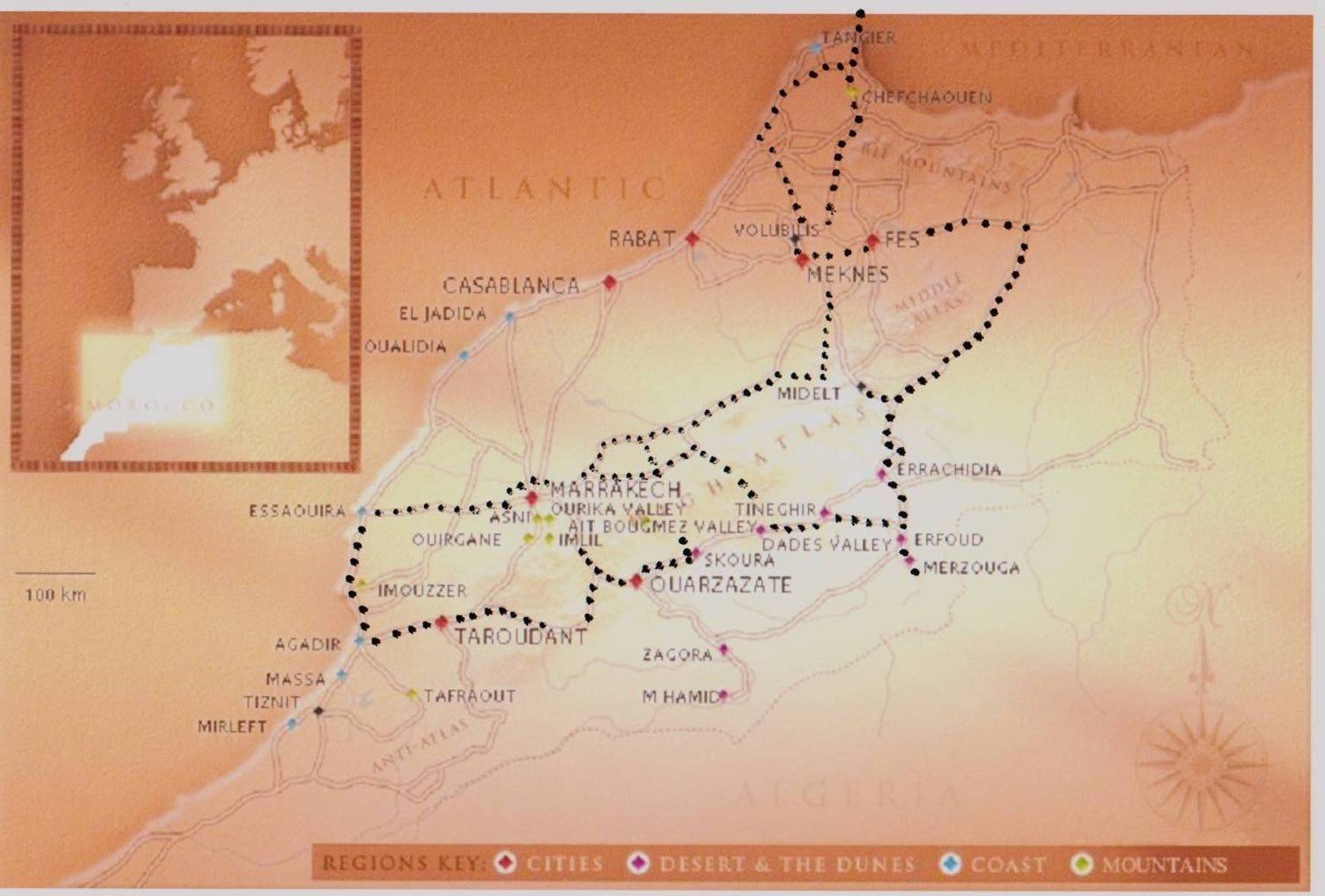
Susan & Brian's Route

The Amovate members, who live on Vale da Telha, made the crossing from Spain to Ceuta in Morocco on December 27th and returned home mid-February after the ambitious adventure in their motor home, accompanied everywhere by their dog Sofie.

Susan kept a daily diary of their travels and also took thousands of photographs, enabling us to post this story of their Arabian Adventures here on the Amovate website.

The changes in culture across this short distance over the Straits of Gibraltar made a huge impact on the Jutsums—but in a more positive way than they had imagined.

“We had a truly memorable time, made even better by the people we met, the truly magnificent scenery and the diversity of Morocco; sand, snow, heat and cold,” they said. “It was probably more of an experience than a holiday.”

The overriding memories of the encounter with such a different culture, beliefs and values which they took away are: “Children, donkeys, markets, camels, mud houses, carpets, scenery, to name but a few.”

They added: “It was colder than we had expected and contrary to what we had been led to believe, very much safer.  Not once did we feel unsafe or threatened, and we could never say that about the UK or Spain!

“Food for thought, perhaps; no alcohol helps?”

On arrival they camped in Maril, on the seaside near Tetouan, south of the ferry port of Ceuta where their first impressions were:

“It was all so clean, street cleaners everywhere and no litter. You could eat your dinner from the pavements. Every man seems to smoke but no tab ends anywhere. It feels a lot safer than last night in Spain near the Port.”

But those impressions of cleanliness were to change as they moved away from the tourist areas, Susan explaining:

“The rubbish and litter problems everywhere else were overwhelming and I think by the time we were on the way back home we had become anaesthetised to the litter; Portugal is so clean and immaculate by comparison.

“The litter problem in Morocco is horrendous especially with plastic bags they are strewn across fields everywhere you go. Largely Morocco has no infrastructure and no education so big problems are being stored for the future.

“Would we recommend Morocco for a holiday? NO!  The only way to see the real Morocco is as an independent traveller, under your own steam, not as a tourist. Not many people we know would cope with the sanitary arrangements and the rubbish.”

But Susan and Brian emphasise that this, albeit literally, was the only blot on the landscape of a country where the people were warm-hearted, friendly and hospitable, where the scenery was spectacular and spellbinding and where a mere seven weeks has left the legacy of a lifetime of happy and vivid memories.

+++

Here, Sofie the dog insists she has something to contribute to this recollection.

“I loved all the amazing smells—after all we dogs don’t recognise bad smells, we just appreciate the thousands and thousands of scents we can explore.

“But Morocco was a canine culture shock for me, too. I was terribly confused because we dogs like to scent other dogs when we need to wee-wee or have a little poo but no-one there keeps dogs, so I had no scents to sniff out. I just had to leave my own.

“Muslims apparently don’t keep dogs (what strange people!) and not only did some of the Arab people avoid me, some of the children screamed.

“But when we went deeper into the country with the Berber people it was really nice place because the Berbers, and especially the children, all smiled at me and petted me. I became quite an attraction but then what would you expect as I am a very nice dog, even though I do say so myself.

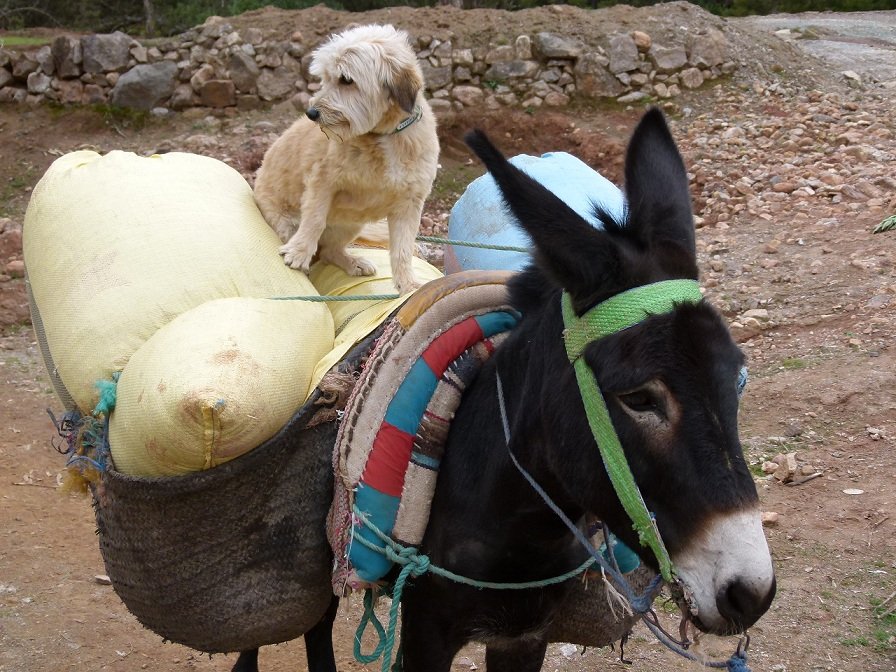
Sofie On A Donkey

“I was quite a celebrity there and my owners, Susan and Brian, just about coped with the hordes of Berber children who are not frightened of me unlike the Arabs.

“So they have to tell them I bite or they would have no peace and no Sofie, because the children all wanted to hold me and lead me away.

“At one point I even had a ride on a donkey which was quite nice as it gave me a rest and a new vantage point to watch this wonderful new world go by.”

+++

The Jutsums first full day in Morocco saw them head off to Chefchaouen, a town tucked away in the Rif Mountains and a place where hashish and cannabis is grown.

In Moulay Idriss, fabulously situated between two hills they bought top quality fillet steak for 7 euros a kilo. In the small intimate Medina they went inside an olive oil pressing shop where the olives are pressed in a similar way to the way Susan and Brian press apples on the land they own in Rogil, but with mats between the olives. The waste skins are then used as fertiliser.

Susan recalled: “The workshop looked quite Dickensian with the Berber watching over proceedings and of course they would allow no photographs to be taken.

“Everyone here owns a donkey, and you would not want to be a woman – they work so very hard, and the men drink mint tea all day. But people look happy.”

From there they moved on to Volubilis, the World Heritage site of the best-preserved Roman town in Morocco, where, for one euro each, they spent a good 3 hours wandering in the sun looking at mosaics and the remnants of houses.

They then saw in the New Year in Fes, where they were in bed for 11pm, with nothing at all happening on their campsite, 7 km from the town.

From there they visited the Medina, which was huge about 1 1/2 k diagonally across.

“We had to have a guide to show us the tanneries where the animals are taken for skinning and the hides made into leather,” said Susan. “We saw all the processes, and the workers still use their feet to press the hides. “Apparently by about 45 years-old they have to pass the job on to another family member as they develop arthritis in the feet and toes.

“The Petite Taxi back was to say the least interesting, like a chase scene from a film, cars everywhere, horns going and the taxi going up the wrong side of the road in 40 minutes of excitement we could do without, and all for 2.4 euros.”

Next port of call was Taza, Susan admitting: “I read a blog on the Internet saying don’t go to Taza so we did—not to the town, but to the National Park, Jbel Tazzeka, which meant 139 fabulous kilometres of driving around 6,000 ft high middle Atlas gorges.

“We stayed one night wild camping, no phone, no Internet just us, no problems whatsoever, except for the cold! It is 24 degrees in the day and -5 at night and not a breath of wind anywhere.

“The cold at night gets into your bones; it really penetrates. We had to sleep in the van with the heating on all night

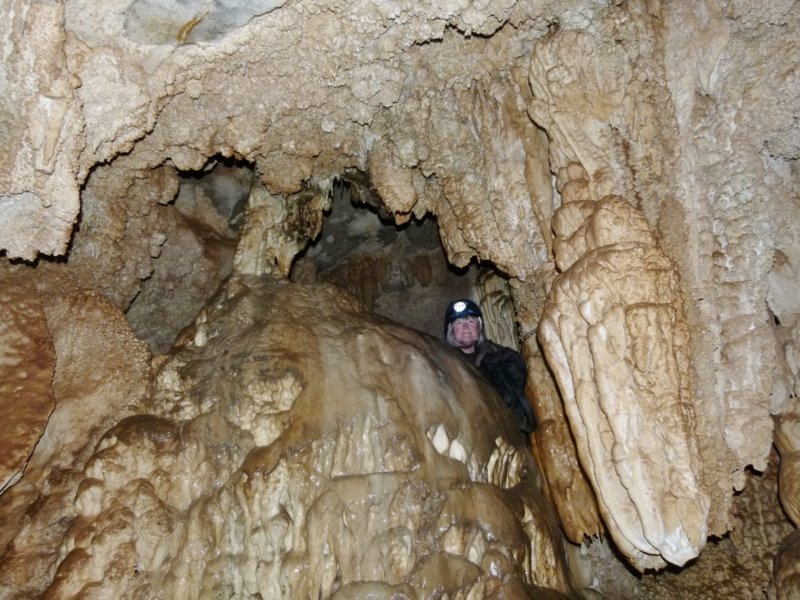
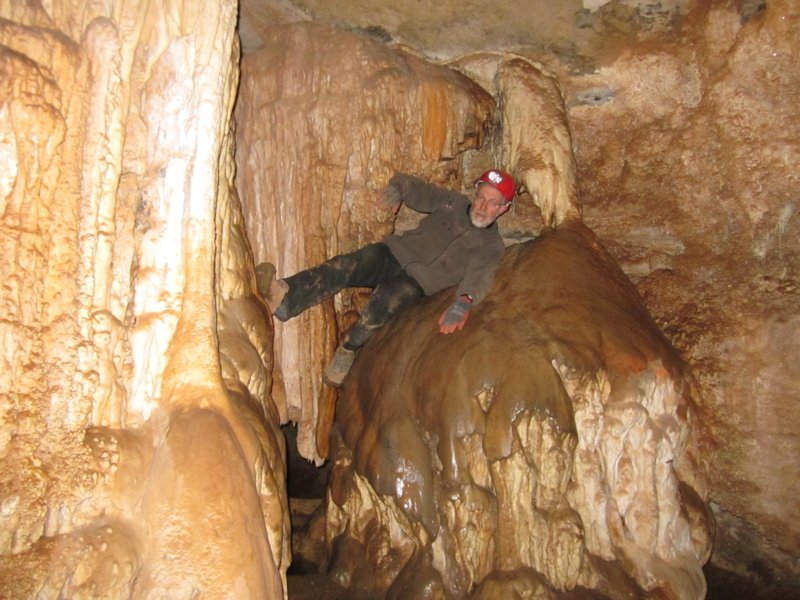
Cave Interior

“We visited a fabulous cave here, not a show cave, really beautiful with a depth of half a mile, and no artificial lighting. If you know Alum Pot in Yorkshire this knocks it into a cocked hat so to speak.

“It was quite gruelling managing almost 600 stone steps carved out of the walls, some 18ins deep and wide and some 3 ins deep. It also meant crawling under deep overhangs, pitches and ladders—lots of clean underwear required after this!

“After one hour when we got to the bottom of the first section (the 580 steps) we had to do a strenuous climb. I pulled a groin muscle and started feeling faint, and as I did not want to stop Brian seeing the only thing he wanted to see they went on without me.

“The descent took us down and down over planks across water and more ladders and pitches. We had our own caving equipment—we wouldn’t have been allowed in without it—but had to have a guide. He was a great kid only 15, and a member of the family who owned the cave.

“I waited in the dark for an hour and managed to get down from my perch and climb up alone until a difficult under climb where I waited again for their return one hour later.

“It was exhilarating and the climb up tough, the spirit is always willing but the bones are a little older than when we did a lot of this in our 30’s in Yorkshire. Emerging back out into the sunshine was lovely.

“Three days later we were both still aching, but it was worth it.”

Susan continued: “Around this national park people don’t even have a donkey as they are too poor.

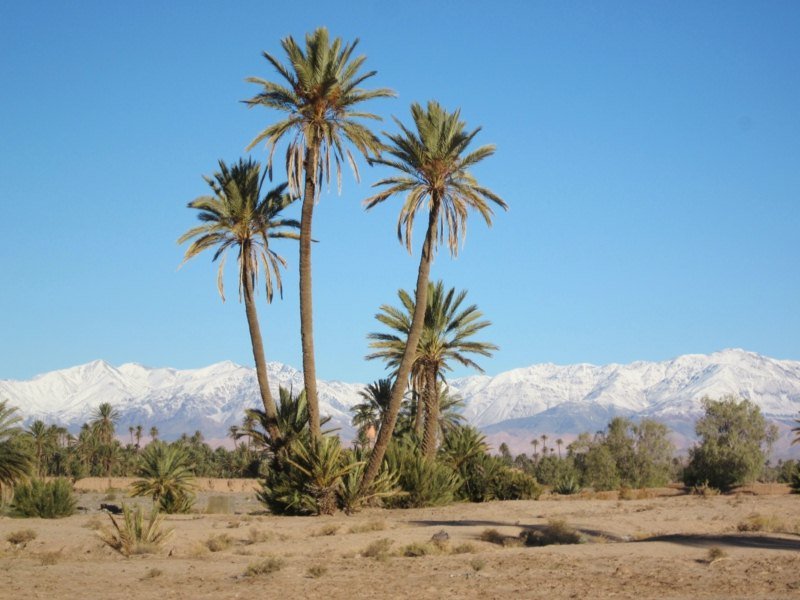
1st Snowfall In Skoura Desert For 30 Years

“From Taza we drove down a desert road passing Guercif and down to Midelt in the foothills of the High Atlas. This was a

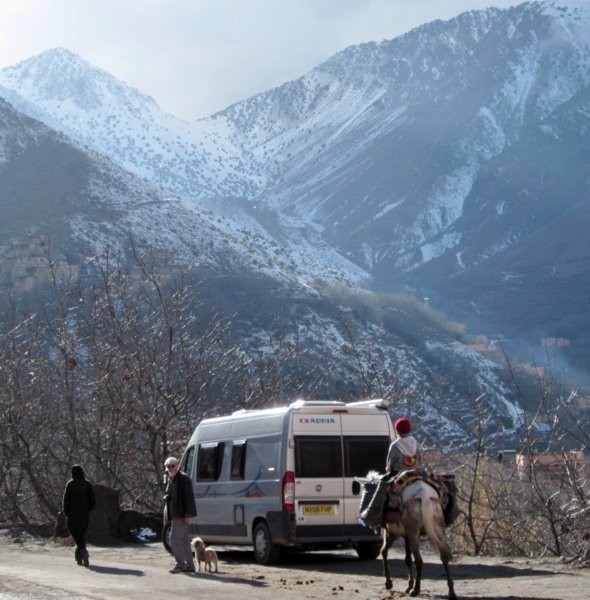
High Atlas at Ain Leuh

long road but lovely scenery passing only goat and camel herdsmen. They all give you a wave and a salute, and seeing our first grazing camels was a lovely sight.

“In Midelt the carpet traders here speak English. Our French is coming on nicely as, up until now, there was no English spoken at all, apart from in Fes. People are more used to tourists here.”

The following day Susan and Brian began their journey to the High Atlas and Deep Gorges, starting in the town of Rich.

“This is where our holiday will really start,” she wrote.” We can camp in the desert with the tribespeople, which sounds great.”


READ PART 2 For the next instalment…………………………..


~~~~~~~~~~~~~~~~~~~~~~~~~~~~~~~~~~~~~~~~~~~~~~~~~~~~~~~~~~~~~~


Susan & Brian’s Arabian Nights – Part 2

By Matt D’Arcy


Part 2

Susan’s next e-mail was dated January 12 2012, and she reported:

“Since my last post the last six days, as expected, have been the best of the trip.

“We left Midelt and travelled to Rich and then Gorges da Ziz, not as spectacular as we have seen in other countries.

“We continued on southward to Ar-Rachidia, Erford  and took a small road to Dar Kauoua. But then the road became inaccessible, except for serious 4×4 driving.

“We went down a track to a village and saw a walled property. I asked a Berber man if we could stay for a night he said yes and invited us up onto the terrace where he served us tea olives and bread.

“The next morning we walked for about 30 minutes until we came to where people were digging minerals, fossils etc. This is an important area for fossils; places selling fossils are everywhere.

“We said goodbye to our host and his family and had to go back to Erford to go round to Rissini to pick the road up to the Erg Chebbi, a large sand dune.

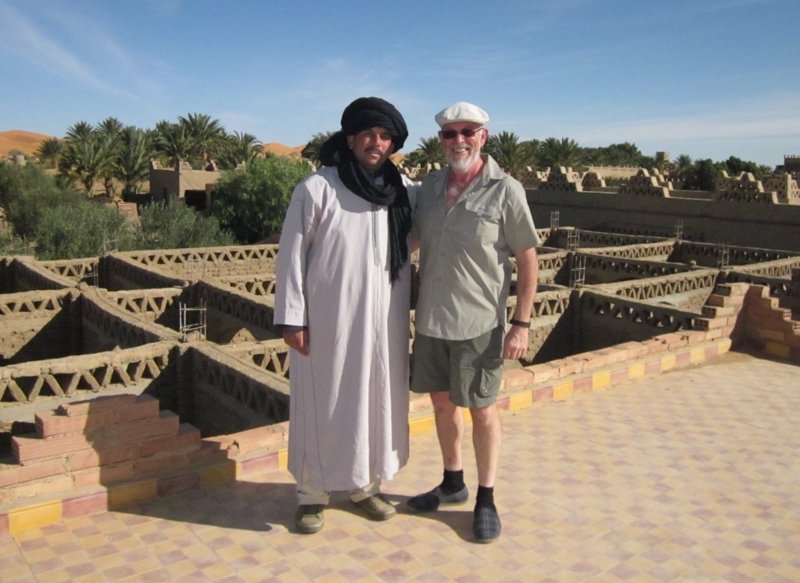
Brian & The Justsums Berber Friend at Merzouga

“We went into the village of Merzouga and parked up deciding what to do. A handsome looking Berber turned up and asked us if we were looking for somewhere to camp.

“We followed him to the village of Adrouine and he took us to an Aubuge (a desert hotel). It was lovely and the staff were fabulous; they had no one staying in the hotel, just 4 campervans—ours, and three from Germany.

“The Aubuge was called Haven in the Desert and it sure was—I could have stayed for ever!

“I never understood why people raved about the desert, thinking that surely it is just sand. But, no, it is much more, peace like you have never known, stars so bright and no wind. We have struck so lucky with the weather and the area and the village were enchanting.”

Susan recalled: “We learned a lot about the desert. When you see palm trees, you assume there is water somewhere. Wells are dug and the water is only 6 metres deep.

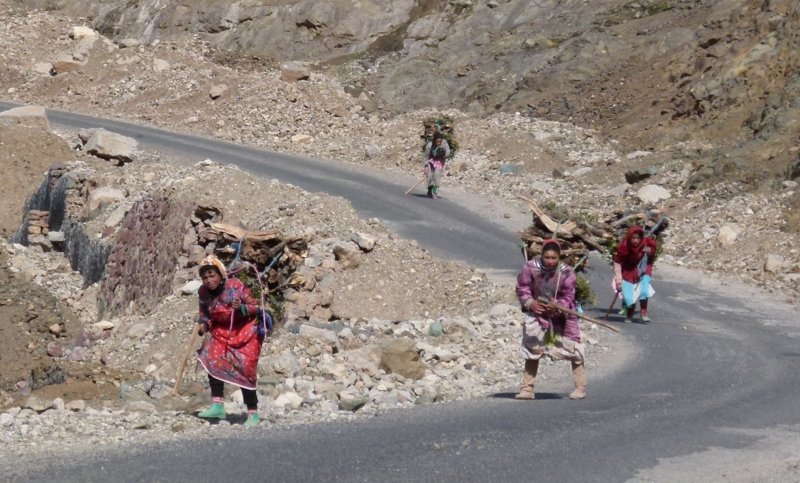
Girls Collecting Wood on High Atlas, Day Before Snows Came

“The Berber women across Northern Africa grow crops under the palm trees, mainly in summer but here they grow them all year round. The women were digging up carrots, white turnips, broad beans and coriander, and of course mint; unbelievable in such a hostile environment of 28 degrees in the day and -2 at night, climbing in summer up to 50 in the day and -14 at night.

“Here apart from bread they eat what they grow. The villagers make lavages and have allotments, each about 6×10 meters and all well watered.

“Walking around the village was great. We were invited into a Berber school for women, all aged about 18 to 40 learning how to write, sew and some in a Spanish class.

“Everyone was so welcoming. We saw a lady sitting on a carpet sorting out grain and she showed us how she had to sort the grain, grind it and make bread every day for a family of 8.

“She also had to go and collect the dead palm leaves to use for fire to cook the bread. How easy do we have it?

“She invited us in for tea and gave us some of her lovely bread. In the houses they have nothing except bench seating covered in carpets and 1 table/ tray for the mint tea.

“One of her little girls aged 8 walked with us back to the village centre where there was one shop. We bought her and her two friends sticky lollies. They were great kids and tried to teach us some Berber language.

“We stayed here three days and could have stayed much longer. I would love to come back here. We had all the facilities of the Auberge, even a swimming pool, for just 4 euros a night, and the best showers and toilets so far.

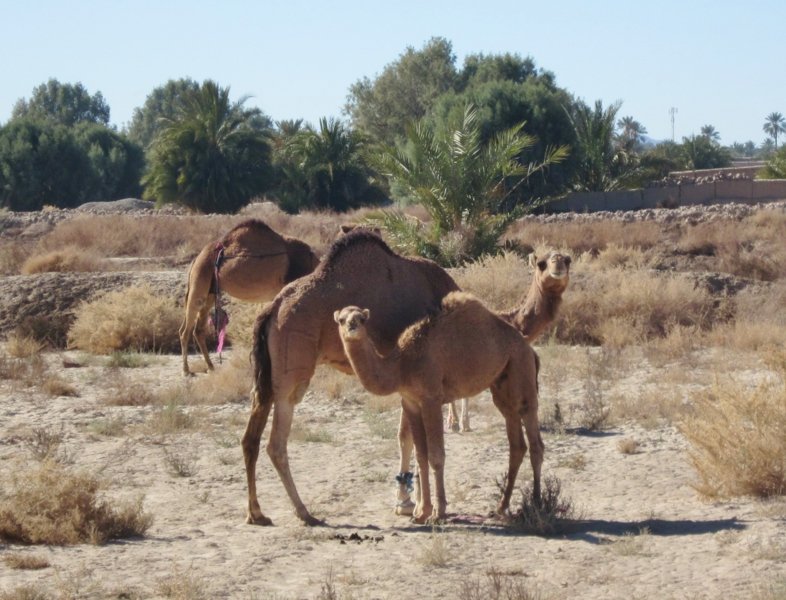
Desert Dromedaries near Merzouga

“Before we set off for this trip I wanted to see camels, and I have now seen so many. But of course they are not camels they are dromedaries, only having one hump.

“It’s best when you see them grazing with their babies feeding, not harnessed or in attire for trips with rich tourists. That’s not us—no rides thank you!”

The following morning Susan and Brian retraced their steps to Ar-Rachidia, stopping at the weekly souk (market) in Rissini.

“This was by far the best to date,” said Susan. “It was a very old locality with narrow alleys and so many stalls, not a tourist in sight, all aimed at the local people.

“They sold everything from camels’ hooves and intestines to spices and silks. In a dark alley we saw about 25 bundles and as we walked by we realised they were women covered in black crouched down; quite spooky.

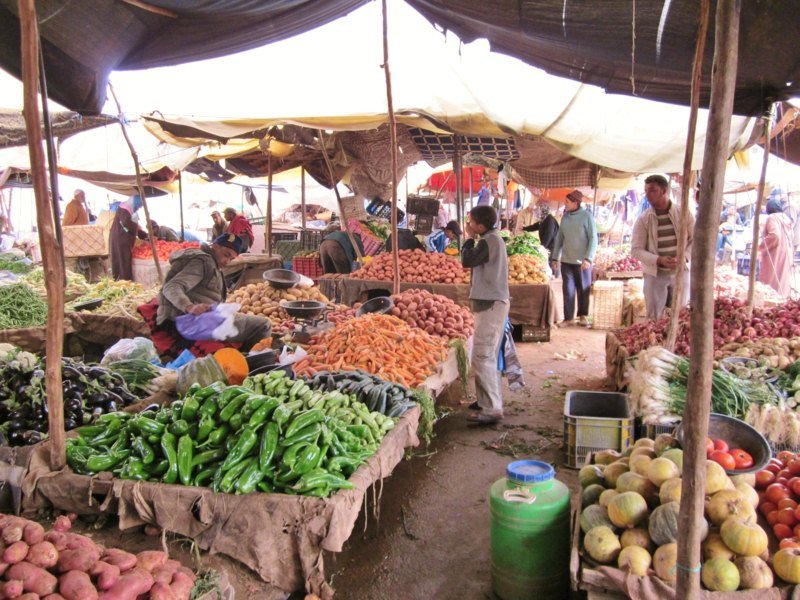
Local Market Vegetable Stalls

“Then, we headed back to Ar-Rachidia and on to Goulmima and Tinerhir. This was on our way to the Todra Gorge staying in a small village on a campsite at Z-S-Abdelali.

“Next morning we set off for the Gorge. The sheer rock face at the start of the gorge is 1000ft straight up and the mountains behind 10,000ft—quite a sight and hard to photograph.

“We walked for about a mile to get the feel of it before our long drive up the Gorge reaching 9,000ft. After about 3 hours we dropped down to the village of Agoudal, about 8,000 ft. high, where yet again we struck lucky.

“It is a place of 2,500 people and we did not see a single vehicle. On the way we are mobbed by children and then we see a small Auberge. As we slow down the proprietor, Ibrahim, comes out to meet us.

“We had not intended to stay here, but we did for 2 nights and it was again fantastic, better than we could have imagined. We should have stayed longer.”

When Susan and Brian went into the Auberge, Ibrahim had lit a fire for them and they saw a picture of a cave they told him they would like to explore.

Susan recalled: “The next morning Ibrahim took us through the village in the van—we would have never found the route

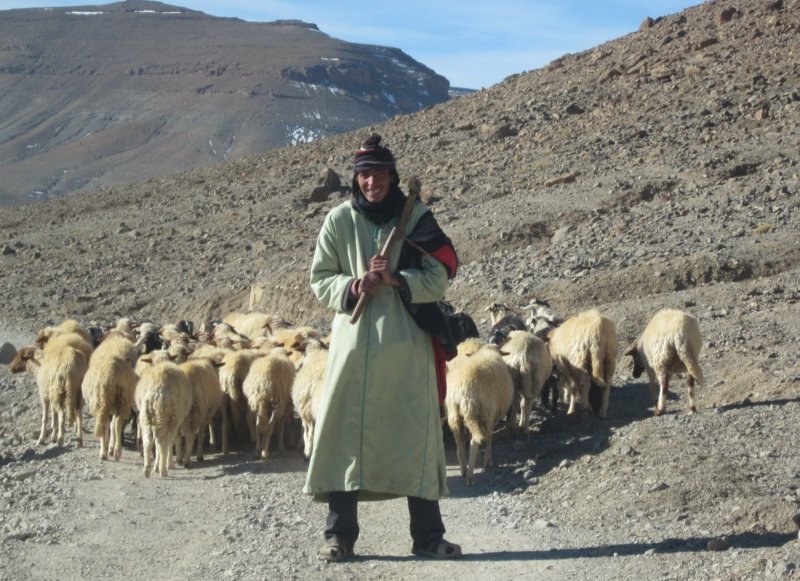
Shepherd En Route To Agoudal Cave

without him. The roads were terrible and he told us to drive “off piste” for about 5km. We passed a few shepherds, who stopped and asked for food; one of them is in the pictures.

“When we arrived at the point Abram had told us to leave the van, near a stream, we started our 5km walk to the cave, leaving the van in the middle of nowhere.

“This area was so bleak little or nothing growing and all the sheep herders carried axes!

Brian In Cave Near Agoudal

“The cave when we eventually found it was fantastic. We had walked uphill through ice fields and frozen waterfalls, until we were at 9,000ft. We found a water point where cleaned sardine tins had been left to drink from.

“After about 3 hours exploring we stared our descent and as the van came into view we could see smoke and a fire, plus goats, a dog—and a shepherd.

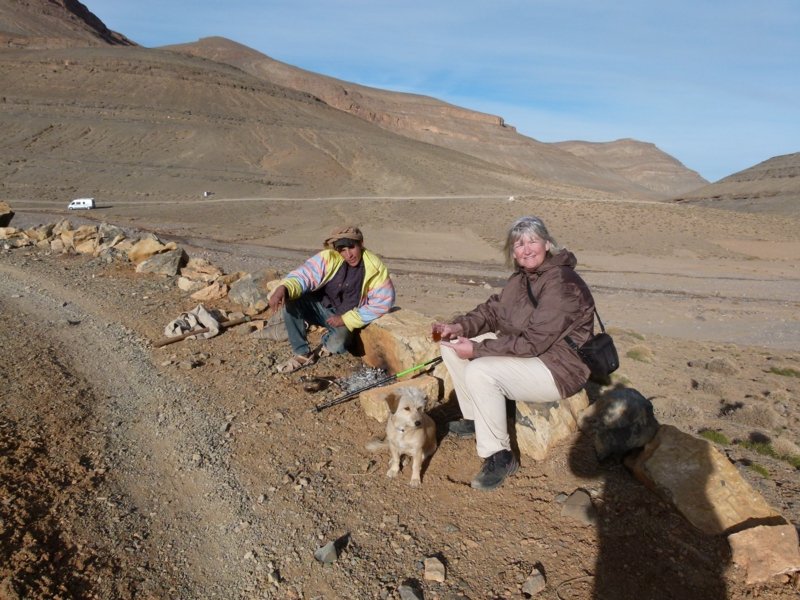
“As we approached him he had water boiling in an old tin tea pot and had made us tea, even though he had just one glass to share between the three of us.

“He had open-toed sandals and it was freezing cold!

“He was a lovely young chap who only spoke Berber, but you can do a lot with a smile and a little sign language. He demonstrated that the axes were to cut what little vegetation there was for the goats to get to the roots.

“He walked back with us to the van where we had made a curry for supper. So gave him a take away and offered him socks but he refused these.

“However, he WAS delighted with his supper and he went over to a bush and set fire to it, beckoning us over to warm our

Susan With the Shepherd

hands.

“At this point I thought perhaps this is where the burning bush in the Bible came from?  Certainly, there were lots of shepherds in the bible!”

Susan wrote that they were still struggling to cope with the way temperatures plummeted at night.

“We have started wearing about 4 layers and 2 pairs of trousers,” she explained. “Our first night here was -4 in the van at 8am and outside at 10am, when the sun had been up two hours, it was still -8.

“We don’t make for early mornings.”

Susan and Brian’s memories of their trip conjure up images as much of the people—particularly the children—as it does about the culture, the scenery, the landscape, the cities, towns and villages.

“The children hunt in packs of about 15 at a time and I just love them,” she wrote.

“Many have faces I will never forget—I could adopt them all.

“Today I met a lady with 14 children and another on the way. She looked so haggard and she showed me the baby had no clothes on under her wrappings.

“Now I know why they are always washing in freezing cold streams—they have to. This is the poorest area we have been to, no donkeys here.

“We both will return with children’s clothes. They don’t want money, as they have nothing to spend it on. This village has only had tarmac for 2 years and it took us 3 hours to drive from Todra.

“We are having an enlightening experience as much as a holiday.

“Morocco is changing fast and much of it will not continue in its present form. What must the people here think of us in our van and warm clothes?”


READ PART 3 for the next installment……………………..


~~~~~~~~~~~~~~~~~~~~~~~~~~~~~~~~~~~~~~~~~~~~~~


Susan & Brian’s Arabian Nights – Part 3

By Matt D’Arcy


Part 3

Susan’s next e-mail was dated January 22 2012, and she reported:

“Our excursions since our last message are better than fantastic.

“Again we were sorry to leave such lovely hospitality; we leave with two rugs made by local ladies.

“We now have a long drive to Beni Mellal. It takes us all day as the roads are so terrible we average only 30km an hour. We pass through dramatic scenery and more very poor villages, often ‘off piste’ (no real road).

“When we arrive in Beni Mellal we decide to stay and have dinner in a roadside café, and they let us camp free. We have really only come here for supplies before re-visiting the Atlas.

Susan & Sofie In The High Atlas

“And wonder of wonders, a French supermarket is here, so we stock up on wine, gin and goodies. At 12 noon only on Saturday there are just two cars in the car park at the supermarket and about six customers inside.

“No wonder Tesco aren’t here.

“We get the van washed and off we go, en route for Bin-el-Ouidane, a nice wiggly drive. We find a nice camp site, cold showers of course but the French proprietor lets us go into his house and shower—so long as we do it together. Typical French!

“We have a quiet night, just us and a Swiss couple and next morning we go looking for caves. Walk about 5 miles and find the caves, and find they are caves people used to live in.

“We are on the banks of the largest reservoir in Morocco and when it was built around 1950, flooding the valley the cave dwellers had to move. So the only way to the caves now is by kayak.

At The Cascades d'Ouzoud

“Back on the road after a nice day of walking we arrive at Cascades d’ Ouzoud where we check into a nice campsite, great showers and toilets. You get obsessed with the toilets, if we meet anyone, which is rare, it is the main topic of conversation, and these are the best since leaving Tavira in Portugal.”

On the following day Susan and Brian head for the nearby waterfalls, hoping to see some Barbary Apes.

Susan reported: “The Great Waterfall drops 450ft.There is not such a lot of water but it is very dramatic. We get away from the few Moroccan tourists here and go to the other side of the gorge and sure enough a family of apes approaches.

“They are really old African primates, a whole family all taking an interest in Sophie; mum, dad, and two babies. We get so close and get some lovely pictures.

Barbary Apes at Cascades d'Ouzoud

“Next morning we head for Demnate and then Imi-N-If rim to see the biggest stone bridge in North Africa. It is a huge cave collapse, and two roads run over the top of it.

“We both go down the approach, which is about 200 steps, but the river is too slippery for me, so Sofie and I return to the top and down the other side to see Brian emerge from the Arch, which is massive.”

After this experience Susan and Brian then had a six-hour drive to Skoura, taking them over the High Atlas for the second time.

Susan recalled: “The scenery is fantastic, but the same can’t be said of the roads and it takes us the six hours to drive 60 miles. It was a gruelling drive but really worth it through deep ravines and high mountains, passing beneath one of the highest peaks, at 13,000 ft.

“We go from almond groves, to shale and then black limestone before arriving once again in the scrub desert. For about 20 miles on the topmost passes we see no houses or people.

“Brian has seen the mountain weather is changing so we have to get over before the snow and he is right! The next day sees it snowing heavily and we can see it from Skoura in the desert.

“The next morning we experience our first sandstorm and it is so cold, we walk around a local palmery absolutely frozen, and visit about 10 old Kasbahs, some dating back to the 16th century.

“We stay put here for 2 days sheltering in the motorhome from the cold. It makes us think about peoples’ myths about Morocco.

“We have never felt threatened or unsafe even at night and we leave the van here in all sorts of places which we would never do in Spain, knowing it will be safe.”

When they renew their journey Susan and Brian arrive in Ouarzate a small but upmarket town,

Said Susan: “We have one day walking around and buy another carpet, then we continue on to Ait-Ben-Haddou.

Little Girl Carries Her Sister, in Agoudal

“This is Ridley Scott the film director’s favourite location. Any film requiring a medieval or Biblical-type scene, like Jerusalem, is filmed here; Gladiator, Jesus of Nazareth etc., as Israel no longer has places like this.

“But how sad is it that people are still living here in almost the same conditions as their ancestors, two millennia in the past.

“Yet people here live a long time. They drink no alcohol and there are no chemicals or additives in food. In the countryside it is not unusual for men to live to 110, 120.

“We expected this place to be very touristy which I imagine it is in summer. But now it is not so bad and we have encountered just a couple of Italian tour groups.

“After our visit we decide to head up to Telouet. We leave at 2pm to do 28 miles but at 6pm we are still eight miles short, and the road disintegrates into a mess of rubble. We have to turn around and return the way we have come.

“We park outside a remote guesthouse for the night. The owner takes us in for tea and almonds he tells us they have only had a tarmac road for a year and the villages here have no water or power in the houses.

“But the Gorges here are fantastic and seeing the villages miles from anywhere with only foot access is just amazing.

“Next morning we go for a walk with Sofie into one of these villages and a young couple come to talk to us. They are laughing and interested in Sophie and an old lady arrives carrying a day-old calf.

“They take us to their home where the whole family comes to see us. They take us into their salon a room with three carpets, a plastic table with two seats from the rear of a car, which we are shown to.

“There are no windows and no electric, the room solely with natural light from the door.

Berber Family Who Welcomed Us Into Their Home For Tea

“The house is above three stables housing four cows and their calves. They show us the kitchen, which is a stove on the floor, and that’s it—no running water, no toilet.

“But they make us tea and are so welcoming, so hospitable. They ask us to take their pictures and give us an address in a town 30 miles away to send them to.

“We have a great two hours with them laughing and joking all in French.

“When we leave the mother, who is lovely, gives us a bag of shelled almonds weighing about 1 kilo.

“As these cost about £8 a kilo here we find this very emotional that a family who have no material possession whatsoever will share with us. As we leave they all say goodbye and wish us well.

“We ask their daughter to come to the van and we give her some fleeces and old leather trainers of mine. She is overwhelmed. The only thing the girl asks me for is an orange—very moving.

We leave our e-mail address so that one day they may be able to contact us, before we are on our way again heading due south to Tazenkht.

Susan’s next e-mail was dated February 25 2012, and she reported:

“We are back home in Portugal. Are we enjoying being back? YES. Very much!

How could we not be happy to be home? After seeing the Atlantic Coast in Morocco there is no contest.

“Brian and I still maintain that this Coast (our coast) is the best in Europe.  “Let’s fly the flag for Vale Da Telha and our fabulous beaches!”

Sue’s final report on the last stages of their Arabian Nights adventure begins:

“After leaving the Middle Atlas we headed for Khenifa where there are more waterfalls at the Source –de-I’oum-er-Riba. It is nice and quiet, just a few local children.

“I make them cheese sandwiches and they are so grateful, and we also donate Sophie’s tennis ball as they only have a plastic bottle to play with.

“After a walk we set off to Ain Leuh but for the second time this holiday we have to retrace our steps, this time because of snow.

“We have to detour 40 miles and at one point Brian tried reversing up a hill but no go.

“So back we go and finish up in Azrou—blimey was it cold!

“We wanted to see the town but as it was -1 at 5pm we decide to sit tight and keep warm.

“Next morning we set off for Ifrane, which is about 5 miles from Mischliffen, the main ski area for the Middle Atlas Mountains but we don’t make it due to the snow.

“Ifrane is weird, very un-Moroccan, a town of pavements, fountains, no rubbish—just bizarre. There are lots of Moroccans day tripping to see the snow.

Fantasia Festival, Mekenes

“We continue to El Haheb and on to Meknes, but on the way through we see lots of activity on the edge of the town with hundreds of people gathering on the edge of a large green area.

“When we investigate we are told it is a ‘Fantasia’, an exhibition of horses, all dressed in either Arab colours, red, or green for Berbers, whilst the riders carry flintlock muskets.

“About 20 horses race in a line, and at the end of the chase the riders all fire the rifles. There were hundreds of horses and riders racing in lines about every eight minutes. We couldn’t work out the ceremony but the crowd loved it.”

After they enjoyed this uniquely local event, Susan and Brian camped near Meknes, before heading for Moulay Bousselham a small town next to a lagoon on the Atlantic coast.

Susan wrote: “We see thousands of flamingos heading north as arrive at this pleasant small town with a good beach and great outside fish market.

“We wake to cloudy skies, so we head north for Larache a larger town, take a look around and move on up country to Ichmil.

“Here, we camp at the Port, a nice walled town with no hassle. We find Moroccan-style fish and chips, but how we could have done with a beer to wash it down!

“Finally, the next morning, with no plans as usual, we turn to each other and say, ‘let’s go home’.

“We both felt it at was time—the North had nothing for us and with hindsight we should have stayed in the southern desert area a lot longer.

“But there is always another year.

“So, we head for Ceuta and our return ferry, land in Spain and head quickly for Portugal, spending a pleasant night in Tavira at one of our favourite Indian Restaurants with lots of cold beer and a bottle of Touriga National Ermalinda wine.

“It’s great to be home.”

Susan’s Summary…

“We have had a truly memorable time, made even better by the people we met, the truly magnificent scenery and the diversity of Morocco—sand, snow, heat and cold.

“Largely Morocco has no infrastructure and no education so big problems are being stored for the future.

“To see the real Morocco it is always necessary to be at least two hours’ drive from tourist areas.  Eventually, we stopped looking at our Rough Guide and only visited towns not in a guide books.

“This country is changing fast and the government hope to have everyone connected to the mains electricity within two years. Even in the desert drilling rigs were everywhere, towns have grants to help them provide water for growing so they can feed themselves better.

“We visited many rural villages and towns with no running water, no sewerage who have just got electricity and now want satellite TV!

“You see satellite dishes appearing in the most remote areas.

“Teenagers in the north all wear western clothes and in the south second hand clothes markets are everywhere. Secondhand anything is big business for all the poorer people.

“With the TV and visitors youngsters see what we in Europe have and naturally they want it too.  What as a nation they don’t want is to change is their mental, mind-set.

“We feel that Muslims and the Koran are not compatible with the 21st Century.

“Women in rural towns (Berbers) are not permitted by their husbands to work in case they come in contact with another man in the workplace, so all jobs are done by men.

“Women are responsible for children, gardens, household chores, making bread and collecting wood.  This is changing in the cities, but slowly.

“So that’s it. I wrote every day in my diary about our experiences, and have much more. So if you want to know anything, just ask.”


~~~~~~~~~~~~~~~~~~~~~~~~~~~~~~~~~~~~~~
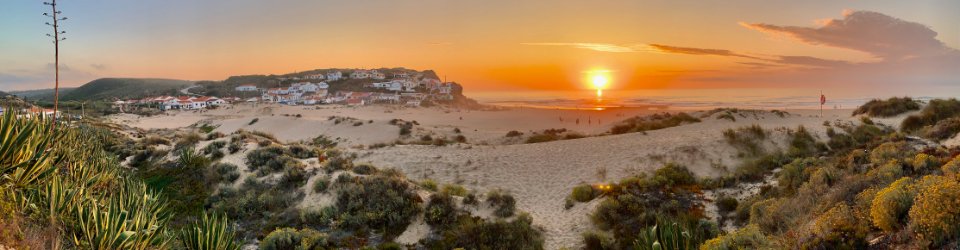


Chicken & Chips Night – Taska do Karisma – ONLY A FEW TICKETS LEFT !!

AMOVATE recently announced plans for a programme to support local businesses by taking some events out into the Community rather than stage them at the Old School House.

And we can now announce that, in association with Amovate, the Taska do Karisma on the Pines Roundabout will be holding a Chicken & Chips evening on May 5th.

It will take the form of music, dance and food, beginning at 4pm and running until the last reveller departs the premises!

You don’t have to be there right from the start—just turn up with your ticket any time that suits you during the evening.

Val and Steve will be taking over Antonio’s kitchen and providing the food, whilst Antonio will be concentrating solely on the bar, making sure everyone has their glasses replenished throughout the evening.

Food comes in the form of chicken and chips, included in the ticket price of just €5, with the option of buying a soup and roll starter for an additional €1.50.

Tickets are available from the Taska do Karisma bar – ONLY UNTIL 2nd MAY.

There will be other events announced in the coming weeks, including our Summer Ball headline event provisionally scheduled for July 21st in the Marquee at the Vale da Telha Hotel, also on the Pines roundabout.

We are also in talks about a Summer Solstice sunset party at the Por do Sol in July.

On September 15th  there will be a Party Night at the Piranha and on a date in October a Portuguese Night at the Vale da Telha Restaurant.

Events still scheduled for the Old School House include Bob & Oggy’s Fun Day on August 4th, the annual Music Festival on August 25th, and the Halloween and Christmas parties so spectacularly staged by Bob and Oggy.

Full details of all the events will be announced shortly.