Walking the Algarve: to Portugal’s Land’s End
(And spending a night on Vale Da Telha along the way)
Never mind the bright lights and sunbathing, get a taste of the authentic Algarve by walking a newly way-marked trail that finishes at Europe’s most south-westerly point.
The Guardian newspaper sent one of its writers to walk from Caldas de Monchique to Sagres, taking in Aljezur and one night at The Vale Da Telha Hotel. Here is his report…
By Kevin Gould,
The Guardian,
Saturday May 10 2014

Kevin Gould’s companions walking on the coast near Bordeira. Photograph: Kevin Gould
It’s a motley crew that set off one morning for the end of the world. Chums Toddy and Nigel, chic architects Eleo and Filipe, leader Terry, Happy the Yorkshire cross, and me. At 68, Terry is fitter and stronger than the rest of us put together: since moving to the Algarve nearly a decade ago, he has, with walking-minded friends, identified and revived an ancient pilgrim trail that wiggles from Alcoutim on the Spanish border to Cabo de São Vicente, Europe’s most south-westerly point. In Neolithic, Roman, Arab and medieval perceptions, this cape was where our earth ended, the sun sinking, hissing, each day into a boiling, snake-filled ocean.

2 GuardianTravel Algarve Map
Terry has tailored for us a four-day walk of about 100km that starts in the foothills below Caldas de Monchique, a spa village high
in the drizzly hills above the Algarve. Known as Al Gharib (“the west”) to the Arabs who ruled here for 500 years, today’s Algarve is more golf than Gulf. The plane to Faro was awash with boozy hen parties and blokey banter, but here, all is peaceful.
Day one: Caldas de Monchique and mountains

A strolling minstrel above Monchique Photograph: Kevin Gould
“Hear that?” Terry asks, his accent pure Norfolk. “That’s the sound of the real Algarve.” We hear larksong, and a soft breeze rustling through oleander. Within minutes, we also hear the thump of blood in our temples, with Terry stepping briskly on while we stump wheezily behind.
As resorts such as Vilamoura and Albufeira on the narrow coastal strip somewhere below bask in sun, we’re grateful for the cool-ish mist that accompanies our first day’s trek up the Picota massif, the first of the region’s two lumpy hill ranges. We’re barely 10km from the resorty seaside yet we’ve found another Algarve – an unvarnished, untarnished place of unassuming beauty, where time (and the trail we’re on) feels endless.
Climbing steadily on footpaths, goat tracks and traffic-free roads, we come to a Tibetan monastery with prayer flags a-flutter, knobbly drystone terraces planted with spindly olive trees, and hardly a human soul. Hundreds of wild arbutus (also known as strawberry bushes) are studded with fruit; when we reach the trig point at the top of Picota at 757 metres, my face is the colour of strawberries, too.
Our happy band head downhill towards lunch through a glade of 600-year-old cork oaks that are in various stages of undress. Among their bare naked trunks the atmosphere is magical and the air is alive with yellow-and-orange Cleopatra butterflies. Pink belladonna lilies fringe a green pond.
The combination of sweat-soaked clothes, pints of cold Sagres, mountains of egg and chips and aching feet makes moving off from pretty Monchique a trial, but soon we are climbing, panting, up though shrubby garrigue to immense rockeries of slippery syenite stone. At the second peak, Fóia – the highest in the Algarve at 902 metres – there are dew-twinkled cobwebs in thickets of Scottish-like gorse and heather. There are also coachloads of excursioning Scots engaged in dedicated, intensive wine tasting at the lonely souvenir shop.
Terry plans his routes according to his groups, with luggage transfers between pre-booked hotels. These range from the bare and simple to tonight’s chintzy, softly lit palace, the spa hotel in Caldas de Monchique. Our spa treatment there involves lying face down under body-length showers of hot spa water while aching limbs are lovingly pummelled by masseuses in swimsuits. I have rarely spent a more tonic 15 minutes, or €15.
Day two: Caldas de Monchique to Aljezur
Striding out on day two we head west, rising and falling through forests of refreshing-smelling eucalyptus. The trees lead us to

Picking walnuts in Marmelete. Photograph: Kevin Gould
Marmelete, a peaceful village of walnut trees and whitewashed houses with indigo architraves. This type of walking – 25km a day across sometimes challenging terrain – calls for levels of fitness and stamina somewhat lacking in our group, but buoyed by lunch at Luz snack bar, cheery waves and many a boa tarde! we press on to the Pasila and Cerca rivers, whose valleys we follow, and waters we ford. An occasional community of self-sufficient spliffed-up hippies reminds us how far we are from The Man and his golf clubs.
Soon, marooned below in arable fields under its squat fort is Aljezur (from the Arabic word for islands) a white town celebrated for its sweet potatoes. Hotel Vale de Telha is more humble than last night’s billet, but the chef at its new restaurant has a wonderful touch with chargrilled octopus and the waiter has a heavy hand with the soft red wine. I dream of white horses.
Day three: Aljezur to Carrapateira

A petisqueira (Portuguese tapas bar) in Carrapateira. Photograph: Kevin Gould
The achey way from Aljezur is fringed with fine sand and deep forests of umbrella pines. The air turns briny before we spot the sea, way below. A distant fisherman casts for sea bass. We clamber down a track and peel off our steaming boots and socks to cavort in the water. Happy is in ecstasy.
Twelve kilometres of bootless beach later we’re at Bordeira, where tousled wetsuited surfers bob around like seals and we strip whitely off to be tumbled and bounced along the seabed by Atlantic rollers. The sleepy village of Carrapateira, an hour further on, depends on surfers, and adventurous tourists. Its Pensão das Dunas will fill with the aroma of our socks this evening, but before then are frozen beers and juicy salads to be enjoyed at the dub-and-dreadlocks vegetarian Microbar in Carrapateira’s main square.
Day four Carrapateira to Cabo de São Vicente

Praia de Castelejo. Photograph: Kevin Gould
Having made a serious dent in Das Dunas’s stocks of Alentejan wine (at a tasty €5 a bottle) the night before, we find our final day dawns rather too brightly. Almost immediately we’re into a series of seven sweaty, panting climbs which lift us along faint, scrabbled (and sometimes scary) paths overland to our reward – a 7km stretch of empty beach, where ours are the only human footprints. A hundred metres above some of these, ropes descend from vast, sea-sculpted rocky promontories allowing precarious access for the few mad fishermen perching on crumbling ledges.
At the southern end of this stretch is tiny Praia de Castelejo, where Senhor Policarpo is proud to show off the octopus he has snared. Young families and old dears splash in the shallows. Shoals of surf schoolers teeter and splash in the rumbling, tumbling waves. There’s a cafe only too happy to supply us with mountains of garlicky clams and chips to support us on the final push to the Cape.
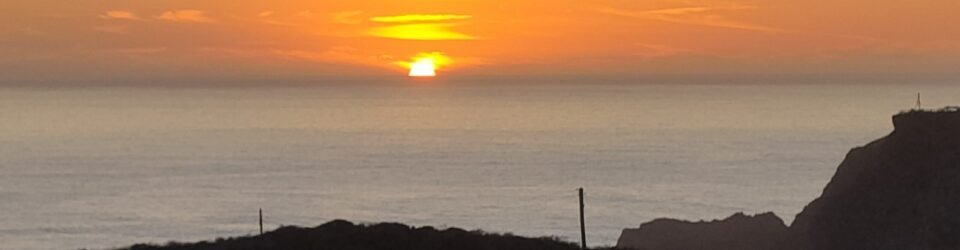
We march on for three or so hours across a rocky plateau towards the lighthouse, which appears to get further away the longer we walk. The final kilometre is on a metalled road until, footsore and with creaking knees, we reach the end of the earth, spent but strong, calm and softly renewed. The Algarve Way has walked us through deliciously old places with their fine old ways. As the magnesium-fringed clouds glow on the horizon, the sea’s surface turns to burnished chain mail. Happy gifts a nuzzle to each one of us. The crowd gathered to witness the sunset clap and whoop and we are immensely cheered.
How to do it
Algarve Walking Experience offers tailored guided walks for people of all abilities, including a route along the entire Algarve Way, from £100 a day for two, including B&B accommodation and luggage transfers.
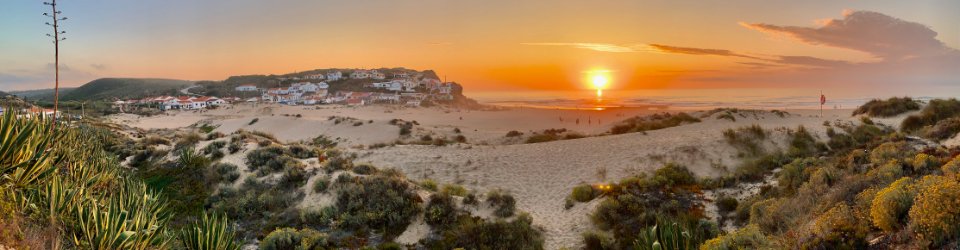




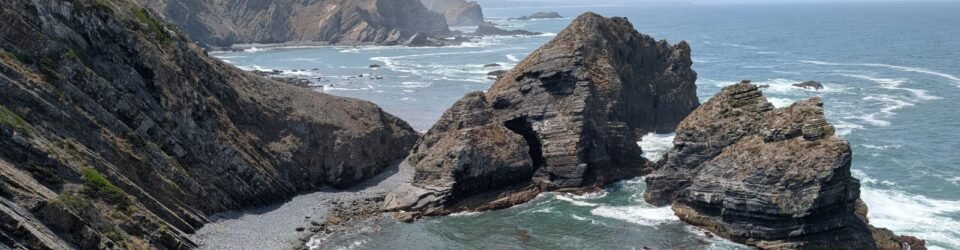
 But there are huge man-made scars now on the face of the natural beauty of the area, just at a time when the busy tourist season is approaching—an industry that is the vital lifeblood of the whole of Aljezur.

 I urge residents of the area to visit the Camara and demand to view the plans of the intended works so they can see for themselves just what devastation this will cause for the restaurant and bar areas and all the families that have people working in these businesses.