



 by Matt D’Arcy
When a surfer talks about a “Beach Break” he’s not talking about his two-week annual holiday reclining on the sand in a sunny southern European country.
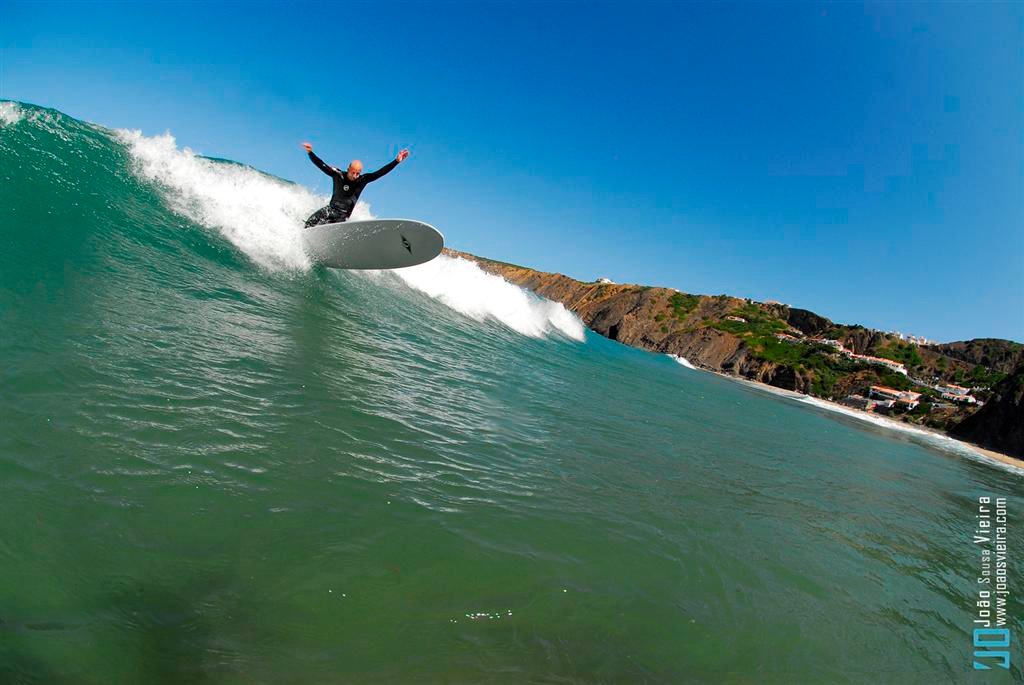
To a surfer the term “beach break” refers to the point where the waves break on the sandy seabed; the type of wave regarded as the best on which to start surfing.
But the fact remains that whether you are a sunbather looking to develop a healthy-looking tan, or a surfer seeking the perfect wave, you’ve everything you need here in south-west Portugal.
====
The wild Atlantic coastline of Portugal is world-renowned as a Surfer’s Paradise.
Those huge, curling white-capped waves racing across the ocean to hit landfall on the most westerly coastline of mainland Europe present a huge challenge to even the most accomplished of surfers.
In fact CCN Travel rated Aljezur’s Carrapateira beach at 31st in their list of the Top 50 surf spots in the world.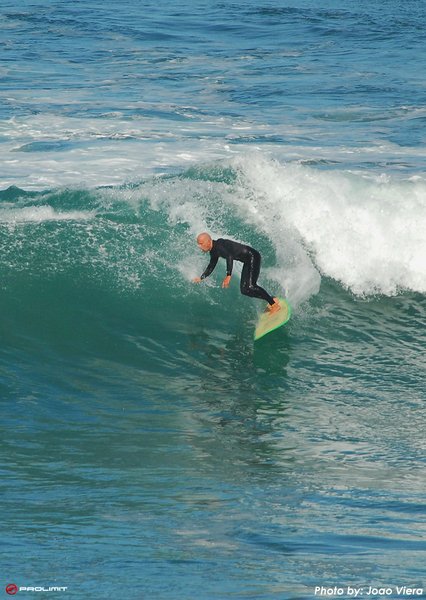
Vale da Telha’s own surf star Kasper van Nuland, who won the Algarve Overall Longboard competition in 2011, describes the surf along the Aljezur coastline as “Magic”.
It certainly cast a spell on Kasper!
This former Dutch police officer even chose Vale da Telha as the place he wished to live and set up his business despite first sampling the surf at Soorts-Hossegor, 20 miles north of Biarritz in the south west of France, which has been called “the surfing capital of Europe”.
Enthusiasts say that there the top professionals can ride tubes,(“when the crest (or lip) of a breaking wave curls over and around a surfer, the resulting situation creates an open area within the wave through which the rider can navigate. This is the epitome, pinnacle, and all-time golden moment in surfing. This, my friends, is a tube”) which can rival Hawaii for heavy walls breaking on an unnervingly shallow sandbank.
Surfing is also a major sport in Portugal’s north, and British surfer Andrew Cotton is waiting to see if he becomes the official World Record holder—and wins a place in the Guinness Book Of World Records—for surfing the biggest wave ever.
In February this year, surfing in Nazaré, 70 miles north of Lisbon, he rode a wave thought to be 24.3 metres (80 ft) high, which would beat the current record of 23.7 metres (78 ft).
In fact American champion surfer Garrett McNamara, from Hawaii, who set a previous world record at Nazaré, is to tour the country’s coastline shooting a video documentary aimed at putting Portugal on the map for surf travellers.
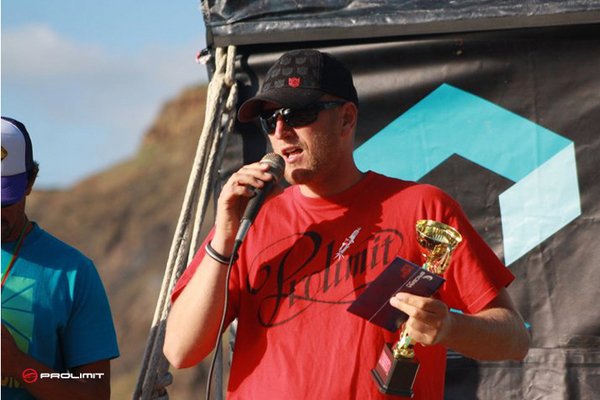 But Kasper, 41, and from Scheveningen—one of the eight districts of The Hague and a modern seaside resort with a long sandy beach, an esplanade, a pier, and a lighthouse—prefers the all-year round action along the Aljezur and Algarve coasts.
He explains: “Hossegor does have great waves but there are too many times when you can’t get a wave. You could book a two-week surfing holiday there and find the whole time that the sea is too flat.
“Here you can surf all the year round and when I first came here I was surprised at the amount of swell during the summer days. There is always an Atlantic swell and it also remains good for surfing in winter. The sea temperature is around 15 degrees, so it is not too cold and you can always find a wave.
“Obviously last winter we had unusually big storms here, Storm Surge Hercules, for example, which did so much damage to beaches like Monte Clerigo.
“But the beauty of being a surfer here is that when the waves are so huge and dangerous like that you can easily go down to Lagos, barely half an hour away, where the waves have lost their speed as they around the Cape, and surf there.
“It means you can surf throughout the year, and that’s why this corner of Portugal is magic for surfers.”
Obviously more and more surfers are beginning to feel the same way, as we see surf houses and surf schools proliferating all around us in Vale da Telha and Aljezur.
“The number of schools here is growing because moré and more people across Europe are discovering what I did all those years ago—that this really is a magical area for surfing.
“But the authorities need to keep a close eye on it because you can have too many surfers in the water and on the beach, so it has to be tightly controlled.”
Kasper, whose HQ is located towards the rear of Jose’s “Restaurante de Vale da Telha” on the Pines roundabout, is concerned more with the sale and supply of surfing equipment than about operating a surf school and giving lessons, although he does make sure he gets on the water just about every day, for enjoyment.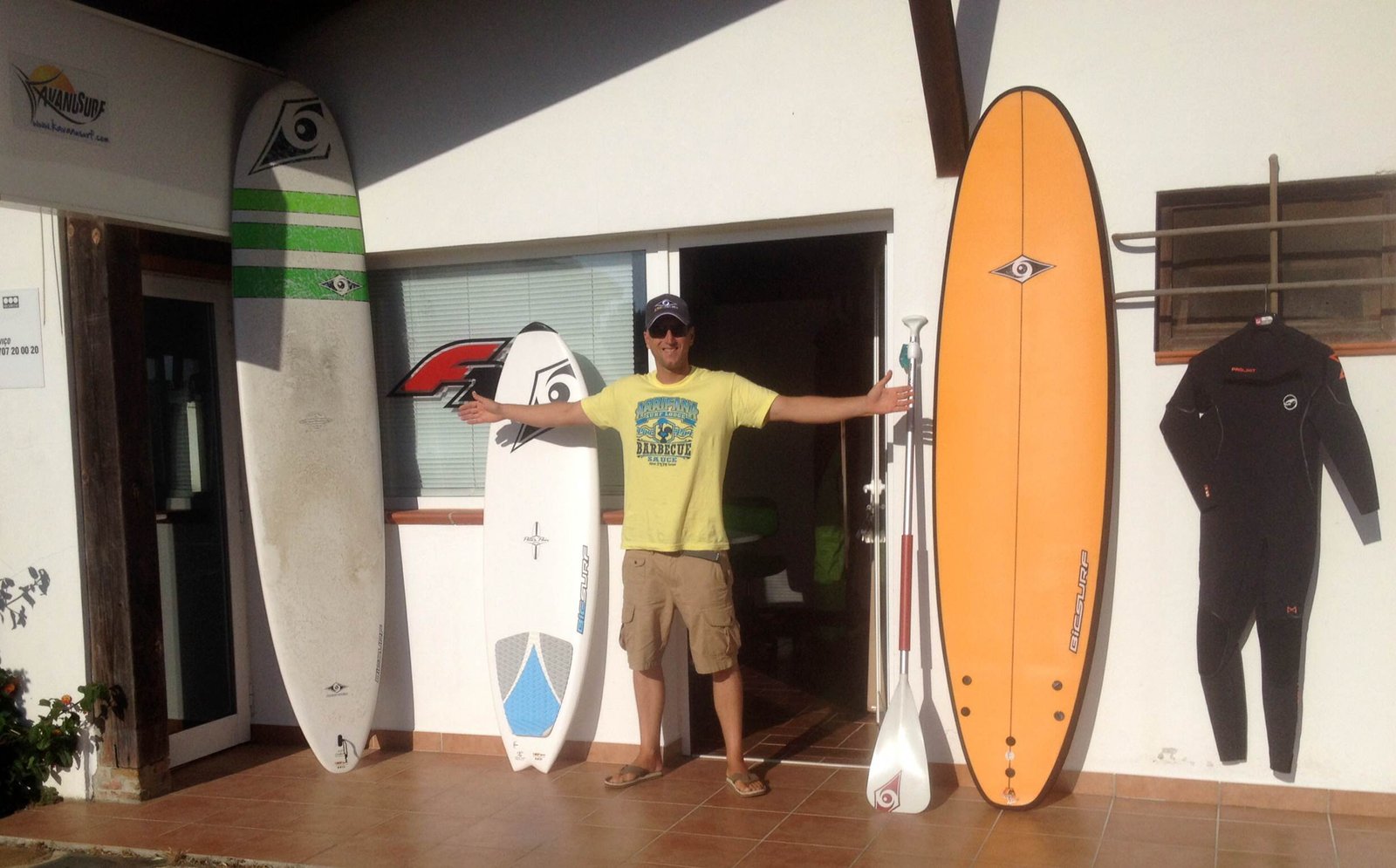
He sells state-of-the-art surfing equipment to surf schools and individuals across Portugal alongside a successful international mail-order business via his website www.kavanusurf.com
After serving with the Royal Military Police in Apeldoorn he was transferred to The Hague—a dream move, because at the time he was a fanatical windsurfer.
Eventually he joined the civilian police there and bought an apartment in Scheveningen, where he would frequently go out surfing at 7am, after finishing night patrols.
Also, he would store up his vacation time to the point where most winters he and girlfriend Marike would “hibernate” (in his words) to France or Portugal for a couple of months in his motor home.
“Surfing was a good hobby to alleviate the stress of wondering the streets at night catching crooks,” he said. “Eventually I began to look on the police work as the hobby and the surfing as my real job.
“So it made sense to turn that into reality.”
On January 1st 2007 Kasper and Marike left their jobs in Holland, bought a bigger campervan and set off for Aljezur, without any real idea of what the future would hold, other than to chill out and learn the language.
Back home Kasper had been given a small sponsorship deal with the international surf company ProLimit’s Netherlands division and when he “pitched” a sales plan for Portugal to export manager Edwin Honsbeek, he was given a licence to sell their products in this country.
It took some time to get a foothold in the market, and eventually he embarked on a sales tour across the country, mostly in the surfing hotbeds of Northern Portugal, where he gradually became accepted, both as a supplier and as a surfer through various competitions.
Now, he says, surfing has become part of daily life here in Aljezur and Vale da Telha, whether during his lunch break or in the evening after work.
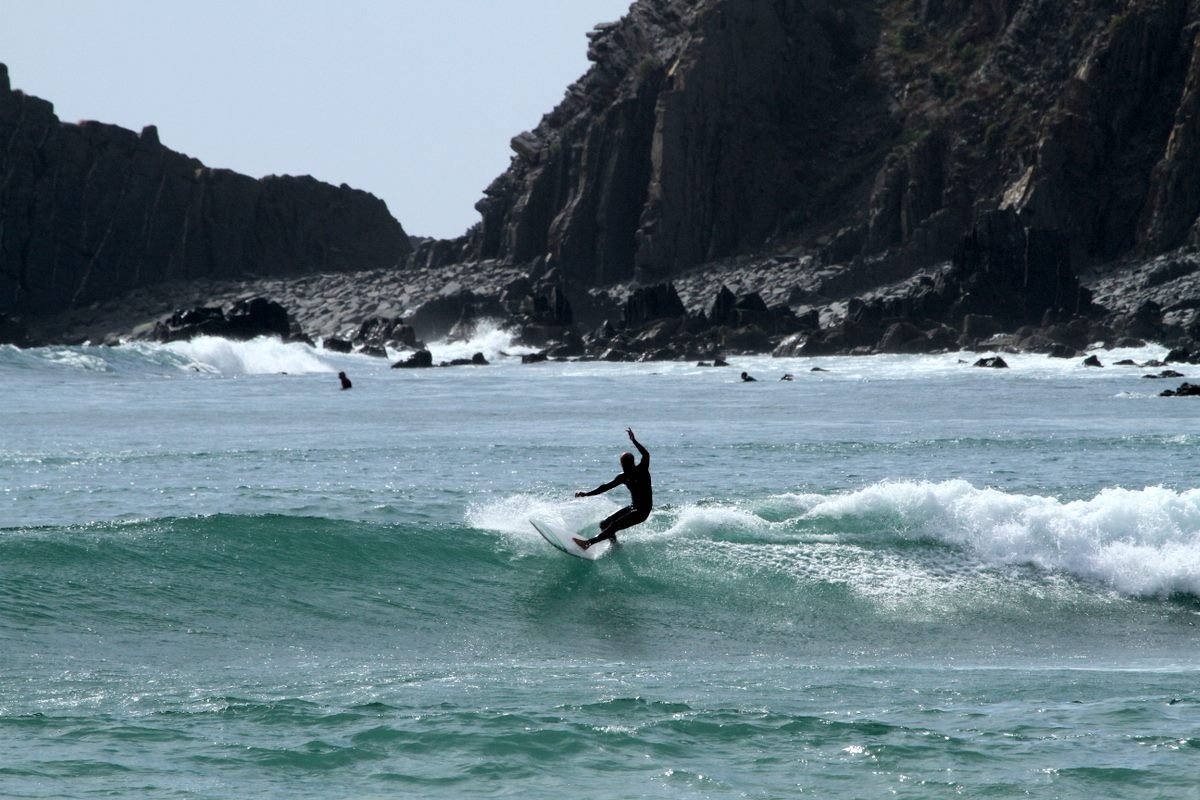 “I just surf for my own pleasure,” he says. “And it certainly is a great pleasure to surf here. There are several great surf spots all around us, each of them having a different location so you can shelter from the north wind, or the “Nortada”.
“Arrifana is the beach I use most. It is such a versatile spot. It has a very good beach break and when a heavy swell arrives you can also surf the right point in the bay.”
Since 2009 Kasper has been working with large numbers of surf schools and shops throughout Portugal and has enjoyed an expansion of the business each year since then to the point of designing clothes and working closely with the Prolimit design team in South Africa.
“Life doesn’t get much better than this—it really is a paradise here on Vale da Telha,” he smiles. “When we get back home to the Netherlands it strikes me how cold it can be and how much everyone is in a hurry.
“Here the pace is slower and the Algarve now is truly our home, a wonderful place to bring up our children.
“There are no restrictions when you go surfing. Total freedom!
“Sun, surf, beautiful surroundings and relaxed people—what more could you want?”
And finally, although surfing is his business it remains his hobby, prompting him to observe:
“Don’t take surfing too seriously. In the water, it’s all about having fun!”
ENDS
Technical details of all Aljezur’s surfing beaches.
……Information from the pamphlet “Surf Guide, Aljezur 2014”.
Surf Beaches Of Aljezur
PRAIA DA AMADO
Amado is a vast sandy beach, secluded and quiet, located just south of the town of Carrapateira and the village of Bordeira in the county of Aljezur. It is considered to be one of the best beaches in Portugal for surfing.
Praia do Amado is sought by practioners throughout Europe and is often the scene of international competitions. It is not only the most experienced who come here because there are surf schools that teach the sport.
Type: Barrelling.
Direction: Left and right.
Suitable for: Beginners.
Length of ride: 100 to 200 metres.
Best wind direction: East.
Tide: High.
Hazards: Strong tides.
Easy access, guarded beach during the bathing season, plenty of car parking, beach café.
N, 37 degrees, 10’, 1,02”, W 8 degrees, 54’, 14,21”
Beach-break.
* * * *
PRAIA DA CARRAPATEIRA
Carrapateira sits on a small indented headland of limestone cliffs. The extremely fast southbound current and the jutting headland make the conditions which have made it a popular surfing destination in recent years.
The Carrapateira beach break can be world class when all the right conditions come together, offshore wind, a good swell and rightly positioned sandbanks. Clean tubes and a solid wall are the results.
Type: Barrelling.
Best wind: SE, East, NE, East.
Direction: Right hand.
Tide: Mid.
Suitable for: Intermediate.
Hazards: Rocks.
Length of ride: 50-100 metres.
Infrastructure: No. The best access is from the top, South. Guarded beach during the bathing season.
NB 37 degrees, 12’ 0, 42” W 8 degrees, 53’, 5.3, 82”.
Beach-break.
* * * *
PRAIA DE VALE FIGUEIRAS.
The area where the Vale de Figueira beach is situated is one of great natural beauty, still standing near the village of Alfambras, a sparsely populated area. It is an extensive golden sandy beach.
To support sports activities there are several surf schools that claim to help those who have not previously ventured into the sport.
Easy pedestrian access. No parking. Pets not allowed. Naturism. Guarded beach during the bathing season. Activities, surf and sport fishing.
N 37 degrees, 16’,13”, W 8 degrees 51’,35”.
* * * *
PRAIA DA ARRIFANA
Blue flag beach, vast and sandy and half a mile long it forms a small bay and is therefore less hit by waves. It is protected by a north rock which shields the bay from the traditional north winds.
Equipped with all of the necessary infrastructure this beach is visited throughout the year by surfers and bodyboarders.
Type: Occasionally barrelling.
Best wind: All directions.
Direction: Right hand.
Tide: All.
Suitable for intermediate.
Hazards: 2 big rocks on the inside.
Length of ride: 100-200 metres.
Infrastructure: Toilets, showers, parking, restaurant, beach with easy access for the disabled, supervised during the bathing season.
N 37 degrees, 17’, 31, 43”, W 8 degrees, 51’ 54, 85”.
Point-break.
* * * *
PRAIA DE MONTE CLERIGO
It’s a long sandy beach situated next to the small fishing village of Monte Clerigo. The sea, when conditions are right, makes it a popular spot for surfing and bodyboarding and in the season there is a surf school.
Please be aware that there is a strong undertow and current just off the beach. Along the the south-east fringe of the beach there is an area of sand dunes.
There is a decent beach break that can be good if the shifting banks are positioned right and the wind is offshore. Has a good swell, but is very exposed to the wind.
Type: Ordinary.
Wind direction: Right hand.
Suitable for beginners.
Length of ride: Short.
Crowds: An empty line-up.
Best wind direction: SE, E, NE.
Tides: High.
Hazards: None.
Infrastructure: Toilets, showers, parking, first-aid station, bars/restaurants, disabled toilets and guarded beach during the bathing season.
N 37 degrees, 20’22, 47, W 8 degrees, 51’, 12.99.
Beach-break.
* * * *
PRAIA DE AMOREIRA
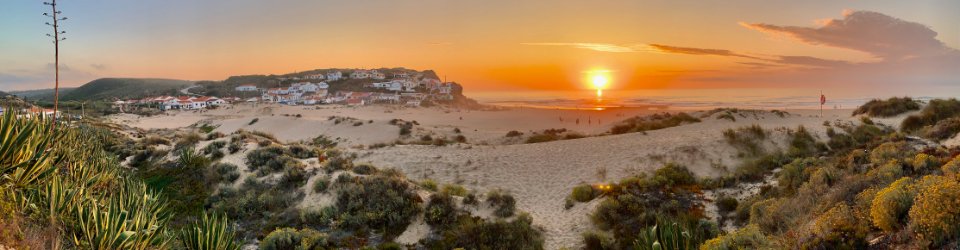
At the mouth the River Aljezur there is this spectacular beach surrounded by dunes and cliffs, the sea and the river. It has excellent conditions for the practice of surf and bodyboarding and tends to become increasingly crowded.
This spot has little or no wind unlike other surf spots along the Aljezur coastline which are more exposed to strong winds in the area
Here, you can always count on good waves.
Infrastructure: bar/restaurant, telephone, guarded beach during the bathing season, parking,
N 37 degrees, 21’17, 26”, W 8 degrees, 50’44.25”
Beach-break.
* * * *
PRAIA DE ODECEIXE
Praia de Odeceixe is the last beach in the Algarve for those travelling along the coast from the south.
It borders the Alentejo and also has access to the other side of the river.
Located at the mouth of the river Seixe is an extensive sandy beach, great for practicing surfing and canoeing on the river. This spot has little or no wind and you can always count on good waves.
Infrastructure: Toilets and showers, parking, bar, telephone, supervised during the bathing season.
N 37 degrees, 26’ 29. W 8 degrees, 47’ 56”
Beach-break.