




Amovate member Faith Clement, a tireless worker for animal charities and the Aljezur International Choir thinks someone else needs your help—the Aljezur Bombeiros Voluntários.
Vale da Telha has in the past many reasons to be thankful for these brave and tireless volunteers, who protect our community both as firefighters and as paramedics.
We really cannot do without them—and they cannot do without us, as they rely heavily on charity donations to sustain their very existence as a precious community asset.
And as Faith says: “As we are in the fire season the Bombeiros need all the help they can get. The firefighters are volunteers and deserve our support.
“If you are not already a member of the Bombeiros family PLEASE pop down to the fire station and either join or just give them a donation.”
Faith says that to join or make a donation you simply go to the office at the Bombeiros, which, while the alterations are taking place, is upstairs, and hand over your donation or say you wish to join.
She added: “I renew my membership in January every year and give them twenty euros, but you can join at any time during the year.
“In January this year they were desperate for new protective gear for the men. The choir use the band practice room every week and we give them a donation every year.
“The community really need them to keep us safe, they put their lives on the line for us and deserve our support.”
Amovate, with the help of Shepperton Aurora Rotary Club are in the process of securing much needed equipment from the U.K. to bolster Aljezur Bombeiros fire fighting kit, along with some machinery to help in the many motor accidents they have to attend.
Amovate member, Dave Good, who is also a member of the Shepperton Rotary Club, has worked closely with the Amovate Committee and Florian, the British organisation that collects unwanted Fire Fighting equipment, to secure a package of much needed essentials that includes boots, protective clothing and helmets.
This work has been ongoing for some 6-8 months and we have just heard that the equipment should be shipped to Portugal very soon. More information on this will be forthcoming in the next few weeks.
Even the famed “Rough Guides” books and website have been so impressed by the work of the Portuguese Bombeiros Voluntários that they paid a moving tribute to their work on that website, which reported:
“Portugal’s famed green countryside is ravaged each year by forest fires, and the problem has worsened markedly in recent years – it’s estimated that ninety percent are caused by human activity, whether it’s arson or carelessness with cigarettes, bonfires and barbecues.
“Matters aren’t helped by the country’s timber industry, which has replaced native tree species with the highly flammable eucalyptus and pine. Peak fire season is mid-summer, but in drought years forest fires break out as early as January and as late as November.
“You don’t need to drive through central and northern Portugal for long before seeing the evidence of past fires – hillsides burned black and torched trees – or the telltale plumes of thick smoke from the latest conflagration.
“On the worst days, ash falls to the streets in distant towns and cities, and major train lines and motorways are closed.
“Extraordinarily, the firefighting service that has the unenviable task of dealing with the problem is almost entirely voluntary. The country’s 20,000 or so Bombeiros Voluntários make up over ninety percent of Portugal’s firefighting forces, with the few (and far better equipped) professional corps (Bombeiros Sapadores) based in the cities or working privately for the country’s timber and paper-pulp concerns.
“You’ll see Bombeiros Voluntários vehicles in every region – helping out with ambulance duties too as part of their remit – and the volunteers are usually the first and only firefighters on the scene when a blaze breaks out.
“Equipment and vehicles are often wholly inadequate; in the past, urgent appeals to the EU have led to specialist aircraft and foreign crews arriving to help.
“It is, of course, horribly dangerous work and firefighters lose their lives every year.
“For this reason – and for their astonishing success rate in saving local homes and properties – the Bombeiros Voluntários have an almost heroic status in Portugal. Rare is the town without a street or avenue named after them, while proud municipal statues and memorials to their deeds proliferate.”
Sourced from: http://www.roughguides.com/destinations/europe/portugal/forest-fires-bombeiros-volunt%c3%a1rios/#ixzz2XWynHKUt
* * * *
From The Algarve Resident archives:
Everything you need to know about the Bombeiros
by VAL JOHNSTONE
Some years ago, I wrote my first article on the Bombeiros in the Algarve to help the general public understand more about the association. Five years later and with many more new expatriates ensconced here, I decided it would be worth reminding established residents and explaining to new arrivals why we hold fundraising events and make donations to our local Bombeiros.
In the Algarve, there are Bombeiros in the areas of Olhão, Tavira, Faro and Loulé, which work for the câmara and thus have their salaries paid and equipment provided. These Bombeiros also have volunteers who do not receive a salary but have any heavy expenses paid for by the câmara. You will see the name outside these stations as just ‘Bombeiros’ or ‘Bombeiros Voluntários’.
Indeed, you may wonder why in some areas the Bombeiros are voluntary and others are funded by the câmara, as I did.
It has been explained to me that when the Bombeiros were first set up in the Algarve, for example in Loulé a station was set up over 77 years ago, they were originally solely for firefighting – going to their local câmaras and forming an association. Therefore, funds raised and any donations made to these Bombeiros may not be kept by them but must be forwarded to the câmara. If you raise funds for the Bombeiros in these areas, I would suggest that you make enquiries as to what is needed at that particular station and purchase and present the required goods personally.
Over the years, the Algarve has grown and other smaller Bombeiros have been set up, which are known as Bombeiros Voluntários. In addition, with the growth in size and population, especially in the central and western Algarve, the Voluntary Bombeiros have an even greater and more demanding job on their hands. They, therefore, rely heavily on the working men and women, who give up their spare time voluntarily, and on donations, gifts and sponsorship.
Each station has to supply their own vehicles and, once bought, they have to be equipped. There are different ambulances and fire engines for different services.
There is an emergency service known as VMER (Viatura Médica de Emergência Rápida) and doctors and nurses from the Barlavento Hospital have been specifically trained for this service.
If you have an emergency, you should call 112 – this number puts you through to the police and the service is provided by INEM (Instituto Nacional de Emergência Médica).
As a medical situation, your call is then put through to CODU (Centro de Orientação de Doentes Urgentes) and a decision is made on the type and seriousness of the emergency. They then contact the Bombeiros nearest to the scene and, if necessary, VMER will be contacted. Therefore, it is always very important to be clear and specific about why you require an ambulance. For example, if you suspect a person has had a heart attack, VMER will be needed, as they are the only service allowed to carry a defibrillator – equipment a heart attack victim may require.
Ambulances throughout the Algarve do not carry defibrillators unless a doctor accompanies a patient. This is not a local ruling, but is legislated by the Ministry of Health. I feel really angry with this because these machines are so easy to use. The machine has a voice recording and tells you exactly what to do. In the UK, large companies, shopping malls, railway and bus stations have them set up and ready for use. Furthermore, should someone have a cardiac arrest, these machines can be the difference between life and death.
If, when you call 112, the person answering does not speak English, ask immediately for CODU. The doctor or nurse who answers will speak English, but remember speak slowly and clearly. They will ask for your phone number and directions and the more information you can give, the quicker they can get the correct service to you.
There are times when you may feel annoyed at how long the Bombeiros take to get to the scene but this is not necessarily the station’s fault. Quite often there is a time delay between calling 112 and CODU making a decision as to what is required. However, as soon as the nearest station receives the call, they are normally at the scene within five minutes. The Bombeiros say, “please, don’t shout at us, as soon as CODU call us we respond immediately.”
As with many things, there are people pulling against each other and this is also the case with INEM and the Bombeiros. INEM is ruled by the Ministry for Health and the Bombeiros come under the Ministry of Internal Affairs, as are the police.
Therefore, at times, it gets very political and it all boils down to the fact that they both want to be in charge. The people at the top will argue and fight, but the people at the bottom trying to do the job are the ones that suffer.
That is one of the reasons they need our help, to help them help us.
So, please, next time you are out and about in Aljezur, don’t drive past the Bombeiros—pop in and join up. You know it make sense.
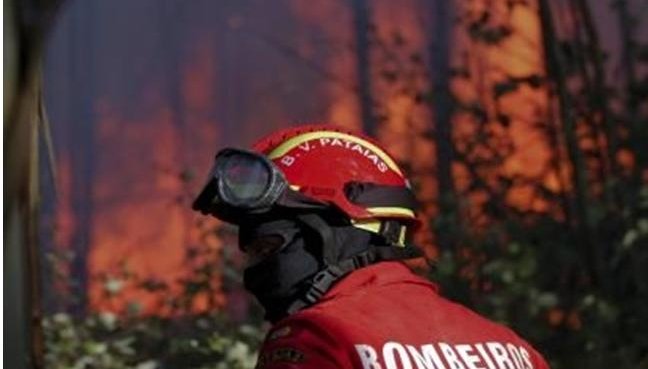
Algarve fire under control
Courtesy of The Portugal News
by Brendan de Beer of the PORTUGAL NEWS in Algarve
July 7.
Approximately 150 fire-fighters have won a fierce battle with a forest fire that raged in the western Algarve on Saturday afternoon.
The fire was located in Chabouco, Aljezur, along the Algarve west coast and saw fire-fighters faced with very high temperatures and a strong westerly wind.
An enormous plume of smoke was visible from 50 kilometres away.
No damage was caused to property, initial reports indicated.
Once again we see the value of the Bombeiros who brought this blaze under control before it moved further north to threaten Vale da Telha.
The threat of fires is not remote. Don’t forget, a large number of buildings in Vale da Telha were destroyed by fires in July, 1992–you can read about it here in our “History of Vale Da Telha” article… Here
As we now know those were the last serious fires up here, and it is extremely unlikely that it would happen again, with so much of the pinewoods now gone, and the authorities carefully creating fire breaks and keeping a close eye on things.
Thankfully, the Bombeiros do remain vigilant in their efforts to protect us, as these pictures show, which explains why we need to give them all of OUR support.
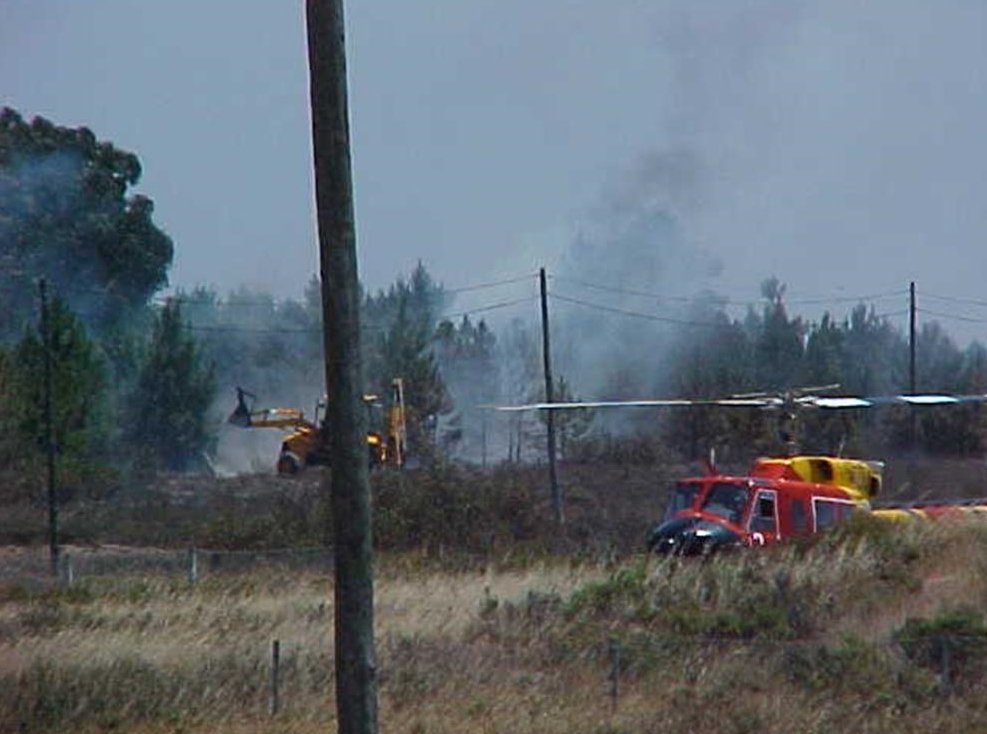
Photo 1
These fires broke out in the fields alongside the road from the Pines Roundabout up to Vales, to the rear of the Lagoa Building Supplies premises, in September, 2006. The photograph No. 1 shows a bulldozer creating a fire break while a helicopter waits to drop water on the flames.
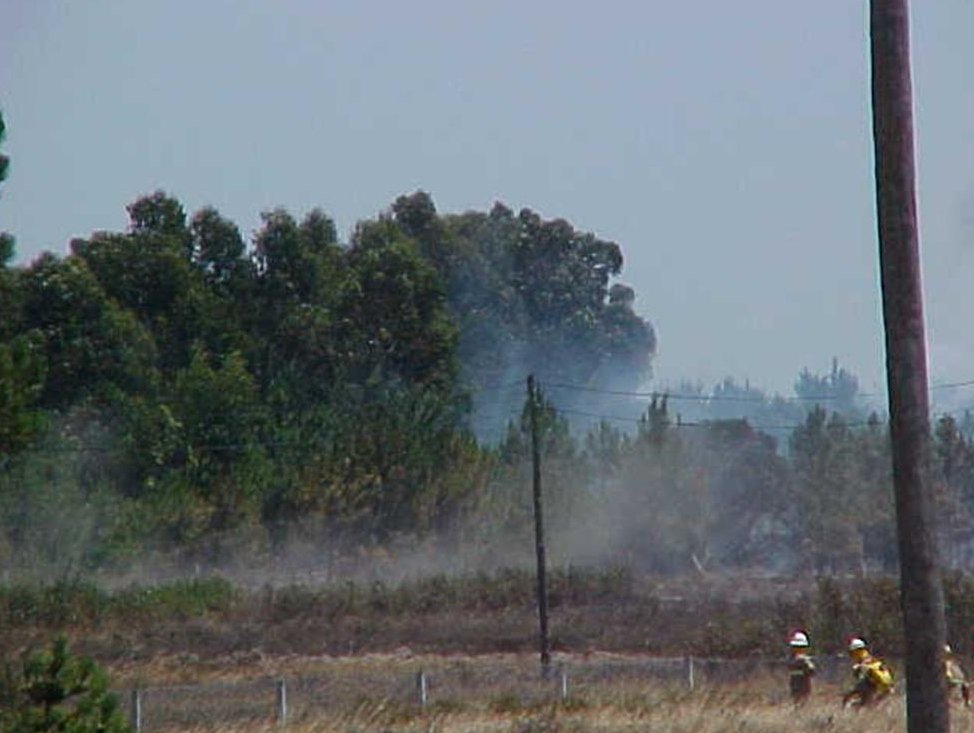
Here, the Bombeiros on the ground prepare to approach the advancing fires.
And in this final photograph the helicopter takes off to support the brave firefighters as they brought the blaze
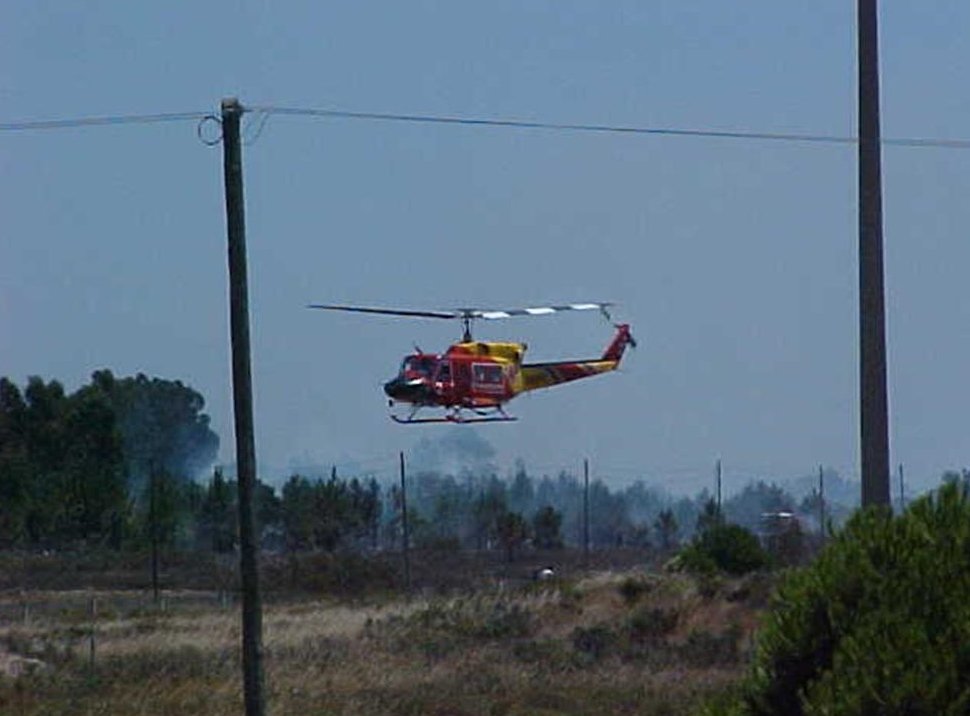
Photo 3
under control before it reached nearby residential property on Paisagem Oceano.